
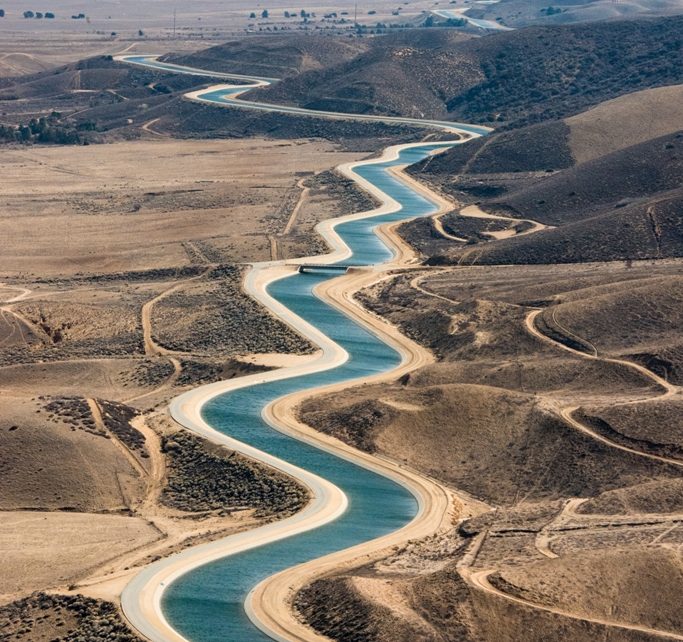
The California Aqueduct. (Photo: CA State Water Project)
Ringside – Building the Abundant Water Coalition
If projects this ambitious were realized, farms and cities would have access to more water than they need
By Edward Ring, March 5, 2026 5:00 am
 If enough people in California agreed on a state water strategy, the political obstacles would be overcome. If every major water agency, every farming association, and a critical mass of environmental groups were all committed to a specific set of policies and projects, then elected politicians would be bound to adhere to those priorities. Regulatory relief, legislative actions, executive orders, agency directives, and sources of funding would all align.
So what would it take for Californians to rediscover a consensus so durable that the state could embark on a water project for the 21st century that rivals the massive projects of the 20th century?
It isn’t as if there aren’t proposals out there. The California Department of Water Resources has the California Water Plan, updated in 2023. Along with SB 72, passed in 2025, it calls for 9 million acre feet of additional supply, conservation, or storage by 2040.
While this is ambitious and sounds encouraging, it leaves a lot of wiggle room, since the stated goal of adding 9 million acre feet of “supply” is reduced by (1) conservation, and (2) the amount of new storage that is not realized in annual yield.
California’s current official water plan does have some great elements: among them; recycle 1.8 MAF/year and capture 500,000 AF/year of stormwater by 2040; build the Sites Reservoir, expand San Luis. It also has uninspiring elements: conserving another 500,000 AF/year by 2030 through “efficiency standards and turf bans,” and desalinating 84,000 AF/year of brackish water by 2040.
While the California Water Plan has the imprimatur of the state, at best it is a cautious recipe for managed decline. If it’s implemented, Californians will have to retire about a million acres of the best farmland on earth, and California’s urban residents will endure the indignities of low flow fixtures, and “smart, “water-sipping” appliances that are a nuisance to operate, don’t work very well, and only last a few years, along with the heat-island spawning, aesthetic abominations known as “xeriscaping.”
This should not be our fate. We need to rehydrate our cities with more water, and we need to preserve as much of our farmland as we possibly can. And we need the resilience that comes when there is surplus water available in normal times, so if a mega drought ever comes, or a disaster that wipes out major water supply infrastructure, we have diverse sources of water to fall back on.
What California needs is an abundant water coalition that embraces the good elements of the California Water Plan (aquifer storage, reservoir expansion, wastewater recycling, and stormwater capture), while adding huge new proposals. They may center around two initiatives.
First, an alliance can be formed between Southern California urban water agencies and Colorado Basin States. The 800,000 acre-feet from the Colorado River that supplies California cities can be given back to Nevada and Arizona, and in return the water agencies in those states would fund desalination plants on the California Coast. Large scale desalination is common throughout the world and its time to bring it here.
With regulatory relief, safe harbor from litigation, and modular off-the-shelf plant designs that incorporate innovative new technologies, the capital cost to build seawater desalination plants with a total capacity of 800,000 AF/year could be under $15 billion. The financing cost of $837/AF (4%, 20 years) would be paid by ratepayers in Arizona and Nevada in exchange for Colorado River water, and the remaining operating cost, around $500/AF, would be easily absorbed by ratepayers in Southern California.
This exchange would benefit everyone. The Colorado River would be 800,000 AF/year less over-drafted, and farmers in Imperial County would still be able to supply Americans with their only source of fresh winter vegetables. Southern California cities would have access to a new source of fresh water that is impervious to droughts or any sort of disruption to the precarious ribbons of pipes and aqueducts that currently enable their survival.
A second big alliance could be struck through new management of the Sacramento-San Joaquin Delta that would provide additional water security to all of California’s coastal cities that import water, minimize if not eliminate the need to retire irrigated farmland in the Central Valley, and make possible new achievements that environmentalists have long cherished but never expected to see in their lifetime.
Making this happen may soon be much easier, as more people realize that the Delta Conveyance will never get built. That project has dominated water policy discussions for decades, and once it’s gone, all the other great plans for the delta will finally get the attention they merit. They center around a few basics: levee repair, aqueduct repair, silt removal (dredging), fish friendly delta diversions, and aquifer storage.
The first thing to recognize here is that all of these projects, altogether, will cost less than the Delta Conveyance would have cost. It’s hypothetical, but anyone betting it would have cost at least $30 billion would probably have made easy money, and $40 billion would have been a 50/50 bet. That’s the amount of money we need to spend to get the delta into shape for the 21st century, and if we could contemplate spending that much for the tunnel, we can think at the same scale about these alternatives.
The necessity for levee and aqueduct repair is self-explanatory. Dredging will restore deep channels to help the salmon migration, enable more water storage in flood control reservoirs, and enable more utilization of the delta pumps. Fish friendly delta diversions, where infiltration beds are cut into a delta island so water can percolate into collection pipes without harming fish, is a concept that could allow safe withdrawal of millions of additional acre feet during wet winters. Underground storage capacity south of the delta is not only capacious enough to bank as much water as can possibly be safely withdrawn, it is an imperative in order to recharge depleted aquifers and arrest land subsidence.
There are policies attendant to these delta projects that will ensure its entire potential to build an alliance of support is realized. The state needs to adopt more reasonable restrictions on delta pumping, and incorporate new approaches to restoring delta ecosystems. Resuming regular dredging may deliver tremendous ecosystem benefits and should be viewed as an environmental project as much as a water supply project.
The key to making this work, however, is to deliver to farmers unallocated water from delta diversions during storms and high water at no charge and with no deduction to their contracted allocations, provided they percolate the water into underground storage. Their incentive to do this could be the right to use or exchange 50 percent of the water they divert, with the other 50 percent left in the aquifer to accelerate overall recharge goals.
And why would environmentalists support these programs? Because if projects this ambitious were realized, farms and cities would have access to more water than they need. All of a sudden, there is no downside to demolishing the O’Shaughnessy Dam and bringing back the Hetch Hetchy Valley. There is no downside to restoring Mono Lake’s shoreline to its historical boundaries. Those two actions together would only take away 300,000 acre feet per year, which is an easy loss to absorb if another 3 million acre feet per year are safely taken out of the delta during winter storms.
Enlisting the support of the environmental community may become more feasible over time, as the potential of big projects to deliver more water without harm becomes accepted. Modern desalination does not seriously harm the marine environment. Fish friendly delta diversions can deliver millions more acre feet per year without harming fish. And with regulatory relief, amazing projects can be funded at reasonable costs.
The abundance mindset has become bipartisan. With two mega-deals — one between SoCal urban water agencies and Colorado Basin states, the other between all coastal city water agencies, farmers from the delta to Kern County, and environmentalists who realize big wins can accompany reasonable compromises — water abundance in California can be more than just rhetoric disguising rationing.


- Ringside: California’s Self-Destructive War on Oil - April 29, 2026
- Ringside: The Abundance Alliance - April 23, 2026
- Ringside: Why Producing More Oil In California HELPS the Environment - April 15, 2026
RELATED ARTICLES
-
 October 31, 2024
 -
-
 January 14, 2026
Love it! But it’s not gonna happen. It will be tied up in the courts indefinately.
Environmental groups are committed to de-population of the entire world. More water to farmers no matter how feasible is the LAST thing they want. You would have an easier time negotiating a surrender of Iran than to get the green mafia to give up an inch.
UNDERSTAND YOUR ENEMY!
The problem with your idea is it is too logical and liberals deal in feelings. The solution of the Colorado problem is brilliant. We give up our allocation for the water while they build us a plant that will replace it. catching the winter run off and sending it to farmlands to fill up the under ground storage is environmental friendly. Capturing the winter run off and putting it in the sites reservoir is also environmental friendly. And to top it off the environmentalists get their little Yosemite back. With a little compromise everybody wins.