

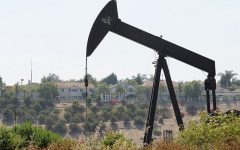
Oil pumpjack, Hwy 101, San Ardo, CA, Monterey County. (Photo: Katy Grimes for California Globe)
Ringside: California’s Self-Destructive War on Oil
California may someday thrive on renewable energy… but not now, and not by 2045
By Edward Ring, April 29, 2026 2:30 pm
 California’s state legislature may succeed in destroying its own oil industry, but it won’t change anything in the world. It will only export jobs and raise the cost-of-living here at home. Here’s a reality check.
According to the Statistical Review of World Energy, in 2024, oil, natural gas, and coal contributed 87 percent of the world’s primary energy supply. Two years ago, that number was quietly revised upwards by the Review from the more commonly cited 82 percent, because they decided to start converting terawatt-hour electricity production from non-combustible sources to the actual exajoules of primary energy they represented. This new method abandons their previous misleading practice of grossing that number up artificially, under the assumption more energy would have been expended if natural gas or coal had been utilized to generate the electricity.
The incontrovertible reality in the world is that the percentage of total primary energy represented by fossil fuel has remained stable across the years, while the absolute amount of primary energy contributed by fossil fuel continues to increase. In 2024, total global oil production was 35 billion barrels, up from 30 billion in 2010, 27 billion in 2000, 24 billion in 1990, and 23 billion in 1980. For more than 40 years, in absolute quantities, worldwide production of oil has been increasing at a consistent rate.
There’s no end in sight. Per capita consumption of raw energy in America was estimated at 268 gigajoules in 2024. The worldwide average, not including Americans, was only 64 gigajoules. With apologies for resorting to arcane energy terminology, it’s the proportions that matter. It doesn’t take an energy economist, or a demographer, to make a basic calculation: For everyone in the world to enjoy half as much primary energy per person as Americans enjoy, global energy production will have to more than double. Here are the numbers:
Total worldwide primary energy production in 2024 was 592 exajoules (for those of us who enjoy spreadsheets, please note: one exajoule equals one billion gigajoules). This means that when global population peaks in 2050 at around 10 billion people, if the per capita global average (including Americans) rises to 134 gigajoules, half of what Americans currently consume, that will require primary energy production of 1,340 exajoules.
Imagine getting there from here purely through “renewables,” when “here” involves 87 percent of 2024’s 592 exajoules of primary energy coming from oil, natural gas, and coal.
Critics of this logic point to the fact that primary energy can go a lot further if it is converted into actual energy services more efficiently. As an example, they will correctly cite the efficiency of an EV, where about 80 percent of the electricity charging the onboard battery will turn into actual horsepower, whereas an internal combustion engine only turns about 25-30 percent of the gasoline energy in the tank into horsepower. But that’s why our target primary input is half America’s per capita average!
Examining the status of renewables in California reinforces this logic. Based on data found on energy flow charts produced by Lawrence Livermore National Labs, the per capita average for Californians in 2023 was 177 gigajoules of primary energy, equating to a total of 7 exajoules for the state as a whole.
That’s considerably lower than the U.S. average, thanks mostly to our mild weather and lack of heavy industry. But like everyone else in the world, Californians are not efficient at converting primary energy into net energy services in the form of horsepower, or heating, cooling, lighting, pumping, computing, communicating, and so on. The actual per capita net energy used by Californians in 2023 was only 63 gigajoules. Statewide, only 2.5 exajoules, 36 percent, made it from those 7 exajoules of primary energy inputs all the way to the other end as net energy services.
But suppose California went all-electric, and we doubled our efficiency. Suppose instead of only 36 percent of primary energy turning into net energy services, 72 percent was utilized. This would mean California’s primary energy goal could be cut in half, from 7 exajoules down to 3.5 exajoules (2.5 EJs / 72% = 3.5 EJs). In terms of electricity, 3.5 exajoules is equal to 972,000 gigawatt-hours.
This means that the trillion dollar question, at least for California, is how to get electricity production up to 972,000 gigawatt-hours or more, when in-state production of electricity in 2024, not including electricity from natural gas fueled power plants, only totaled 129,702 gigawatt-hours. To go electric while eliminating natural gas, in-state production of electricity has to increase by more than seven times current output.
The numbers get even more challenging if you delve into the details by source. A recent analysis published on the California Policy Center website does just that. In the scenario outlined, California would have to nearly double hydroelectric output, quintuple nuclear energy capacity, and more than quintuple biomass power generation. They would have to build, deploy, and maintain more than 2,000 floating wind turbines in the deep ocean, each of them longer than a modern super carrier when measured from the bottom of the flotation pontoons to the tip of the rotor. And they would have to purchase, install, and maintain 14 times as many photovoltaics as currently exist in the state, along with enough batteries to buffer the intermittent power.
These challenging numbers nonetheless reflect an absolute best case scenario. Achieving a 72 percent efficiency between primary energy and energy services is extremely ambitious. The advent of data centers and robots presage increasing per capita energy consumption. And California’s low numbers can’t be extrapolated internationally, since Californians import infrastructure components and durable goods that are produced elsewhere.
Hard facts apparently elude the politicians that California’s voters have entrusted with the state’s energy future. In 2024, Californians imported 77 percent of their oil. From end to end – drillers, distributors, and refiners – our in-state oil industry is on the verge of collapse despite crude oil still representing 45 percent of our primary fuel input, and natural gas providing another 33 percent.
So we must ask tough questions: Are Californians really prepared to scale all of these noncombustible fuel sources by these multiples. Does California’s renewables lobby acknowledge the sheer resource impact of all these wind turbines, photovoltaic panels, batteries, and EVs? And do Californians have any intention of mining or manufacturing any of this in their own state?
For all of its innovative brilliance and stupendous wealth, California cannot escape the same energy challenges facing every other state and nation. California may someday thrive on renewable energy. But not now, and not by 2045. Natural gas and oil are going to be with us here in California and the rest of the world for many decades to come.


- Ringside: Observations as a New Water Year Begins - October 8, 2026
- Ringside – Geothermal Energy: A Huge Wildcard - October 1, 2026
- Ringside: El Nino Emergency Planning Must Include Dredging the Delta - September 24, 2026
RELATED ARTICLES
-
 June 5, 2025
 -
 January 25, 2024
 -
February 5, 2026
One thought on “Ringside: California’s Self-Destructive War on Oil”