
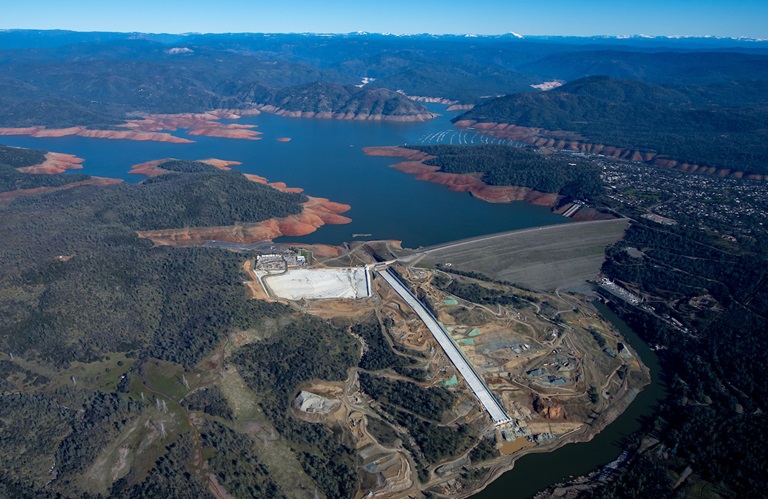
Oroville Dam. (Photo: DWR.ca.gov)
Ringside: Politically Viable Water Supply Projects
Bring back California’s timber industry to profitably thin the state’s overgrown forests
By Edward Ring, November 27, 2025 6:30 am
A few years ago I was involved in an effort to qualify a ballot initiative, the “Water Infrastructure Funding Act.” While we failed to gather sufficient signatures to get it onto the November 2022 state ballot, if it had been approved by voters, water scarcity in California would have been eliminated forever. Unfortunately, certain provisions in that measure attracted immediate, forceful opposition which put potential major supporters into an impossible position: Donate about $5 million to qualify the initiative, then spend another $50 million or so on a campaign for votes, and risk losing.
The allegedly toxic provisions we’d included are no secret. The initiative named seawater desalination and surface reservoirs as among the projects eligible for funding, and was neutral on the Delta Tunnel. Any one of those three attracts apoplectic opposition from a critical mass of powerful players.
The failure of our effort invites a worthwhile question. What combination of water supply projects might be assembled that would not invite apoplectic opposition, but together could still eliminate water scarcity? Here’s an attempt at such a list.
1 – Dredge the channels in the Sacramento-San Joaquin Delta. For over 100 years, ever since the delta was channelized in the 19th century, dredging was routinely performed, and much of it was done by local farmers with private funds. And until the practice was stopped by environmentalists in the 1970s, migratory salmon populations thrived despite the presence of introduced bass predators. That’s because deep channels of cool water attract salmon and repel bass who prefer warm shallows. Dredging not only would help salmon populations. It would increase the volume of fresh water in the delta, which would mean more water could be pumped into the aqueducts without reversing the current and pulling in salt water from San Pablo Bay. Dredging would also increase flow capacity in the delta, which would allow more reservoir storage during winter, because there would be more capacity to drain spring snowmelt without risking floods. Another benefit of dredging would be that the recovered silt could be used to enrich farming soil as well as to strengthen levees.
2 – Remove sediment from California’s major reservoirs. A 2014 analysis estimated sediment had already reduced total reservoir capacity in the state by nearly 2 million acre feet. There are innovative new ways to remove sediment in a manner that mimics a natural river, i.e., the process could be ongoing with the sediment redeposited downstream of the reservoir at a faster rate than it accumulates upstream of the dam. In this way, reservoir capacities would be gradually expanded with annual yields increasing proportionately.
3 – Develop massive aquifer recharge capacity in the San Joaquin Valley. Private farmers might willingly bear most of the cost for this if (a) there were a swift and secure way to temporarily transfer rights to floodwater withdrawal in wet years, (b) the state’s regulatory agencies got out of the way, and (c) farmers could pump back up a reasonable percent of the water they’d percolated on their land. With a sufficiently streamlined process, it would still be profitable for farmers even if they consistently recharged more water than they pumped back up. Significant expansion of annual recharge capacity would permit storage of additional millions of acre feet each year from the delta.
4 – Build new facilities to withdraw water from the delta during wet winters. The San Joaquin Valley Blueprint is one example of this. Another is to extend the Folsom South Canal to serve a huge portion of the northern San Joaquin Valley, if not all the way to the existing delta pumps on the Clifton Court Forebay. Even in drought years, there are periodic storms where the volume of water flowing through the delta is well in excess of ecosystem requirements. Building capacity to take a bigger gulp whenever there are high flows could yield millions of acre feet per year of additional water.
5 – Build small scale seawater and brackish water desalination plants. Thanks to improved filter design and the development of modular, nearly plug-and-play systems, costs to build desalination plants are dropping, as is the amount of energy required to power them. California’s policymakers are yet to recognize the utility of large scale desalination plants, but from Antioch to Dana Point, smaller plants are getting built. Let’s build more of them.
6 – Optimize urban runoff harvesting. A 2022 study from the prestigious Pacific Institute estimated the “Volume of Urban Stormwater Potentially Available for Capture and Reuse” to range between 770,000 acre feet in dry years to 3.9 million acre feet in wet years. While capturing, say, 10 inches of rain that hits the San Gabriel Mountains in a single day-long torrent before all of it makes its way a mere 30 miles to Long Beach is an impossible engineering challenge, there is nonetheless great potential. By daylighting streams, reducing impermeable surfaces, and building percolation basins in unlikely places (for example, underneath parking garages and playing fields), storm runoff can replenish the aquifers that urban users rely on for their water supply with hundreds of thousands of additional acre feet of freshwater per year.
7 – Increase urban wastewater recycling. Costs to recycle wastewater are rising with the new requirements to remove PFAS. But with approximately 2 million acre feet per year of urban wastewater that is not reused, this remains a tremendous opportunity. Reusing wastewater has the added benefit of greatly improving downstream water quality. In the San Francisco Bay, for example, wastewater treatment plants release over 400,000 acre feet per year of nitrogen rich effluent that nourishes algae blooms.
8 – It’s arguable that this next solution is not explicitly water oriented, but the impact of its enactment yields too much additional water to ignore. Bring back California’s timber industry to profitably thin the state’s overgrown forests. This will reduce fire danger, generate tax revenue, and create jobs. A 2011 study from UC Merced reported that 60 percent of the state’s consumptive water comes in the form of Sierra runoff, and that when forest cover is reduced by 40 percent, total runoff increases by an estimated 9 percent. That means if California’s forests were thinned, 2.2 million acre feet of water would be added to California’s annual water supply.
How might all this add up? Here goes:
- Increase flow capacity and water volume by dredging delta channels – 1 MAF/year
- Increased reservoir capacity by removing sediment – 1 MAF/year
- Develop massive additional aquifer recharge and storage capacity (net, i.e., local storm runoff) – 1 MAF/year
- Increase capacity to safely withdraw water from delta (net, i.e., major storms) – 2 MAF/year
- Desal, urban runoff harvesting, urban wastewater reuse (combined) – 2 MAF/year
- More tributary runoff when forests are thinned to historical norms – 2 MAF/year
An encouraging fact about these estimates, totaling 9 MAF/year, is they don’t differ much from lists that include new reservoirs and large scale desalination. Does this mean those solutions aren’t good ones? Not necessarily. Raising the height of the Shasta Dam and building a large desalination plant in Huntington Beach are economically sound proposals that in a different political environment would come to fruition. But even with these more controversial categories off the table, there remains another barrier to water abundance: regulations.
The initiative we developed back in 2021 also streamlined CEQA review and other sources of bureaucratic and legal obstruction, and that, too, was politically toxic. There is some evidence that a consensus is forming to revisit the regulations that have rendered all major infrastructure development in California almost impossible to complete and prohibitively expensive. Any list of water projects, in whatever mix may become politically feasible, will have to decisively address this additional challenge.


RELATED ARTICLES
-
-
 September 4, 2024
 -
Wait! This whole article sounds a lot like creative common sense. We CANNOT have that here! Not in California…if I were Governor, I’d say let’s do it. Put all of this on the ballot, have Californians vote on it (some of the measures have got to pass) or executive order. Emergency executive order. Good article. Thank you.
^^^ 100% agree….
LOGIC??? COMMON SENSE???
Those two behaviors terrify emotion-driven “progressives”, especially those that delude themselves into thinking that they are intellectually AND morally superior to everyone else…. which describes 99% of California Democrats…
Mr. Ring has listed solid water projects that would help alleviate California’s chronic water supply issues. Unfortunately for Californians, Hair-gel Hitler Newsom and the criminal Democrat thug mafia that controls the legislature would never go for them because they’re all about creating water scarcity to better control Californians while blaming climate change.
A simple solution, that doesn’t cost any money, would be to ban all exports of agricultural products and wine to outside California. What’s grown in California, stays in California. These prohibitions could be loosened once California gets its act together as recommended above.
California under democrats have two main traits: If there is an environmental decision to be made, they will make the wrong one.
And, if there is a infrastructure decision to be made, they will not make it at all.
The movie “Idiocracy” was written based on California governance.
If a ballot measure is passed it must include a provision that after a point in time the governor and legislature are financially punished for for every day the project is unfunded, maybe a thousand bucks a day straight from their personal bank accounts might do the trick. There has to be a meaningful punishment for recalcitrent legislators because all kinds of ballot measures can be popular and passed but sacramento can defeat them by simply not funding them.
Every coastal city needs to be fitted with a desalination plant cojoined with its very own electrical generation plant. Whether the electrical plant is owned by the project or by the local utility franchise, the desalination plant gets power first before the excess power is sold elsewhere, local markets first. Before my time, the Antelope Valley had artesian wells before alfalfa farms pumped the aquifier so low it was cost prohibitive to farm. The coastal metropolitan areas need to depend on desalination while water from the Sierras, Owens Valley and Colorado River sources need to be used to refill the aquafiers of San Joaquin, Indian Wells, Antelope, and Victor Valleys.