
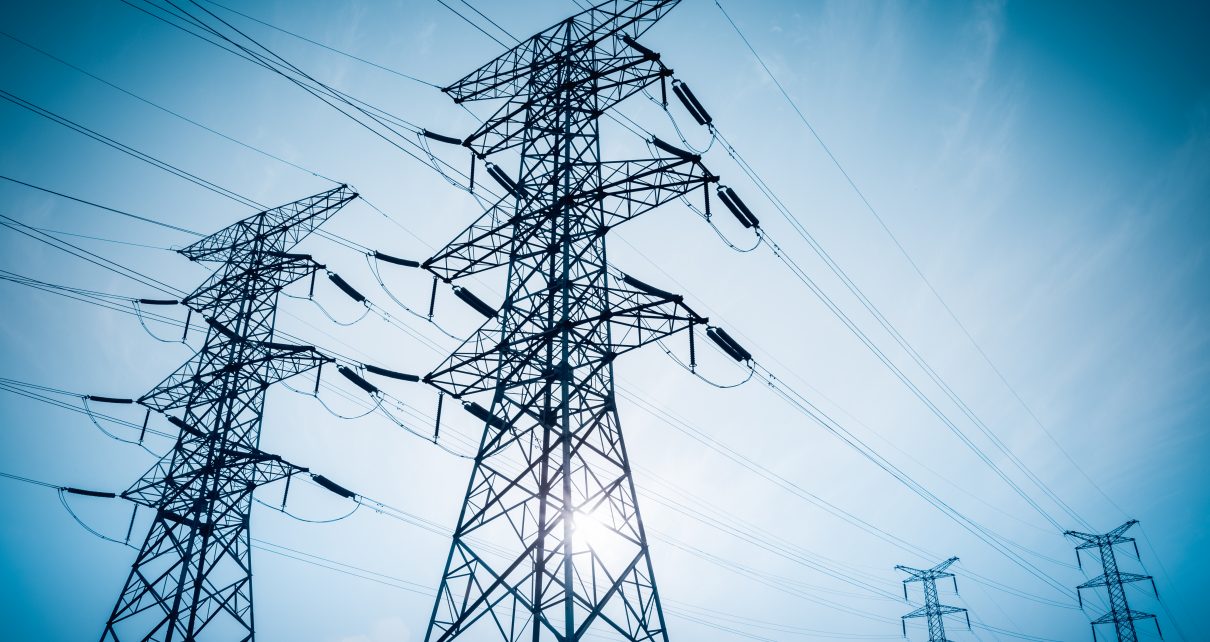
Electricity Transmission. (Photo: chuyuss/Shutterstock)
Ringside: What Really Keeps California’s Electricity So Expensive?
California will never rely on intermittent sources for 100 percent of its electricity
By Edward Ring, November 27, 2026 7:00 am
Californians reportedly consumed over 267,000 gigawatt-hours (GWh) of electricity in 2025, with just under 206,000 GWh produced in-state and nearly 62,000 GWh imported from other states. California’s determination to further electrify its economy is reflected in the official state goal to consume 500,000 GWh per year by 2045.
Getting from here to there is an enormous challenge, of course, and the debate over what technologies to prioritize is often framed in terms of production cost. But easily lost in that discussion is the fact that the wholesale price of electricity is only a small fraction of what retail consumers ultimately have to pay.
For example, approximately 80 percent of California’s high voltage electricity flow is managed by the California Independent System Operator (CAISO). This organization also operates the marketplace where power suppliers and utilities buy and sell wholesale electricity. For 2025, CAISO reported an average wholesale price for electricity at $0.035/kWh. Three and one-half cents. So why are California’s end-users paying their utilities, on average, $0.30/kWh?
A January 2026 report from PG&E, titled “Bundled residential electric average rate breakout,” shows what is bundled into residential electricity rates. The report displays a pie chart showing percentages by cost category, with only 31.2 percent for “energy supply.” This implies a cost for PG&E’s “energy supply” that is well in excess of the wholesale price, thanks mostly to long-term power purchase agreements for electricity from sources that meet California’s renewable energy requirement.
But if the remaining percentages are applied to a retail price of $0.30/kWh, here’s what else is in a homeowner’s electricity bill:
3.1¢, existing long-distance transmission,
7.4¢, last mile distribution,
4.6¢, wildfire related charges,
2.1¢, public purpose programs,
1.3¢, other (service, metering, billing, etc.),
2.1¢, taxes and insurance,
For those counting, these additional costs total $0.206 per kilowatt-hour.
All kinds of criticisms can be leveled at this analysis, so let’s consider a few of the big ones. First among them is probably the contention that PG&E bears substantial liability for wildfires, but that only affects PG&E customers. But for all practical purposes, almost every utility ratepayer in the state does share in wildfire liability. California’s three largest electricity utilities, PG&E, Southern California Edison (SCE), and San Diego Gas & Electric Company (SDG&E) are all liable for “infrastructure-ignited” wildfires. Also liable is California’s largest publicly owned electric utility, the Los Angeles Department of Water and Power (LADWP), along with many smaller utilities.
As for the other major additional costs, it is true that some smaller utilities that only serve densely-populated urban areas may have lower last mile distribution charges, but that will only shave a few cents off their rates. Meanwhile, most of them still have to pay grid fees for electricity transmitted to them over far-flung high-voltage lines, and they all have to pay for basic services overhead, mandated public purpose programs, insurance, and taxes.
Nearly every source of electricity has opponents who attack it as too expensive to be an option. The obvious targets are anything intermittent, along with nuclear, and, even notwithstanding alleged climate externalities, natural gas. But as noted, the disproportionate additional costs point to the uncomfortable conclusion that the cost of generating electricity is usually not as relevant as these critics imply.
Some of these criticisms seem more valid than others. Floating offshore wind, most notably, brings with it – using government projections – a wholesale cost of at least $0.20/kWh, and that’s before construction overruns and any shared overhead for battery storage. Against a wholesale price averaging $0.035/kWh in California, the extreme cost for 25 gigawatts of floating offshore wind capacity represents a roughly $300 billion investment that ought to be spent elsewhere. Anywhere. The price of raw photovoltaics has dropped by more than 95 percent in the last 20 years; batteries between 85-90 percent. Start there.
Apart from floating offshore wind, the future of cost-effective intermittent sources of electricity may carry with it great potential. The biggest variable may be if and when the next generation of EVs arrive. Because if a new EV only costing $20,000 can deliver a 500 mile range, gets 4 miles (or more) per kWh, and charges in under ten minutes, almost everybody is going to buy one. Zero to sixty in under three seconds is already a feature sufficient to attract some of the most hardened skeptics. But there’s an additional upside to widespread EV adoption: V2G, or “vehicle to grid” technology.
Battery farm investors take note: daily price arbitrage is on a collision course with V2G, where EVs send stored electricity from their batteries back into the power grid using bidirectional charging. Here’s a hypothetical example:
Imagine Californians are consuming the planned 500,000 GWh per year, and 100 percent of it is from renewable sources. Spread evenly (this is hypothetical), that’s 57 GWh of consumption per hour. Now imagine that half the day, 12 hours, there is no renewable electricity available: sun is down, wind is still. That would mean 685 GWh per day, or 685 million kWh, would need to come from batteries or via other storage means. Now consider that the average EV can charge during the 12 hours of surplus and then, during the daily 12 hours of deficit supply, sell half of its stored electricity, 25 kWh, back to the grid. This would require a fleet of 27 million EVs in California. The state has a total of 36 million registered vehicles.
This is not a preposterous scenario. The assumptions are extreme, but the model is real. California will never rely on intermittent sources for 100 percent of its electricity. The state’s utility-scale battery farms already have over 70 GWh per day of storage capacity, and home battery systems already have bidirectional capacity. Moreover, in conjunction with decentralized installations of privately owned photovoltaics, electricity supply and storage will be in proximity to electricity demand. This will reduce the requirement for new high voltage transmission lines, lowering costs to maintain the grid.
There are other ways to lower electricity costs in California. Take away the portion of public purpose payments that fund projects destined to become permanent economic drains on the state’s taxpayers and ratepayers – floating offshore wind and high speed rail are prime examples. To lower insurance premiums and future wildfire mitigation costs, bring back the state’s logging and milling industry to responsibly harvest California’s dangerously overgrown forests, while also streamlining permits for grazing, thinning, and controlled burns.
Finally, stop shutting down natural gas power plants that are paid for and can instead be upgraded. And keep Diablo Canyon open. It’s paid for and with upgrades it’s designed to operate past mid-century.
It will take years to recover from policies that have driven electricity prices in California to be among the highest in the country. But rapidly emerging electricity generating and storage technologies are going to bring prices down. How soon that happens is a political decision.


- Ringside: What Really Keeps California’s Electricity So Expensive? - November 27, 2026
- Ringside: Green Mega Water Projects for California - November 19, 2026
- Ringside: Water Abundance Means Thinking Big Again - November 11, 2026
RELATED ARTICLES
-
-
 December 4, 2025
-
March 12, 2026