

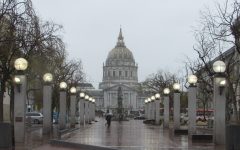
San Francisco City Hall (Photo: Evan Symon for California Globe)
San Francisco’s Lurie Deficit: A Fiscal Crisis City Hall Refuses to Address
San Francisco boasts one of the highest employee-to-resident ratios in the nation – roughly 1:24
By Richie Greenberg, December 10, 2025 2:55 am
San Francisco faces a daunting financial challenge once again: a projected one-billion-dollar budget deficit for the 2026 fiscal year. Mayor Daniel Lurie’s made startling remarks revealed at the Wired conference here last week.
Lurie, though acting as the city’s ambassador with daily posts of positivity and good cheer to social media, admitted to San Francisco’s deteriorating fiscal health, noting that while 2025 city hall coffers are already strained, 2026 could see a shortfall approaching or exceeding $1 billion against a $16 billion budget.
At the heart of the problem lies a fundamental imbalance between revenues and expenditures, akin to a household living beyond its means. We need to confront reality. The city’s revenue streams – sales tax, business taxes, property taxes and more – fall short of covering escalating costs. A key culprit is the explosive growth in the budget itself.
Under former Mayor Ed Lee a decade ago, the budget hovered around $7-8 billion; it ballooned to $16 billion during London Breed’s tenure which started July 2018. This expansion stems from the government as a “jobs program,” funneling taxpayer money into unnecessary positions and departments without commensurate value.
The city’s workforce exemplifies this inefficiency. With approximately 37,000 employees serving a population of around 870,000, San Francisco boasts one of the highest employee-to-resident ratios in the nation – roughly 1:24. Moreover, many of these workers commute from outside the city, a setup not inherently problematic but insulting to residents footing the bill through taxes. Departments like the Department of Public Health, consuming $3.25 billion, or 20% of the city budget, exemplify this bloat. Despite its massive allocation, visible urban decay – rampant homelessness, drug issues, and unclean streets – suggests poor performance. Anyone walking through certain impacted neighborhoods would question the department’s effectiveness. Lurie should be advocating for cutting the budget funding where accountability falters.
Another bloated entity is the Department of Homelessness and Supportive Housing (HSH), a relatively new creation sucking hundreds of millions annually from taxpayers. I argue its time to outright eliminate the HSH; it’s not intrinsic to governance and has failed to deliver results.
Within weeks of being sworn-in to office, Mayor Lurie demanded budget reductions from each department. yet many ignored him, prioritizing funding status quo over fiscal responsibility. Compounding this are long-term city employee obligations like pensions and retirement benefits. It’s a financial disaster in the making.
There are real ideological barriers to reform. We know this. Efforts to boost revenue through taxes have backfired spectacularly. San Francisco’s Proposition C of November 2018, championed by Salesforce’s Marc Benioff to fund homelessness initiatives by taxing large businesses, passed amid controversy and fierce opposition by companies like PayPal and Stripe. Similarly, Supervisor Matt Haney’s Proposition L, the “overpaid CEO tax” passed in 2020, which penalized firms where executive pay exceeded a multiple of the lowest wage earner, alienated corporations. A new extension of this CEO Tax is now in process of gathering signatures, perpetuating a “punitive approach” driven by Marxist rhetoric of “making capitalists pay their fair share.”
This ideology ignores economic realities: businesses generate jobs, community contributions, and tax revenue. Prosperity flows from growth, not redistribution from a finite pot.
Counterproductive policies like the “San Francisco New Deal,” which temporarily fill vacant storefronts with non-profits or facades that look vibrant, contribute essentially nothing financially. To truly increase revenue, the city must attract “paying entities” – thriving businesses that pay taxes and employ locals. Yet, looming tax hikes on property owners, hotels, and gas could exacerbate the exodus, making San Francisco even less appealing. Such desperate measures are counterproductive; we need solutions through a rational, non-ideological lens.
Ultimately, balancing the runaway budget demands a dual strategy: prudent (painful) cuts and revenue enhancement without alienating taxpayers. Prioritization is key: Essential services like hospitals must be safeguarded, but fraud, inefficiencies, and non-essential programs warrant big cutbacks or outright elimination. Unfortunately, no department head wants to admit incompetence, mirroring national-level scrutiny where federal audits under DOGE uncovered waste. Refusing to act only deepens the crisis.
San Francisco can close its shortfall. It’s not mysterious math but a matter of willpower. Ditch punitive taxes, streamline bureaucracy and foster business growth. This requires leadership from Lurie and the Board of Supervisors to transcend ideology and embrace pragmatism. If only officials would prioritize reality over rhetoric.


- Greenberg: Yes, Trump Has the Legal Power to Strike - March 2, 2026
- Greenberg: Newsom Once Again Proves He’s Unfit to Lead - February 26, 2026
- Greenberg: The Irony – Ineligible Blacks May Fund SF Reparations - February 22, 2026
RELATED ARTICLES
-
-
 January 9, 2025
 -
August 4, 2025
@Richie, has SF ever operated with a BALANCED budget? If so, when did this happen and who was the mayor?