
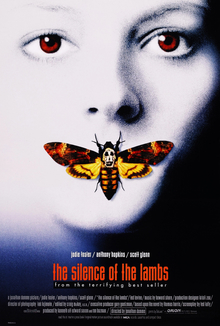
The Silence of the Lambs poster. (Photo: fair use, Orion Pictures)
Silence of the Lambs Retroactively Slammed as Transphobic
Art reflects the human condition in all its messiness—violence, identity, madness
By J. Mitchell Sances, February 20, 2026 7:00 am
The classic horror film, The Silence of the Lambs has recently been labeled as transphobic. Progressivism is seeking to sacrifice another Hollywood masterpiece to their “problematic” gods because the mentally ill villain of the film is a man so desperate to be a woman that he murders for it. While the character is never labeled as trans, the fictional portrayal has been deemed offensive.
In the annals of cinematic history, few films have left as indelible a mark as The Silence of the Lambs. Released in 1991, Jonathan Demme’s masterful adaptation of Thomas Harris’s novel not only swept the Oscars—claiming Best Picture, Best Director, Best Actor, Best Actress, and Best Adapted Screenplay—but also redefined the psychological thriller genre. Jodie Foster’s Clarice Starling became an icon of female empowerment in a male-dominated FBI world, while Anthony Hopkins’s Hannibal Lecter chilled audiences with his erudite cannibalism.
Yet, three decades later, the film finds itself ensnared in the crosshairs of contemporary culture wars. Critics now view its antagonist, Buffalo Bill, as a harmful caricature of transgender identity rather than a singular mentally ill serial killer. Buffalo Bill is a murderer who kidnaps and skins women to fashion a “woman suit” for himself. The character’s motivations stem from a profound hatred of his own body and a desire to transform it—a plot point that activists argue links gender dysphoria with violence and monstrosity. Queer activists at the time of release protested the film, and in recent years, the criticism has amplified. A 2021 academic paper from UC Irvine, for instance, argued that the film constructs an “inauthentic transgender-ness” synonymous with social instability, undermining the validity of trans experiences. More recently, trans propaganda machine Them has labeled Buffalo Bill as perpetuating the “crossdressing serial killer” stereotype, fueling real-world transphobia.
Ted Levine, the actor who portrayed serial killer Buffalo Bill also made comments in a recent interview with The Hollywood Reporter. Levine reflected on his role with a mix of pride and regret. “There are certain aspects of the movie that don’t hold up too well,” he admitted. “We all know more, and I’m a lot wiser about transgender issues. There are some lines in that script and movie that are unfortunate.” He went further: “It’s unfortunate that the film vilified that…”
However, if one considers fact over feeling, a concept completely novel to ravenous activists, the character’s motivation is not so simple. In the film, Hannibal Lecter explicitly states, “Billy is not a real transsexual. But he thinks he is. He tries to be.” This clear statement opens up the viewer to consider what deeper psychological pathology is at the bottom of the character’s mental illness. It is certainly not pure gender dysphoria.
Furthermore, look at the director of the film: Johnathan Demme. He is also well known for the very progressive film Philadelphia, which aimed to humanize the LGBT victims of the AIDS tragedy of the 1980s. To think that the same filmmaker would intentionally target and vilify trans people in another of his projects is asinine. Demme clearly aimed to portray Buffalo Bill as a product of abuse, not a stand-in for an entire community.
Putting fact aside for a moment, let’s assume the character was meant to be transgender for the sake of argument. Is portraying a singular member of a community in a particular light supposed to be indicative of the entire community? If that were the case, then a black killer in a horror film would be racist. Yet the film Candyman has not been critiqued. And extrapolating this ridiculous notion to real life, a single trans murder would put a stain on all trans people. Considering the fact that over the last three years there have been 5 mass shootings killing 18 people all perpetrated by trans shooters, there may be a correlation to mental illness and violence, but the actions of these few individuals do not condemn all trans people. Here again is the difference between individualism and collectivism. Conservatives see the world in terms of the individual: you are responsible and judged for your actions, no one else’s. Leftists see the world in terms of collective groups: you are judged by the actions of your group. The latter is unfair and dangerous.
If The Silence of the Lambs is deemed transphobic, which other classics will fall next? Hitchcock’s Psycho, with its cross-dressing killer? Or even modern works like Joker, accused of inciting violence? Art reflects the human condition in all its messiness—violence, identity, madness. Sanitizing it retroactively doesn’t protect minority groups; it impoverishes the cultural dialogue.


RELATED ARTICLES
-
 August 19, 2025
 -
 August 1, 2022
 -
 September 12, 2018
“Oh, was she a great big fat person?”
Buffalo Bill was a fat shamer too!
Ummm, it’s a EFFING MOVIE, people… it’s NOT reality….
If you don’t like the message, don’t buy the product…and that product is THIRTY-FIVE YEARS OLD now…
Get over yourselves, PLEASE???!!!
There are SO many other MORE IMPORTANT problems in this society to be addressed, such as California VOTING FRAUD, California HOMEOWNER’S INSURANCE being unavailable or unaffordable on the commercial market (thanks to DEMOCRAT BAD POLICIES and MISmanagement of resources, both natural and financial) and a HOST of other REAL-WORLD problems that Gavin Newsom & his merry band of idiot Democrats ARE NOT ADDRESSING…
But “Orange Man Bad” and Trump Derangement Syndrome is all they have to stake their claims for power upon….
#ClownWorld
Well said CriticalDfence9. I think, what these people need is a good healthy dose of reality. I wonder if World War II would have happened during these generations AFTER my grandfathers generation, if we would even have a country left. Now THOSE MEN and WOMEN got a dose of reality. I think, maybe, unfortunately, it would take something like that to put a lot of this nonsense to bed and straighten up some politicians. NO-ONE has time to think about this crap when people are shooting at you. Yep, we have bigger issues.
There is no such thng as a transexual. There are male, female, homosexuals who dress like nen, homosexuals who dress like women, and the flip side with lesbians. There is only xy and xx, and anyone who truly thinks they are the opposite are mentally ill.
I prefer the musical version “Silence” featuring a Greek chorus of lambs narrating the story.