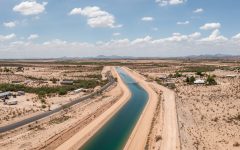
Rendering of SpaceX AI center in Cochise County, AZ. (Photo: SpaceX)
SpaceX Details Self-Contained Power and Water Plan for Arizona AI Site as Progressive NGO Mobilizes Opposition
Dry-cooling design and $3.6 billion grid commitment face resistance from progressive nonprofit Rural Arizona Engagement ahead of December 9 hearing
By Megan Barth, November 25, 2026 1:38 pm
SpaceX on Wednesday publicly detailed the design principles behind its proposed $50 billion-plus artificial intelligence supercompute campus in Arizona’s Cochise County, emphasizing zero on-site gas generation, no industrial water use, and a dry-cooling closed-loop system while pledging major local economic benefits and grid upgrades.
In a post on X, the company stated that its supercompute site “has been designed with Arizona in mind: no gas plant, no industrial water use, and a dry-cooling closed-loop water system.” SpaceX said it will invest $50 billion or more in the area, create 1,000 permanent local jobs and up to 5,500 construction jobs, pay for its own power, and contribute $3.6 billion toward grid upgrades. “Current residents will not subsidize this project – in fact, residential rates for SSVEC customers may decrease by up to 40%,” the company wrote. It also affirmed it values community input and looks forward to addressing questions at a planned December 9 meeting, asking the county commission to proceed so residents can be heard publicly.
Our supercompute site in Cochise County has been designed with Arizona in mind: no gas plant, no industrial water use, and a dry-cooling closed-loop water system. SpaceX will also invest $50B+ into the area, bringing 1,000 local permanent jobs and up to 5,500 construction jobs to… pic.twitter.com/1OpyYXT8MN
— SpaceX (@SpaceX) November 25, 2026
The update builds on SpaceX’s previously disclosed plans for a roughly 747-acre site along U.S. Highway 191 near Cochise, filed as Special Use Authorization SU26-22 by Tombstone Resources LLC. The multi-phase project envisions up to nine computing buildings with an estimated full-buildout electrical demand of 6 gigawatts, supported by battery storage, for AI model training and related applications including medical research, emergency response, manufacturing, and national security. Cochise County’s Planning and Zoning Commission is scheduled to consider the application on December 9 at 2 p.m. in Bisbee, with written comments due by noon on November 27. The land is currently zoned rural (RU-4).
Founder Elon Musk weighed in, noting “SpaceX Colossus 3 will greatly benefit the Arizona community.”
As reported earlier by the California Globe, the proposal is part of SpaceX’s broader push into supercompute infrastructure across Texas and Arizona. The company has highlighted closed-loop cooling that recirculates water as a coolant with minimal evaporative loss, limited domestic water use for employees, and compliance with dark-sky lighting standards. Power would be delivered through arrangements involving the Sulphur Springs Valley Electric Cooperative (SSVEC) and Arizona Electric Power Cooperative, with the developer responsible for infrastructure costs and subject to Arizona Corporation Commission oversight. Projected local benefits include property and sales tax revenue, potential education funding, and possible rate offsets for cooperative members, though final agreements remain under negotiation.
Opposition has grown since the project became public. An online petition urging denial has gathered thousands of signatures. At a November 4 community meeting at Cochise Elementary School, hundreds of residents attended, with many holding “No Data Center” signs and raising concerns about groundwater, wildlife (including federally protected sandhill cranes near the nearby Willcox Playa), noise, light pollution, and electricity demand. Among the groups helping organize local pushback is Rural Arizona Engagement (RAZE), a Coolidge-based 501(c)(3) nonprofit co-founded by Natali Fierros Bock and Pablo Correa that focuses on progressive civic engagement and voter registration in rural communities.

RAZE, which has reported more than $5.6 million in revenue in 2024 from foundation grants including nearly $1 million from the Tides Foundation—a conduit long linked to George Soros’s Open Society Foundations network—has assisted with petition efforts and community outreach through its organizing director Tara Clayton, who has publicly questioned the project’s water use, wildlife impacts, and transparency. The group previously helped defeat a large data center proposal in Pinal County.
Arizona Attorney General Kris Mayes has urged the Planning and Zoning Commission to delay the December 9 vote. In a November 19 letter and public statements, Mayes called for state and federal reviews of the project’s potential effects on the electric grid, water resources, public safety (including emergency response near battery storage outside a fire district), transportation, wildlife, and other issues before any local approval. She stated that “the people of Cochise County deserve answers before county officials approve a project of this magnitude” and has scheduled a town hall for residents.
County Board of Supervisors Chair Frank Antenori has noted that SpaceX has addressed several concerns, including no groundwater use for operations and the grid investment commitment. SpaceX’s latest statement positions the facility as self-contained on power and water while generating local employment and rate relief, framing the December 9 hearing as an opportunity for transparent public discussion.
The county has not yet made a determination on the application, and any energy agreements would require further regulatory steps. The project’s scale—one of the largest data center proposals in Arizona and the nation—continues to draw both economic interest and calls for additional scrutiny in rural Cochise County.


- SpaceX Details Self-Contained Power and Water Plan for Arizona AI Site as Progressive NGO Mobilizes Opposition - November 25, 2026
- California and Arizona Challenge HUD Rule Ending Taxpayer Subsidies for Units Housing Ineligible Noncitizens - November 24, 2026
- Trump Orders Death Penalty for Child Killers, Condemns Newsom’s Mass Commutation of 548 Death Sentences - November 23, 2026