
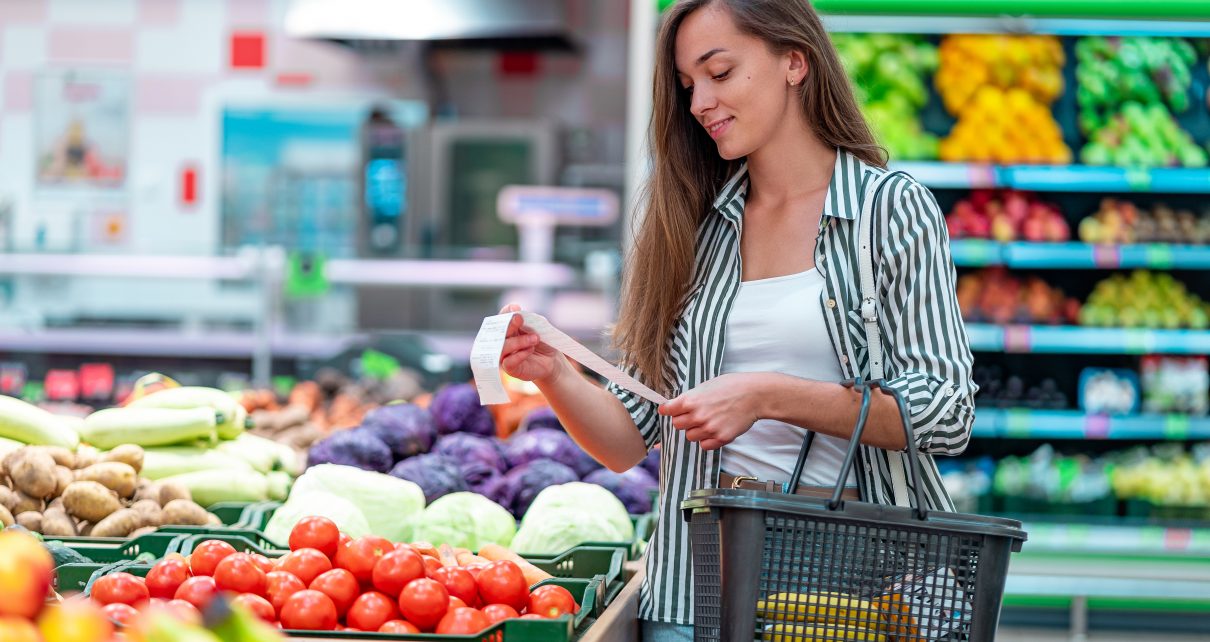
Woman checks sales receipt after purchasing food in a grocery store. (Photo: goffkein.pro/Shutterstock)
The ‘Dirty Dozen’ Gets It Wrong About California Produce
Out of more than 1,050 samples, food labeled ‘Grown in California were over 99.7% residue-free or well within safety standards
By Hector Barajas, January 27, 2026 4:43 pm
Every year, headlines warn shoppers about the so-called “Dirty Dozen,” a list that suggests common fruits and vegetables are coated in dangerous chemicals. Those stories generate fear, but they consistently ignore the facts. In California, the science tells a very different story, one grounded in safety, accountability, and care.
The California Department of Pesticide Regulation’s most recent produce monitoring report confirms that food grown here is among the safest in the world. DPR tested more than 3,500 unwashed samples of fruits and vegetables sold across the state. Ninety-seven percent had either no detectable pesticide residues or levels far below strict federal safety limits.
When DPR narrowed its focus to food labeled “Grown in California,” the results were even clearer. Out of more than 1,050 samples, over 99.7 percent were residue-free or well within safety standards.
These outcomes reflect decades of deliberate work by farmers, farm workers, scientists, pest management professionals, and regulators who share a single objective: protecting public health while ensuring a reliable and affordable food supply.
Over more than 20 years working in communications and public affairs, I have worked alongside agricultural groups, farmers, water agencies, pest control operators, farmworkers, chemical manufacturers, regulators, and elected officials. What they all have in common is that this industry is personal. They live in the same communities as the families they feed. Their children attend the same schools. They buy the same produce found on store shelves. Safety is not a talking point. It is a responsibility.
Behind DPR’s statistics are real people and real science.
Each year, hundreds of thousands of California farmers and farmworkers receive training on the responsible use of agricultural tools.
Modern pest control products undergo years of rigorous testing before they are approved for use. These evaluations examine environmental behavior, water safety, and potential human health impacts. Federal and state reviews can take more than a decade, often longer than the approval process for most pharmaceuticals.
The phrase “no detectable residues” may sound simple, but given our modern science, it reflects extraordinary precision.
Today’s laboratories can detect substances at levels as low as parts per billion and parts per trillion. For perspective, one part per billion is like a single drop of water in an Olympic-sized swimming pool. And one part per trillion is like one drop in 20 Olympic-sized swimming pools. So, when the DPR report states that it found “no detectable residues,” it means nothing was found under extraordinarily sensitive levels.
DPR’s program is intentionally rigorous. The report notes that they prioritize foods consumed by infants and children, crops with past issues, and imports from countries with weaker oversight. The goal is to find problems, not avoid them. Even with that approach, California agriculture continues to pass the test.
At a time when misinformation spreads faster than facts, it is worth stating plainly: fear is not food policy. Science is.
California’s agricultural community has earned public trust through accountability, innovation, and care. Every bite of food grown here reflects that commitment.


- A Second Grader Should Not Have to Ask, ‘Is He Dead?’ - March 3, 2026
- The Social Media Trial Is Missing the Real Defendant: Us - February 24, 2026
- ‘Why Would Anyone Want This Job?’ - February 23, 2026
RELATED ARTICLES
-
 May 28, 2025
 -
 September 11, 2024
 -
 August 19, 2025
Some stores spray produce with chemicals even the organic food. Those misters you see are not benign. I wonder if this report tested produce from the store or at the wholesale level.
The 3500 pieces of fruits and vegetables were taken from stores and markets.
You actually believe that Grocery Stores spray insecticides and preservites on produce? That is so sick and twisted.
You actually believe that Grocery Stores spray insecticides and preservates on produce? That is so sick and twisted.
It is called Produce Max and yes it is sick.
It is called Produce Max and yes it is sick.
Produce Maxx (often written as ProduceMaxx) is a commercial antimicrobial produce wash and quality treatment solution used by grocery stores, food processors, and food-service operations to help clean, sanitize, and preserve fresh fruits and vegetables.
🧴 What It Is
Produce Maxx is an EPA-registered antimicrobial product that is approved as a food contact substance and designed to reduce harmful bacteria and spoilage organisms in produce wash water and on produce surfaces.
It kills 99.999% of E. coli O157:H7, Salmonella enterica, and Listeria monocytogenes in wash water.
It controls spoilage-causing bacteria to improve product quality and extend shelf life.
It’s approved for use on both whole and cut fruits and vegetables.
🛠️ How It’s Used
Produce Maxx is not something consumers typically buy for home use — it’s used professionally:
Washing/Crisping: Added to wash basins to clean and crisp produce before display or packaging.
Cut Fruit Preparation: Helps reduce cross-contamination when preparing cut produce.
Misting: Some grocery stores dose their produce misting systems with a highly diluted solution to help control bacteria and keep produce looking fresh on the shelf.
🧪 What It’s Made Of
The active ingredient in Produce Maxx is hypochlorous acid, a chlorine-based antimicrobial that’s effective against bacterial pathogens.
While it’s registered with the EPA as a “pesticide” (in the antimicrobial category), it doesn’t act like herbicides or insecticides — its purpose is to control microbes on produce surfaces or in wash water.
🧾 Regulatory Notes
It is registered with the U.S. Environmental Protection Agency (EPA Registration No. 46597-4).
It is also approved as an FDA food contact substance and can be used in organic produce handling when label directions are followed.
In summary, Produce Maxx is a professional sanitizing and quality-control solution for fresh produce — used mainly by retailers and processors to enhance food safety and shelf life.
Paruse Cali’s central valley: One’s observation and conclusion should be; how is it we receive the quality produce we do at an affordable price.
The farm workers toil performing back breaking work that is a huge part of California’s notarity throughout the word.
Eyeinthesky hasn’t perused California’s Central Valley lately.
California farmers have increasingly adopted mechanization which is most evident in labor-intensive crops like strawberries, lettuce, and tomatoes, where robotic harvesters and automated packaging systems are now being deployed to reduce reliance on seasonal manual labor. Innovations such as self-propelled robotic tractors and AI-driven crop monitoring are expanding, though their full deployment is currently restricted in California due to outdated regulations by Democrats that require an operator to be physically present at the controls.
Eyeinthesky is a pathetic troll who deflects and covers for Gov. “Hair-gel Hitler” Newsom and the criminal Democrat thug mafia that has destroyed the state.
The FDA, EPA. USDA and other agencies that claim to protect us are wholly controlled by the industries they claim to regulate which is why they hate Kennedy so much.