
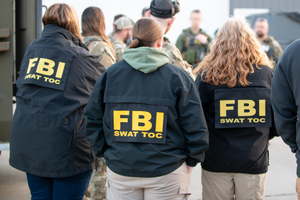
FBI, SWAT and state/local partners. (Photo: FBI.gov
The FBI’s New Moral Standard: Apparently, There Isn’t One
Victims deserve mercy; Federal power demands character
By Maureen Steele, September 17, 2026 3:33 pm
Victims deserve compassion. But voluntary participation in prostitution, bestiality, animal cruelty, theft or violence should disqualify anyone seeking the extraordinary power of a federal badge.
There are certain sentences Americans should never have to hear during an FBI oversight hearing.
“Does that disqualify the animal?”
Yet that was an actual question Senator John Kennedy was driven to ask FBI Director Kash Patel after learning that the Bureau had quietly changed its employment standards concerning prostitution, theft, animal cruelty and bestiality.
Yes, bestiality.
According to CBS News, internal FBI guidance issued in June removed several automatic disqualifications for applicants. The reported changes include hiring a prostitute under certain circumstances, stealing from an employer and engaging in bestiality or animal cruelty before the age of eighteen.
The FBI insists it is not lowering its standards.
The American people are expected to believe that removing automatic disqualifications for grotesque, criminal and deeply compromising conduct somehow does not constitute lowering standards.
During the Senate Judiciary Committee oversight hearing, Senator Kennedy was understandably incredulous.
“When you saw bestiality,” he asked Patel, “why didn’t you just say, ‘What planet did you parachute in from?’”
Patel conceded that this had essentially been his first reaction. He said FBI officials subsequently showed him cases involving applicants who had allegedly been forced into degrading sexual acts through human trafficking.
That distinction matters enormously.
A child or trafficking victim who was coerced into prostitution or subjected to sexual abuse must never be treated as though he or she voluntarily committed the acts involved. A victim is not a perpetrator. What was inflicted upon someone cannot fairly be used as proof of that person’s moral character.
But if that is what the FBI intended to address, why didn’t it write a precise exemption for documented victims of coercion, trafficking and abuse?
Why remove the automatic disqualification in language broad enough to create this controversy at all?
Kennedy put the obvious hypothetical directly to Patel: If an applicant voluntarily participated in bestiality, not as the animal, Kennedy specified, but as the human, should that person be disqualified?
Patel answered yes.
Then put that in writing.
Make the distinction unmistakable. Protect victims while categorically excluding voluntary perpetrators. It should not require four hours of congressional testimony, verbal gymnastics and a discussion about whether an animal could qualify for FBI employment to establish something that elementary.
Senator Dick Durbin identified the same problem from the other side of the aisle. The wording, he argued, concerned applicants who had “engaged” in bestiality, not merely people victimized by it.
Patel responded that applicants who engaged in it could themselves have been forced and therefore could be victims. That can certainly be true. But it still does not explain why the policy was not written narrowly enough to say exactly that.
This is not a partisan question. It is a question of judgment, integrity and public trust.
Federal agents are entrusted with guns, surveillance powers, confidential intelligence, coercive authority and access to some of the most sensitive information imaginable. They can help destroy someone’s reputation, freedom and livelihood. They can enter homes, interview children, cultivate informants and assemble evidence used to imprison American citizens.
The standards for giving someone that power should be extraordinarily high.
An applicant’s past does not always tell us everything about that person, but it tells us something. A history of voluntary cruelty, sexual exploitation, violence, dishonesty or criminal conduct is not irrelevant personal trivia. It can speak directly to judgment, impulse control, susceptibility to blackmail, respect for the law and the moral restraint required of someone entrusted with federal authority.
We have spent years watching government institutions protect their own, conceal misconduct and close ranks when accountability comes knocking. Americans have witnessed political investigations, selective enforcement, unanswered questions and endless assurances that internal procedures are sufficient.
They are not sufficient.
Former Deputy Director Dan Bongino entered the FBI amid enormous promises of reform and left in less than ten months. Patel remains at the helm of an institution suffering from a profound credibility crisis. This was precisely the moment to establish exacting standards and radical transparency, not to quietly loosen disqualifications involving prostitution, employer theft and cruelty to animals.
The FBI says it wants to consider the “whole person.” Fine. Then the Bureau should release the complete policy, its definitions, its safeguards and the evidentiary requirements used to distinguish coercion from willing participation.
Congress should demand to know how many applicants prompted this policy change and how many of them were documented victims of trafficking or abuse. It should identify who recommended these revisions, what conduct remains an absolute disqualification and how the FBI verifies an applicant’s claim of coercion. The Bureau must also explain whether these exceptions apply only to conduct committed while an applicant was a minor and whether a person who voluntarily purchased sex, abused an animal or stole from an employer can now receive a federal badge.
Those are not salacious questions. They go directly to the integrity of the nation’s most powerful law-enforcement agency.
Compassion and standards are not enemies. A responsible policy can protect victims while firmly rejecting voluntary perpetrators. It can recognize that abused children bear no moral responsibility for what adults forced upon them while still declaring that deliberate cruelty, exploitation and criminal dishonesty are incompatible with service in the FBI.
This should not be difficult.
The Bureau does not owe every applicant a federal law-enforcement career. It owes the American people agents whose judgment, character and integrity can withstand the tremendous authority placed in their hands.
Senator Kennedy’s humor exposed the absurdity of the hearing, but underneath the laughter was a devastatingly serious question: How did America reach the point where Congress must debate whether voluntary bestiality should prevent someone from becoming an FBI agent?
Victims deserve mercy.
Federal power demands character.
And an institution unable, or unwilling, to draw that line clearly has no business asking the American people to trust it.


- The Paradox of Protecting Children - September 24, 2026
- The FBI’s New Moral Standard: Apparently, There Isn’t One - September 17, 2026
- You Cannot Take Someone’s Children on the Presumption That the Mail Arrived - September 2, 2026
RELATED ARTICLES
-
 August 7, 2019
 -
 November 18, 2022
 -

In an earlier time, this would have been codified in more restrictive, explicit terms…
This is just more evidence of the creeping cultural cancer of progressivism as that frequently promulgated by perverted freaks like Scott Weiner, and the rainbow cultural warriors…
It’s a slippery slope whan an institution relaxes their hiring codes, it will only get looser and looser, to the point someone unacceptable today will be fully acceptable in a year or two….NOT WHAT WE WANT!
As the rule book gets fatter and fatter, its usefulness gets smaller and smaller.
America is literally drowning in red tape. The misbehavior red tape tries to stop lives in the details buried deeply in nonsense.
Gives a whole new meaning to “The Silence of the Lambs” doesn’t it?