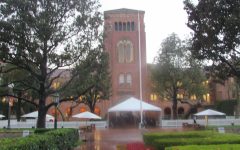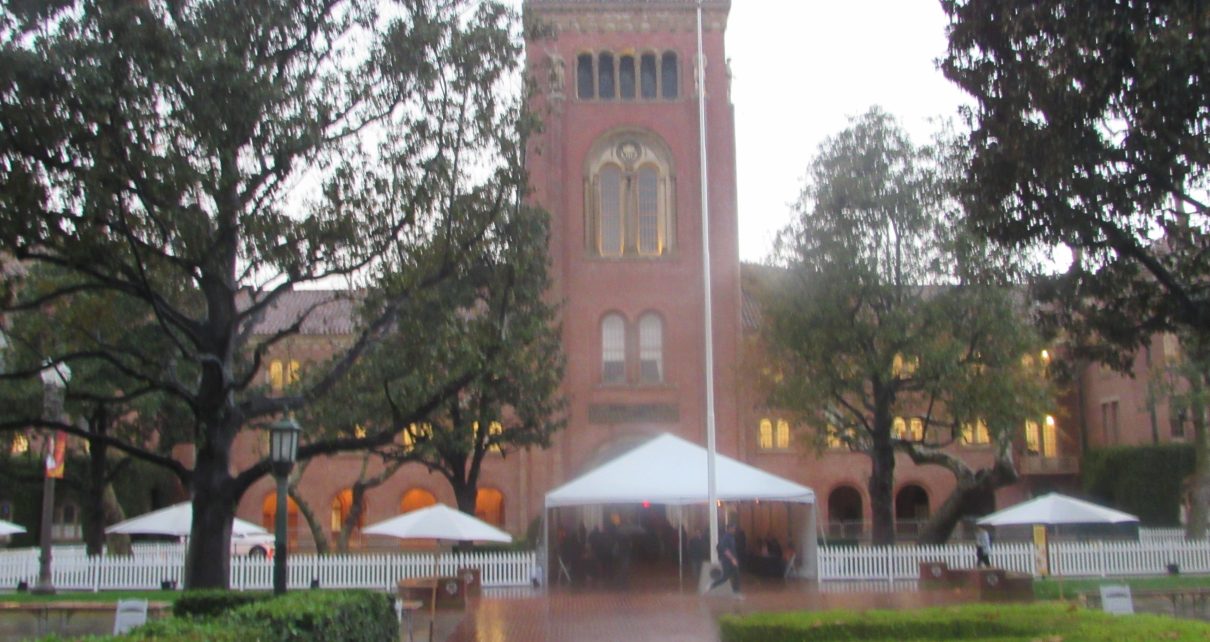
The USC Bovard Auditorium on 1/22/2024 in Los Angeles (Photo: Evan Symon for the California Globe)
USC Launches AI Institute for Actors: Students Get AI ‘Agents’ While Paying Premium Tuition
No AI system is going to give the same advice or feedback that the real flesh and blood human will
By J. Mitchell Sances, April 20, 2026 7:30 am
The USC School of Dramatic Arts has launched the Institute for Actor-Driven Innovation (USC-IAI), an ambitious new program designed to equip acting students with artificial intelligence tools amid Hollywood’s rapid technological shifts. Announced this month, the institute aims to move actors from the “wrong end” of AI changes to thoughtful engagement with the technology. While the university and spokespeople from the School of Dramatic Arts make it seem like an innovative dive into the future, in reality it seems more like a rip-off rife with legal and ethical potholes
According to Dean Emily Roxworthy, “Up until now actors have really been on the wrong end of these changes. We want to do something about that.” The program will initially focus on teaching the rudiments of AI through educational events, lab spaces, and student think tanks equipped with technology and guidance. Adobe is among the sponsors for upcoming sessions. Joint classes with USC’s law school will cover controlling likeness rights.
Promotional materials and statements highlight practical benefits for students, including reading scenes with “legendary partners” such as a digitally resurrected Laurence Olivier, getting advice on setting up a production company, and receiving notes from A-listers “who would not otherwise be available.” The institute also envisions AI serving as a de facto representative. “They can have somebody — or something, I suppose — that is combing breakdowns for them and really looking out for them in a way that representatives would,” Dean Roxworthy said.
Let’s take off the rose colored glasses and look at this more realistically. USC remains one of the nation’s most expensive universities. For the 2025-26 academic year, undergraduate tuition for 12-18 credits stood at $73,260, with total estimated cost of attendance reaching approximately $99,139 for students living on campus (including housing, food, and fees). For 2026-27, tuition has risen to $75,384, pushing the full cost of attendance above $100,000 for many.
At these prices, the introduction of AI as a stand-in for certain instructional elements—scene notes, career guidance, and production advice—prompts scrutiny over whether the return on investment matches the cost. Students and families paying six figures for a USC education may question if algorithmic feedback and simulated interactions justify the expense when human faculty, guest artists, and real industry mentors have traditionally formed the core of elite acting training.
The institute’s vision includes students receiving “notes from A-listers who would not otherwise be available.” Program descriptions frame this as a benefit of AI augmentation, raising the practical question of whether the technology will impersonate living or deceased stars to deliver critiques or guidance. Such interactions, while innovative on paper, rely on generated content that cannot replicate the authentic perspective, experience, or accountability of an actual working professional. It doesn’t matter how much information is available about a celebrity’s life or career. No AI system is going to give the same advice or feedback that the real flesh and blood human will. Students seeking genuine industry insight may instead receive synthesized or hypothetical feedback that lacks any nuance, emotion, or humanity.
Even more striking is the institute’s suggestion that AI could function as a stand-in agent, “combing breakdowns” and “looking out for” unsigned students in the manner of a traditional representative. This twist on the term “AI agent” positions the technology as a career advisor, scout, and advocate rolled into one. However, career decisions in entertainment often involve complex negotiations, contract reviews, and strategic counsel that carry legal weight. Relying on AI for such representation introduces serious risks. Algorithms cannot be held accountable for bad advice, they do not possess licensed legal expertise, and they often draw from incomplete or outdated data. Students not yet signed with professional representation could find themselves making pivotal career moves based on machine-generated recommendations that no human agent or attorney would endorse.
Dean Roxworthy and Director Polos frame the institute as an opportunity for actors to reclaim agency in an AI-driven future. As the program rolls out its labs and think tanks, the central tension remains whether these technological shortcuts deliver commensurate value for students investing in one of the country’s priciest dramatic arts educations, or whether the real innovation lies in preserving the irreplaceable human elements of acting training that no algorithm can fully replicate.


- Everybody’s Welcome, Until She Isn’t: West Hollywood’s Lesbian Bar Cancels a Lesbian - October 7, 2026
- Hollywood Edited Out October 7 Massacre But The Protesters Brought the Footage - October 5, 2026
- Big Brother Behind the Counter: The Ninth Circuit Blesses California’s Gun-Store Listening Law - September 30, 2026