
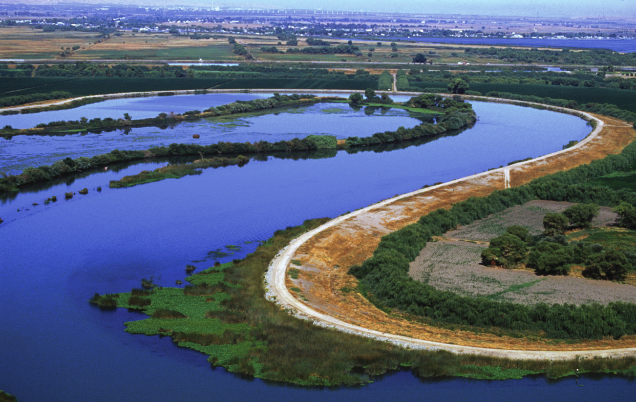
California Bay Delta water (Photo: USGS.gov)
Ringside: How Much Flow Preserves the Sacramento-San Joaquin Delta?
The affluent Bay Area cities would have to finally find the wherewithal to clean up their sewage
By Edward Ring, June 18, 2026 7:00 am
 When choosing what policies and projects might best ensure abundant water for California’s ecosystems, farms, and cities, the role of the delta is central. Even if large scale desalination were to someday deliver over a million acre feet of water per year to California’s coastal cities, how we manage the delta affects many times that amount.
The numbers easily reveal the scale of the opportunity. When comparing how much water flowed into the San Francisco Bay versus how much water was exported via the state and federal pumps, here is the data for the last seven water years (10/01 through 9/30 of the following year):
2020 – 7.0 MAF to bay, 3.5 MAF exported
2021 – 4.1 MAF to bay, 1.5 MAF exported
2022 – 6.0 MAF to bay, 2.1 MAF exported
2023 – 27.2 MAF to bay, 5.2 MAF exported
2024 – 18.1 MAF to bay, 4.2 MAF exported
2025 – 18.6 MAF to bay, 4.8 MAF exported
2026 (through 6/15) – 12.9 MAF to bay, 2.7 MAF exported
Regardless of how one may assess the many restrictions that govern how much water can be pumped into the aqueducts, and when, it is reasonable to accept that total exports are going to be lower in dry years than during wet years. This is reflected in the data.
But during wet years, shouldn’t a statewide water strategy recognize some maximum amount of flow from the delta into the SF Bay necessary to preserve ecosystem health? And if so, couldn’t we consider any outflow beyond that amount simply overkill, and therefore wasted if it isn’t diverted?
The implications of agreeing on such an assessment aren’t trivial. If, for example, 15 million acre feet was chosen as the magic number, the discussion could then turn to what projects could be developed that could safely remove 100 percent of any flow in excess of that amount. And what if that was state water policy, and what if those projects existed?
Over the most recent three full water years, if we had managed to harvest all delta flow in excess of 15 million acre feet in any given year, we could have exported 33.1 MAF over the three year period. That’s more than twice the amount that was actually exported during that time period, 14.2 MAF.
Nuances the size of Lake Tahoe abound, of course, when engaging in such uninhibited speculation. But none of them change the facts or decisively undermine the potential. We need a combination of more storage upstream from the delta, greater capacity to safely withdraw water from the delta, and more storage downstream along the aqueducts. And if we did that, not millions of acre feet, but tens of millions of additional acre feet of water would be available.
When it comes to storage, new instream and off-stream reservoirs are possibilities. Underground storage solutions are less controversial and offer limitless capacity. In many cases the percolation basins can also serve as flood bypasses and valuable seasonal habitat. At a percolation rate of 0.5 feet per day, which is a moderate to high-permeability site, if 20,000 acres were inundated for 100 days, they could store a million acre feet. Drop the rate by half, to 3 inches per day, which is a common soil type, and up the goal to 2 MAF in a single winter, and you would have to allocate 80,000 acres for percolation. That’s less than 2 percent of the total irrigated farmland in the San Joaquin Valley. And why stop there?
Getting water out of the delta and moved south during high flow is the toughest challenge. The first step is to restore capacity to the aqueducts. If the Delta Mendota and California aqueducts, along with the pumps that feed them, both operated at 100 percent of capacity for 100 days, and at 40 percent of capacity the other 265 days, they could move 6.2 million acre feet a year. We could start right there. But how could water be more safely extracted from the delta?
This can be accomplished through a combination of dredging, strategically placed gates and barriers throughout the delta, and fish friendly diversion basins. Integrating and implementing these three innovative solutions could route additional millions of acre feet to the Clifton Court Forebay without harming fish populations, and would also lead to far better management of salinity. They are credible, practical, cost-effective options that merit far more scrutiny than they’re getting.
If Californians developed this capacity to take the so-called big gulp during wet winters, what else would have to happen? To begin with, the affluent Bay Area cities would have to finally find the wherewithal to clean up their sewage, since no amount of delta outflow flushing out the SF Bay is enough to fully remove a perennial outfall of roughly 400,000 acre feet per year of nitrogen rich effluent. Who knows? If we cleaned up the bay, managed salinity, restored habitat and protected fish, the magic outflow number might drop to 12 million acre feet per year. That would offer an additional nine million acre feet available for diversion over the past three years.
Down south, if farmers received 100 percent of their contracted allocations, and maybe even more than 100 percent in order for wet year surpluses to make up for dry year deficits, they might be incentivized to rapidly recharge their aquifers. The footprint of agriculture in California is limited by the available water, but surely until aquifers are recharged and water tables restored, full water allocations can come with the caveat that more water must go into the ground than comes out.
Pick a number, Sacramento. Water consumers in California deserve that certainty, and water agencies and irrigation districts can base their proposals and plans around something that isn’t a moving target.


- Ringside: Induced Demand is a Prerequisite for Abundance - October 14, 2026
- Ringside: Observations as a New Water Year Begins - October 8, 2026
- Ringside – Geothermal Energy: A Huge Wildcard - October 1, 2026
RELATED ARTICLES
-

-
 December 5, 2024
 -
One thought on “Ringside: How Much Flow Preserves the Sacramento-San Joaquin Delta?”