
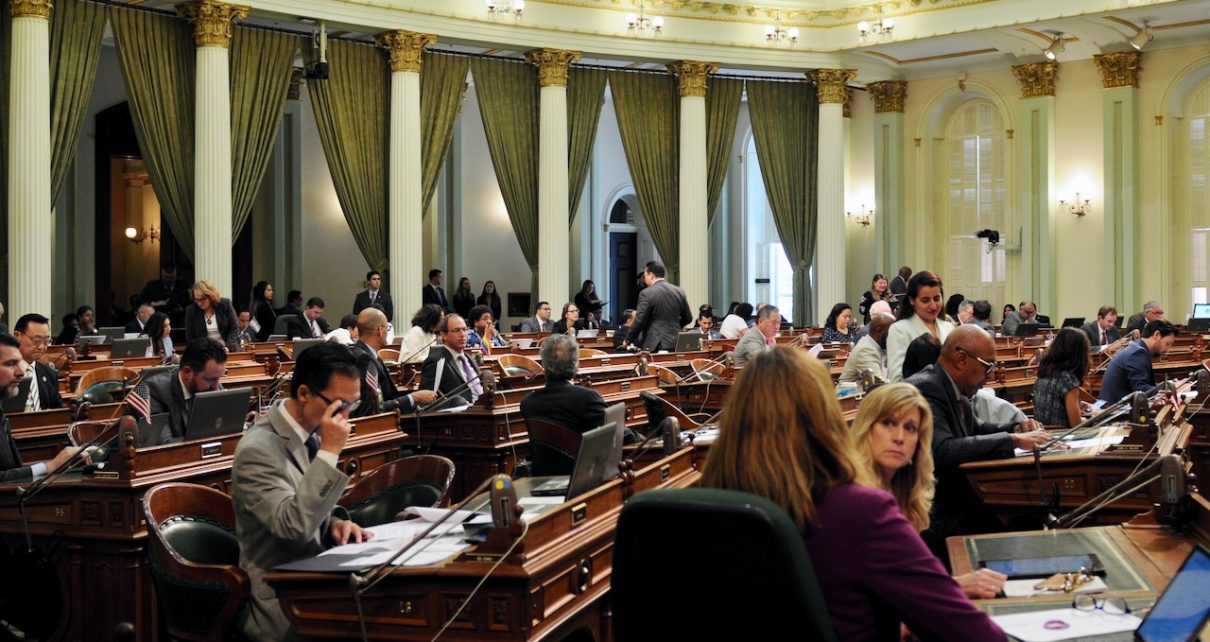
California State Assembly Chamber. (Photo: Kevin Sanders for California Globe)
California Budget’s $26 Million Thumb in the Eye to Trump on Trans ‘Healthcare’
Trans-identifying individuals make up a tiny fraction of California’s residents—well under 1 percent of adults
By J. Mitchell Sances, June 27, 2026 6:00 am
The California Legislature’s proposed budget includes a one-time $26 million General Fund allocation for a Transgender Health Care Fund. Coalition advocates, led by groups like Equality California, describe it as a modest, strategic investment to stabilize “medically necessary” care for transgender, gender-expansive, and intersex (TGI) Californians. They claim it will create a state-only Medi-Cal pathway and support providers in case federal funding faces restrictions.
A closer look shows this line item for what it is: a calculated political provocation. It serves as Sacramento’s open defiance of the Trump administration’s efforts to curb federal support for experimental interventions on minors and to protect children from irreversible medical alterations. At the same time, it diverts substantial resources to an extremely small slice of the population while shortchanging the broader LGBT community and California taxpayers who never signed up for medical tourism subsidies.This $26 million does not stand alone. California’s Medi-Cal program already covers gender-affirming procedures, including hormones and surgeries, for qualifying residents. The new fund layers on top of that existing coverage, creating a dedicated state backstop explicitly designed to neutralize any federal pushback. In practice, it guarantees that California taxpayers continue bankrolling these interventions regardless of national policy shifts.
The scale of the spending stands in stark contrast to the size of the population it targets. Trans-identifying individuals make up a tiny fraction of California’s residents—well under 1 percent of adults by most estimates. Youth identification rates have risen sharply in recent years, but even these remain a small minority, often driven by social influences and accompanied by high rates of comorbidities. Pouring millions into specialized funding for this narrow group represents a disproportionate priority in a state facing real fiscal pressures on housing, infrastructure, education, and public safety.
Within the broader LGBT funding landscape, the imbalance grows more glaring. A large share of dedicated resources already flows specifically to the “T,” even as gay and lesbian Californians formed the historical core of the movement and continue to represent the majority within the acronym. Transgender individuals also draw from general LGBT center funding and programs. With this extra $26 million allocation, the result is a clear skew: the T receives outsized, targeted support on top of shared resources, leaving gay and lesbian priorities comparatively sidelined. This is not equitable treatment within the coalition; it is dominance dressed up as inclusion.
Compounding the unfairness is California’s role as a magnet for out-of-state families. The state’s expansive laws and shield policies have made it a destination for parents from jurisdictions that have restricted these interventions on minors. Families travel to California seeking hormones, blockers, and surgeries for their children, often accessing Medi-Cal or provider networks sustained by state dollars. These families contribute nothing to California’s tax base yet benefit directly from policies funded by local residents. It amounts to subsidized medical tourism for controversial procedures that other states have chosen to limit or ban.
The Trump administration has signaled a clear intent to restrict federal involvement in these practices, particularly for minors. The rationale centers on the experimental nature of the interventions, questions about long-term evidence, high desistance rates in many cases, and the permanent physical consequences—sterility risks, bone health impacts, and lifelong medical needs. These are not minor or fully reversible adjustments. They involve the deliberate alteration of healthy developing bodies. Sacramento’s response is to double down with dedicated state funding, framing resistance as compassion while ignoring the growing body of concern from European countries that have scaled back youth access after systematic reviews.
This budget choice reveals priorities that favor ideological signaling over fiscal responsibility or child safeguarding. California already struggles with high costs of living, homelessness, and education outcomes. Allocating $26 million to create a firewall for one narrow set of procedures, while gay and lesbian Californians see their slice of the pie shrink relatively and while out-of-state families tap into the system, does not reflect prudent governance. It reflects a legislature more invested in activist demands than in protecting the vulnerable or treating all citizens fairly.
The $26 million is not modest. It is a statement. And like so many recent Sacramento moves on these issues, it places political posturing ahead of evidence, equity within communities, and the basic duty to safeguard children from hasty, life-altering decisions they cannot fully consent to.
Californians footing the bill deserve a budget that reflects reality rather than activist fantasy.


- WGA East Partners With Cloak to Keep AI Script Summaries Off the Table - October 22, 2026
- Netflix’s ‘14th’ Filmmakers Urge Americans to ‘Fight’ While Lecturing on Autocracy - October 19, 2026
- Private Initiative Steps Up While Sacramento and City Hall Stall: Caruso, Skydance, and the Bay Theater’s Return to the Palisades - October 15, 2026
RELATED ARTICLES
-

-
 November 16, 2018
 -

Josef Mengele was an avid proponent of alternitve children’s healthcare too.