

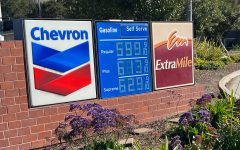
Gas prices, Sacramento, April 4, 2026. (Photo: Katy Grimes for California Globe)
Memo to Other States: Don’t Copy California on $6+ Gas
Electric vehicles, advanced biofuels, hydrogen technologies, and other emerging transportation solutions should compete and succeed on their merits
By Ray Haynes, July 6, 2026 3:00 pm
For years, California politicians have treated transportation fuels not as an economic necessity but as a problem to eliminate.
The result? Californians now pay some of the highest gasoline prices in the nation, businesses face rising transportation costs, and working families bear the burden of policies designed to force a transition away from tried-and-true fuels before affordable alternatives are ready.
Unfortunately, California’s experiment is no longer confined to California.
Across the country, states are considering adopting versions of California’s Low Carbon Fuel Standard (LCFS), often rebranded under names such as “Clean Transportation Standards” or “Clean Fuels Programs.” Legislators and regulators in states including Minnesota, New Mexico, Illinois, Michigan, New York, New Jersey, Pennsylvania, and others have explored or actively debated policies modeled after California’s approach.
Before they move forward, they should take a hard look at what has happened here.
The premise behind these programs sounds appealing. Regulators establish increasingly stringent carbon-intensity requirements for transportation fuels, rewarding favored technologies and penalizing conventional gasoline and diesel. Advocates promise reduced emissions, accelerated innovation, and a smoother transition to cleaner transportation.
What they rarely discuss is the cost.
California’s Low Carbon Fuel Standard has added billions of dollars in compliance costs throughout the fuel supply chain. Those costs do not simply disappear. They are passed on to consumers through higher prices at the pump, higher shipping costs, and ultimately higher prices for nearly all products that must be transported—which is virtually everything.
The people hit hardest are not wealthy professionals who can afford the latest electric vehicle or install charging equipment at home. The burden falls on truck drivers, tradespeople, farmers, delivery workers, commuters, and families already struggling with inflation and rising living expenses.
In Sacramento, policymakers often speak as though a rapid transition away from liquid fuels is simply a matter of political will. But reality is far more complicated.
Even California’s leaders have been forced to acknowledge the challenges. During periods of extreme heat, residents have repeatedly been urged to conserve electricity to avoid straining the grid. At the same time, state policy continues pushing millions of additional vehicles toward electrification.
That contradiction should concern policymakers elsewhere.
States in the Midwest, Northeast, and Great Lakes regions face different economic realities than coastal California. Many have larger rural populations, longer driving distances, colder winters, and economies that depend heavily on agriculture, manufacturing, construction, and freight transportation. Affordable and reliable fuel is not a luxury. It is a necessity.
Supporters often frame opposition to Low Carbon Fuel Standards as opposition to innovation. That is simply untrue.
Innovation works best when consumers have choices. Electric vehicles, advanced biofuels, hydrogen technologies, and other emerging transportation solutions should compete and succeed on their merits. But government should not artificially make existing fuels unaffordable in order to force adoption of alternatives that may not yet be practical or economical for millions of Americans.
California’s experience offers an important lesson. Grand promises about energy transitions often sound simple in legislative hearings and political speeches. In practice, the costs are real, the tradeoffs are significant, and the consequences fall most heavily on working families.
States considering California-style fuel standards should ask a simple question: If these policies have contributed to some of the highest fuel prices in America, why would anyone want to replicate them?
The goal should be cleaner transportation, not more expensive transportation.
There is a difference.
California has already shown the nation what happens when policymakers get that distinction wrong. Other states should be careful not to follow us down the same road.


- California Can Show America How to Strengthen U.S. Drug Innovation - July 27, 2026
- Memo to Other States: Don’t Copy California on $6+ Gas - July 6, 2026
- Gov. Gavin Newsom – A Tinhorn Dictatorship - July 6, 2022
RELATED ARTICLES
-
-
-
 March 15, 2022
California legislators fancy themselves as wotld leaders and believe they’re better and smarter than everyone, so they create pie-in-the-sky objectives that have no reasonable phase in period, which drives up costs in the short run…
Either that or they’re on the take from the globalist communists at the WEF, CCP or all of the above…
It was legislative Democrats who imposed these crazy fuel policies and fuel taxes that has resulted in California having the highest fuel prices in the country. Most working Californians never wanted this nonsense! The only way Newsom and legislative Democrats stay in power is through voter fraud and rigged voting machines!