
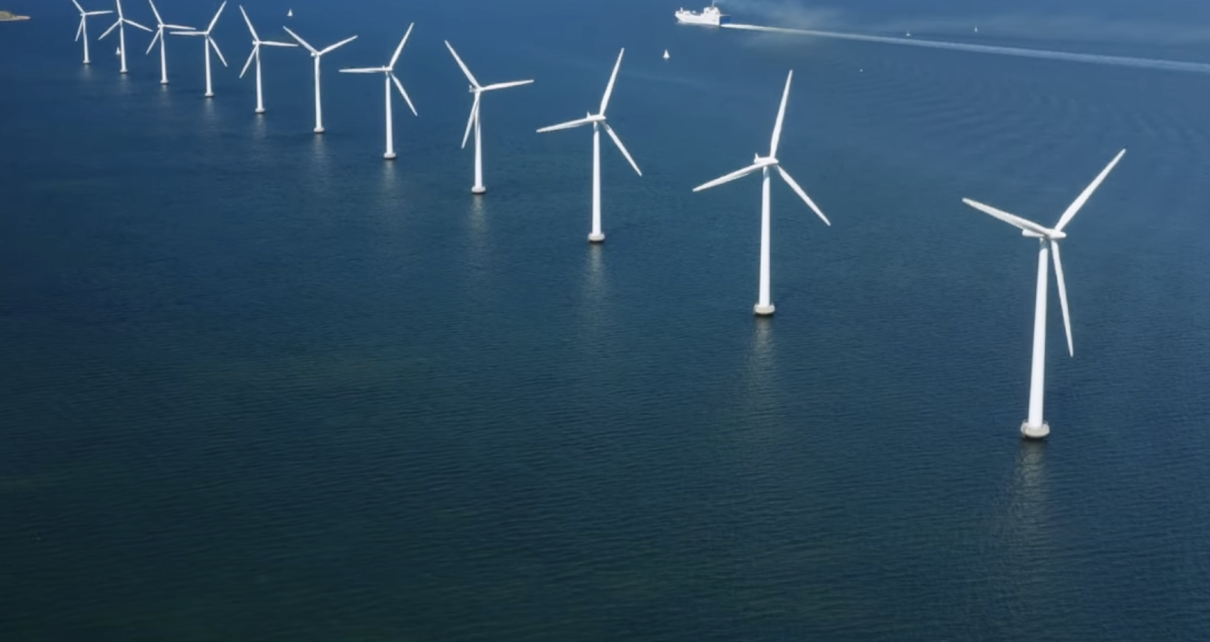
Offshore Wind farm. (Photo: Energy.ca.gov)
Bonta’s Wind Lawsuit Shows Why Congress Must Fix Permitting
Resolving projects that no longer have a realistic path forward may be necessary on a case by case basis
By John Doolittle, September 28, 2026 1:48 pm
In September, California Attorney General Rob Bonta filed his second lawsuit challenging Trump Administration agreements to unwind offshore wind leases in Morro Bay. Both lawsuits – which target the Golden State Wind and Invenergy leases – allege that the federal government unlawfully paid the developers to abandon projects California had spent millions of dollars and years of staff time preparing for. They also seek to invalidate the agreements and prevent similar settlements with California’s other offshore-wind lessees from being carried out.
I do not share Bonta’s enthusiasm for offshore wind or his tendency to pursue energy policy through litigation. I also believe his lawsuit attacks a remedy rather than addressing the underlying problem. It is widely recognized that our permitting system is too vulnerable to conflict and uncertainty and is badly in need of reform.
The federal government spent years studying the Morro Bay area before auctioning development rights in 2022. Golden State Wind spent over $120 million for the lease itself and millions conducting site surveys and environmental studies and submitted five progress reports to federal regulators. Yet the lease was not permission to build. It merely gave the company the right to pursue a project that still faced years of environmental review, permitting and transmission planning before construction could begin.
When the project could no longer advance under current federal policy, a negotiated exit became necessary. Bonta has characterized the agreement as an unlawful “buyout,” but the settlement is also narrower than Bonta’s “buyout” rhetoric suggests.
Golden State Wind is not being reimbursed for every dollar spent developing the project, nor does the agreement itself provide a profit. Under the United States Department of Interior’s published terms, only after an affiliate invests an equivalent sum in American oil and gas assets, energy infrastructure or liquefied-natural-gas projects may the company recover up to the amount originally paid to the Treasury for the lease.
Its other development costs are not reimbursed.
Nor are such agreements limited to California. Interior reached a similar agreement with Bluepoint Wind and its investor, Global Infrastructure Partners. The company must invest up to $765 million – the amount originally paid for Bluepoint’s federal lease in the New York Bight – in a domestic LNG facility before receiving reimbursement for its original bid and relinquishing the lease. The arrangement recovers a stranded lease payment while directing an equivalent amount of private capital toward a viable American energy asset.
These two projects are but two examples of a larger trend. Since March, the Trump administration had reached settlements covering a dozen offshore-wind leases and nearly $4 billion. Resolving projects that no longer have a realistic path forward may be necessary on a case by case basis. The need to negotiate agreements on this scale, however, demonstrates that the underlying system has failed.
Infrastructure finance operates on a longer timetable than politics. Power plants, pipelines, mines and transmission lines can take years to approve and then operate for decades. Investors can evaluate construction costs, market demand and technological challenges. What they cannot reasonably manage is a regulatory process that encourages long-term investment without establishing durable rules for whether a project may proceed or how investors may exit when it should be determined that it cannot proceed.
That uncertainty raises the cost of every American project: Lenders charge more to compensate for regulatory risk; developers postpone commitments; and capital moves toward countries with less regulatory friction. The result is less energy infrastructure, tighter supplies and higher costs for families and businesses.
Uncertainty also weakens America’s ability to power new factories and data centers, attract investment and reduce its dependence on foreign energy and critical minerals.
Congress has understandably focused its permitting-reform efforts to date on reducing delays. A Council on Environmental Quality review found that a full federal environmental-impact statement took 4.5 years on average, while 25 percent took more than six years.
Faster reviews are essential, but permitting is a chain rather than a single decision. Shortening one stage accomplishes little if unresolved questions at the next stage can leave a project stalled indefinitely.
Reform should therefore move beyond accelerating environmental reviews and should create a coherent process from application through construction. This process must include enforceable deadlines, clearer coordination between federal and state authorities and defined limits on judicial challenges. Congress should also establish predictable procedures for suspending or unwinding projects when development should become impossible. Fraud, serious safety violations and genuine national security threats must remain grounds for government intervention. But the broader objective should be a permitting system in which decisions are timely, responsibilities are clear and investors can reasonably rely on the government’s commitments.
The Golden State Wind settlement was a necessary response to a project that no longer had a workable path. Bonta’s lawsuit demonstrates that, under the current system, even a negotiated exit can produce another round of uncertainty and litigation. When developers cannot rely on either a path forward or a predictable way out, fewer businesses will risk investing in American infrastructure. Congress must close that gap before the next stalled project produces the next costly dispute.


- Bonta’s Wind Lawsuit Shows Why Congress Must Fix Permitting - September 28, 2026
- California Must Break Its Regulatory-Litigation Cycle - July 28, 2026
- An Economic New Year’s Resolution for California - January 2, 2025
RELATED ARTICLES
-
 February 23, 2023
 -
August 11, 2022
-
 March 28, 2024