
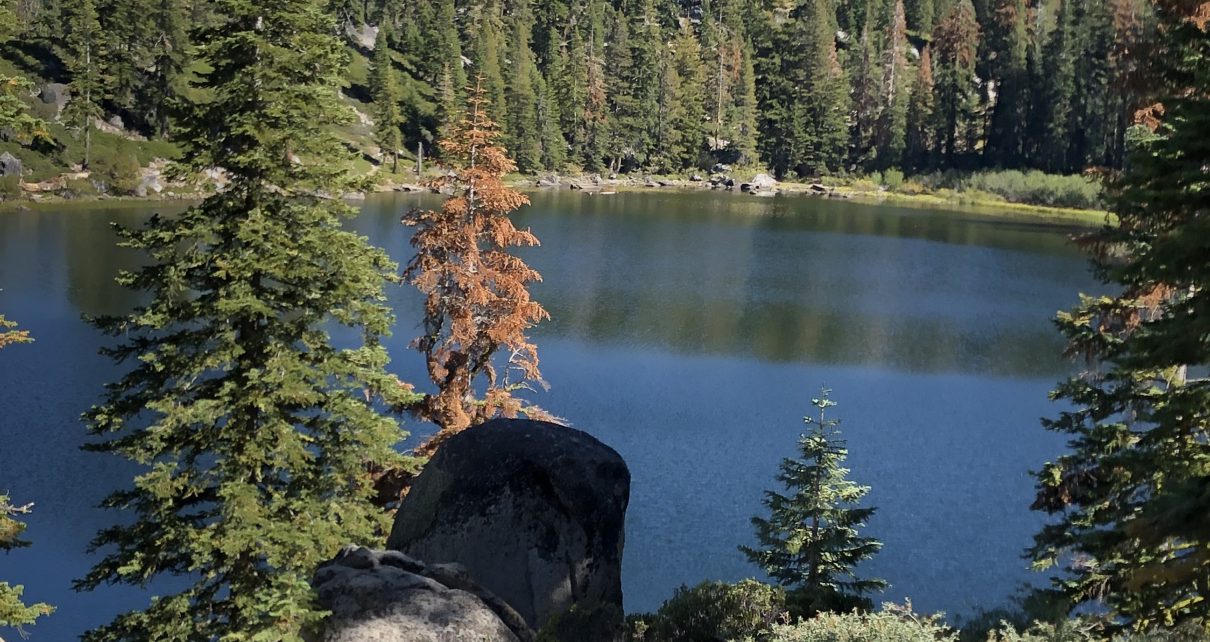
El Dorado National Forest, California. (Photo: Katy Grimes for California Globe)
Ringside: Practical Steps to Climate Resilience
California’s climate agenda is an exercise in stunning hypocrisy, driven by special interests
By Edward Ring, October 28, 2026 3:30 pm
With a mission to explore California’s energy and water future, it would be negligent to ignore California’s just released “Fifth Climate Change Assessment.” After all, climate, and its intimate cousin, carbon, are the foundations upon which every energy and water policy and project proposal in the state are evaluated.
It may be heretical to say so, but the “grim future that researchers laid out” (Politico, 10/23) may be an overstatement. Earlier this year, the California Policy Center reviewed over a century of raw station data, evaluating hundreds of thousands of individual reports by month going back to 1925 on precipitation, temperature, humidity, and snow depth. Summarized in four quarter century increments, we found the first 25 years of the 21st century exhibited no trend whatsoever for any of these variables with the exception of snow depth, which was down 9 percent compared to 20th century measurements.
These findings were in direct contradiction to reports from the authoritative U.S. Drought Monitor, which is the sort of resource that researchers producing climate assessments rely upon. But our analysis was derived using actual recorded weather station data from throughout the state.
A few years ago, we gained access to data compiled by Dr. John R. Christy, a California native with a Ph.D in Atmospheric Science who, until retiring in 2026, served as the Distinguished Professor of Atmospheric Science and Director of the Earth System Science Center at The University of Alabama in Huntsville. Christy’s research corroborates our own findings, which is that California is not experiencing rapid warming, nor is it experiencing unusually violent weather.
As for sea level rise, to the extent it is calculated on the basis of melting icecaps and glaciers, the estimates of volumetric ice cap decline are demonstrably uncertain. For example, over the past quarter century, Antarctic ice mass is officially estimated to have declined by 750 cubic miles. But the total estimated volume of Antarctic ice is 6.5 million cubic miles. It should be obvious that 750 over 6.5 million is firmly within the so-called “variability of measurement.” To a significant degree, the same uncertainty applies in the case of Greenland, as well as the world’s glaciers.
None of this is to deny that we may be experiencing some sea level rise, both from melting ice and thermal expansion. But when our media and regulatory bureaucrats characterize this as an unusual and unprecedented crisis, much less as something we can solve ourselves if we all simply drove EVs, they lose credibility.
It is slightly less heretical, but even more certain, to reiterate the fact that nothing California does on its own is going to affect global climate, even if a statewide “net zero” economy could be achieved. If California wants to set an example to the world, it will have to recognize that rapidly industrializing, demographic heavyweight nations, including China, India, Indonesia, Pakistan, Nigeria, Brazil, Bangladesh, and, collectively, dozens of others, are not about to stop using fossil fuel.
What California’s energy policies amount to is a deindustrialization agenda married to a scarcity oriented profit model. It is a policy agenda that cannot possibly be exported to nations that lack California’s wealth. And if every state and nation were to emulate California, who would manufacture batteries, photovoltaic panels, and wind turbines, or grow biofuel and renewable diesel, or mine, refine, drill, and log, etc., in order to deliver all these imported necessities to keep the lights on in our state?
California’s climate agenda is an exercise in stunning hypocrisy, driven by special interests. It results in poor investment decisions, higher prices, and absurdly misapplied priorities. It harms ordinary Californians while failing to efficiently deliver climate resiliency, which is – climate crisis or not – a compelling and legitimate objective.
When it comes to achieving climate resiliency in California, practical solutions offer additional heresy. But they would deliver jobs, prosperity, and a lower cost-of-living. To have abundant electricity, retrofit natural gas power plants to again deliver baseload power. Keep Diablo Canyon open and streamline permitting for large and small scale additional nuclear power plants. Encourage solar/battery solutions, but let them compete without subsidies, since according to their own proponents they are now our cheapest source of electricity.
Meanwhile, restore reasonable regulations to encourage in-state oil and natural gas extraction and refining, since California still acquires 75 percent of its raw energy from those two sources. Employ best practices, using everything we’ve learned, and set an example to a world that’s going to depend on these fossil fuels for many decades to come.
With respect to water policies in California, stop spending decades engaging in “process,” wasting billions on bureaucracy and litigation. Build more in-stream and off-stream reservoirs and permit more farmers to divert flood water onto their fields to recharge aquifers. Fix the aqueducts. Build large scale desalination plants and recycle 100 percent of urban wastewater; both of these major infrastructure investments would cost far less if it weren’t for bureaucracy and litigation, so fix that.
Speaking of water, restore responsible forest management. If California’s conifer forests were thinned to their historical density, they wouldn’t have superfires, and an estimated two million acre feet of additional runoff per year would flow into our rivers instead of being absorbed and transpirated by stressed, overcrowded, bone dry trees. Restore fire roads and cleared transmission line corridors to enable access for responsible logging and more effective fire fighting. The example of Shaver Lake, a 20,000 acre watershed – with species counts higher than in the hands-off acreage adjacent to it – should be a model for the whole state. As a result of controlled burns, mechanical thinning, grazing, and selective logging, this forest was completely spared despite being in the path of the Creek fire that burnt nearly 400,000 acres in 2020.
Climate resilience is a perennial imperative that should not be sold to voters by using apocalyptic visions of climate disasters. Nature has always inflicted periodic catastrophes onto human civilization. This century is no exception. Raise the levees. Allocate flood bypasses. Dredge the rivers and channels. Thin the forests. Fortify our coastal highways. Get busy.


- Ringside: Practical Steps to Climate Resilience - October 28, 2026
- Ringside: Save Our Lawns, Reform AB 1572 - October 21, 2026
- Ringside: Induced Demand is a Prerequisite for Abundance - October 14, 2026
RELATED ARTICLES
-

-
 April 11, 2022
-
 September 25, 2018