

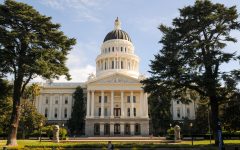
California State Capitol (Photo: Kevin Sanders for California Globe)
Comparing California and Other State Governments
All 50 states provide for a republican form of government in their individual constitutions
By Chris Micheli, October 28, 2026 4:00 pm
By Chris Micheli and Vincent Micheli
In reviewing some of the major provisions of state governments, we compiled a listing of comparisons and contrasts among the fifty states and branches of governments and processes. The following are some of the highlights of our research:
Three Readings of a Bill
Most U.S. state constitutions include a traditional requirement that bills must be read on three separate days (or undergo three readings) in each legislative chamber before final passage. About 40 states mandate three readings across their state constitutions or legislative rules. Many states allow this rule to be bypassed or suspended (including California), though doing so usually requires a supermajority vote (such as 2/3, 3/4, or 4/5 of the chamber). In practice, full text is rarely read aloud three times because it would consume too much time.
Enacting Clause
Virtually all 50 states require an enacting clause for legislation, though the exact wording and whether it is mandated by the state constitution or state statute varies. In the vast majority of states, the requirement for an enacting clause (a short introductory phrase declaring the source of legislative authority, such as “Be it enacted by…”) is explicitly written into the state constitution. In a small number of states (including California), the requirement is established by statute (e.g., the California Government Code), rather than a direct constitutional mandate.
Single Subject Rule
43 state constitutions include a single-subject requirement for legislation. 41 states (including California) apply the single-subject rule to all general legislation. 2 states (Mississippi and Arkansas) apply the single-subject rule exclusively to appropriations bills. North Carolina, New Hampshire, and several other states do not apply a general single-subject rule to all legislation in the same manner, or restrict them differently (such as New York and Wisconsin applying theirs only to private and local laws). 19 states enforce a single-subject rule specifically for statewide citizen-initiated ballot measures.
California is one of a few states that features two distinct single-subject provisions. Article IV, Section 9 restricts regular legislative statutes to “embrace but one subject”. Article II, Section 8(d) applies a separate single-subject rule to voter-enacted initiatives.
Enrolled Bill Rule
About 19 states (including California) strictly follow the enrolled bill rule as a conclusive presumption. The enrolled bill rule is a judicial doctrine holding that once a bill is properly passed by the legislature, signed by the presiding officers, and authenticated, courts treat it as conclusive evidence of proper enactment. Judges generally refuse to “look behind” the document to examine legislative journals or internal committee records for procedural errors. The doctrine is rooted in the separation of powers, preventing courts from second-guessing the internal record-keeping and governance of a coequal legislative branch. Many states (not California) follow a “journal entry” or broader inquiry rule, which allows courts to inspect official legislative journals or extrinsic evidence to verify whether mandatory constitutional procedures (such as required quorum counts or reading requirements) were actually met. Over time, some states that originally adopted a strict version (such as Kentucky and Pennsylvania) have softened or carved out exceptions for clear constitutional violations.
Signatures Required for Citizen Initiatives
While 24 states utilize an initiative process, California stands out due to its historically low signature-gathering thresholds required to qualify measures for the statewide ballot.
When a Governor Does Not Act on a Bill
50 US states allow a bill to become law without the governor’s signature if the governor fails to act on the legislation within a constitutionally specified timeframe while the legislature is in session. Each state constitution gives the governor a specific number of days (usually ranging from 3 to 60 days, depending on whether the legislature is currently in session) to sign or veto a bill. If the governor does not take action before the deadline expires, the bill automatically becomes law without a signature. In several states, if the legislature adjourns (ends its session) before the governor’s review period is over, the governor’s inaction acts as a “pocket veto,” meaning the bill dies rather than becoming law.
Republican Form of Government
All 50 states provide for a republican form of government in their individual constitutions. And all of the states are based upon the federal government with three branches: legislative, executive, and judicial.
Houses in the Legislative Branch
With one exception (Nebraska), all states are bicameral and they all have upper and lower houses of differing sizes.
Terms of Legislators
For the lower house of the Legislature, half a dozen states provide 4-year terms, while the remaining states (including California), provide 2-year terms. For the upper house, a dozen states provide 2-year terms, while the remaining states (including California), provide 4-year terms.
Legislative Terms Limits
California is one of 15 states with strict lifetime legislative term limits, capping total service to a maximum of 12 years across the Assembly and Senate. Roughly 35 states do not impose any legislative term limits.
Sizes of Legislatures
The size of the lower houses ranges from 42 to 400 members. The size of the upper houses ranges from 21 to 67 members.
Legislative Vote Requirements
About 22 states have a simple majority vote requirement for all measures. The remaining states (including California), have a hybrid system requiring both simple and super majority votes for measures that are considered.
Chief Executive
The governor is the chief executive in all 50 states.
Governor’s Term
In two states, the length of a gubernatorial term is two years. In the remaining states (including California), it is a four-year term. Roughly 16 states do not have a maximum limit on terms that a governor can serve, while the remaining states (including California), cap the number of terms to two.
Second Highest State Official
Lt. Governor takes the place of the Governor in specified circumstances. In California, the Lt. Governor is elected separately and is limited to two 4-year terms. About half a dozen states do not have a Lt. Governor, while the remaining states do.
Highest Court
All of the states have a supreme court as the highest court in their state. Most states, including California, have seven seats on the high court, with the lowest at five and the highest at nine.
Terms of Judges
Four states have lifetime appointments, while the remainder use six to fourteen-year terms, with a majority at eight years. Roughly twenty states have a mandatory retirement age for judges. About twenty states elect their high court justices, while the remainder (including California), are appointed to their office.
Line-item Veto Authority
44 states grant their governors line-item veto authority. This power typically allows the governor to strike down individual spending provisions within appropriations bills without having to reject the entire budget or spending bill.
OAL Review of Regulations
Over 200 state agencies, boards, and commissions possess quasi-legislative rulemaking power in California. Unlike many states where rules take effect directly through agency filing, California mandates that every executive branch rule be reviewed by the independent Office of Administrative Law (OAL) under six statutory standards, unless expressly exempt by statute.
Session Frequency and Length
California operates on a biennial session divided into two active working years with regular summer and winter recesses. By contrast, many states (such as Texas) hold part-time, biennial sessions that meet for up to 140 days every two years, whereas other state legislatures meet annually for just a few months.
Full-Time vs. Part-Time Legislators
California lawmakers are considered full-time professional legislators with higher salaries (around $120,000+ per year). Most other states have part-time or citizen legislatures where members receive modest pay and maintain outside employment.
Constituency Size
Because of California’s massive population paired with a compact Legislature of only 40 Senators and 80 Assembly Members, each California State Senator represents nearly 976,000 people, and each Assembly Member represents about 488,000 people, which are the largest ratios of any state in the nation. For example, New Hampshire Representatives have about 3,500 individuals a piece, while their Senators represent about 50,000 constituents.
Bill Volume and Output
California introduces thousands of bills per two-year session (~4,200 to 4,500 total), resulting in roughly 1,000 to 2,000 laws enacted per cycle. Many states have far smaller introduction caps and lower overall bill output. Around 2,000 bills are introduced every two years in the New Hampshire Legislature which has 424 legislators.
Selection of Judges
While many states use merit selection, partisan elections, or lifetime/long mandatory retirement ages, California’s blend of gubernatorial appointment with long 12-year retention cycles for appellate benches and direct county elections for trial courts is distinct.
Gubernatorial Term Limits
The California Governor can serve a maximum of two four-year terms (8 years total). While many states enforce a two-term limit, approximately 16 states place no term limits on their governors.
Highest Volume of Regulations
California ranks 1st in the nation for regulatory volume, with over 60,000 individual sections and more than 23 million words spread across 28 subject-matter titles in the California Code of Regulations (CCR). The Texas Administrative Code has nearly 20 million words and New York has about 18 million words.
Recall of State Officials
About 19 states allow voters to recall state officials. California is one of them, and its process is unusual because the recall question and the list of replacement candidates appear on the same ballot. Voters first decide whether to remove the official, and then choose a successor from the candidates listed, with the top vote-getter winning even without a majority. California recalled Governor Gray Davis in 2003, and Governor Gavin Newsom survived a recall election in 2021.
Amending the State Constitution
About 18 states allow citizens to amend their constitution by initiative, including California. The California Legislature can also place a constitutional amendment on the ballot with a two-thirds vote of each house. Unlike some states that require approval in two successive legislative sessions before a proposed amendment goes to voters, California requires only a single legislative vote. As a result, California’s constitution has been amended more than 500 times and is one of the longest state constitutions in the nation.
Vincent Micheli is a registered lobbyist and an associate at Snodgrass & Micheli, LLC.


- Comparing California and Other State Governments - October 28, 2026
- Obligations of Owners - October 28, 2026
- Ballot Measures and California Statutory Construction - October 28, 2026
RELATED ARTICLES
-
 August 19, 2025
-
 December 28, 2022
-
 July 12, 2020