
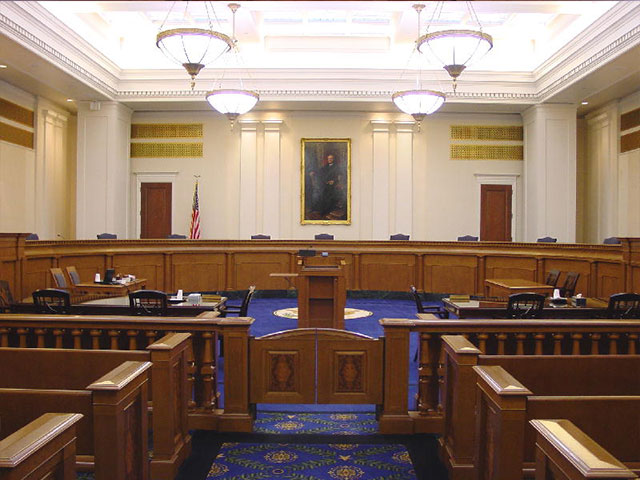
Courtroom (Photo: public domain)
What Is ‘Latent Ambiguity’ in California Law?
How do the state’s courts handle these latent ambiguities?
By Chris Micheli, October 31, 2026 11:20 am
A latent ambiguity in California law is an uncertainty or double meaning in a contract, will, or legal document, or in statutory language, that is not obvious from simply reading the text, but only appears when the terms are applied to a real world scenario.
In California statutory construction, a latent ambiguity is a hidden uncertainty that is not apparent from simply reading the statutory text, but becomes clear only when the language is applied to real-world circumstances. As defined by the California Supreme Court in Mosk v. Superior Court, a latent ambiguity exists:
“where the language employed is clear and intelligible and suggests but a single meaning, but some extrinsic evidence creates a necessity for interpretation or a choice among two or more possible meanings.”
The written words look completely clear, certain, and single-meaning when someone initially reads the statutory language. However, the ambiguity emerges only when the reader looks at the surrounding circumstances or extrinsic evidence (facts outside the text itself).
So, how do the state’s courts handle these latent ambiguities? Under California’s broad contract and probate rules (such as G.W. Thomas Drayage & Rigging Co. and California Probate Code § 21120), courts do not just look at the four corners of the document. Even if a document looks plain and clear on its face, California courts will admit relevant extrinsic evidence to see if a latent ambiguity exists.
Once a latent ambiguity is exposed, the court uses outside evidence (such as the parties’ negotiations, industry customs, or personal usage) to figure out and enforce what the parties or testator actually intended.
Unlike a strict plain-meaning approach that closes the door at the end of the text, California courts allow a provisional inquiry into extrinsic circumstances or matter to determine whether a tenable latent ambiguity actually exists.
The extrinsic evidence cannot create an ambiguity out of thin air or rewrite clear legislative commands. In other words, the underlying ambiguity must still find a foothold in how the statutory language operates. For example, in Casterson v. Superior Court, a field trip immunity statute explicitly covered school districts but omitted school district employees, creating a latent ambiguity given vicarious liability rules.
Once a latent ambiguity is established, California courts move past the literal text to determine the overarching legislative intent. They may examine legislative history, the statutory scheme or purpose, intent or declaration statements, and substantive canons.


- Guidance on California Constitution - October 31, 2026
- What Is ‘Latent Ambiguity’ in California Law? - October 31, 2026
- Guidance on California Legislative Drafting - October 31, 2026
RELATED ARTICLES
-
 May 18, 2026
-
 May 31, 2025
-
April 14, 2026