

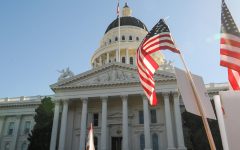
CalPERS headquarters, Sacramento. (Photo: calpers.ca.gov)
The Trustee Problem
How Board Architecture Manufactures the Pension Underfunding It Claims to Prevent
By Jay Rogers, November 8, 2026 2:14 pm
Public pension boards are built so that nobody at the table speaks for long-term solvency, and CalPERS handed us the proof this fall. On July 13 the fund reported a 14.8% return for the year ending June 30, against an assumed 6.8%, and a funded status of 85%, up from 79%. On September 15 its Finance and Administration Committee considered whether to lower that 6.8%. Staff recommended no change. One trustee moved to accept the recommendation, another seconded, and the committee approved it by voice.
Nobody in that room acted in bad faith. The transcript shows whom they answer to. Trustee Ramon Rubalcava said, “employers want stability. And I know whenever the discount rate is lowered, it increases their contribution amount.” Trustee Mullissa Willette said employers and members “depend on stability.” The chief actuary, Scott Terando, noted that most plans cluster between 6.5% and 7%, so 6.8% sits with the herd. A herd isn’t a benchmark. Willette and Kevin Palkki, who seconded the motion, were two of three trustees declared winners of their seats unopposed on May 15. No ballot went out.
I’ve spent thirty years in institutional investment management across private equity, private credit, and hedge funds. When a board tells me its assumed return is 7%, I ask what happens if it earns 5%. The answer is usually silence. A discount rate converts what a fund owes into today’s dollars. Raise it and the liability shrinks on paper without shrinking what’s owed. The Manhattan Institute’s Daniel DiSalvo put the incentive plainly in 2018: a governor’s appointee is unlikely “to push for a lower discount rate that would drive up the ARC,” the actuarially required contribution. Andonov, Bauer, and Cremers documented in the Review of Financial Studies that discounting liabilities at expected asset returns also rewards risk, since a riskier portfolio justifies a higher rate and a smaller reported debt.
The size of the gap is not in dispute. Oliver Giesecke of the Hoover Institution calculated that at the end of fiscal 2023, state and local pensions reported $1.638 trillion in unfunded liabilities and a funded ratio of 75.3%. At market-based discount rates, the shortfall was $4.582 trillion and the funded ratio 52.2%. That’s 2.8 times the reported figure, produced by the choice of rate. The Equable Institute’s State of Pensions 2026 puts the average of 253 plans at 85.0% funded with a $1.13 trillion shortfall, the best showing since 2009. A strong market lifts the reported ratio. It doesn’t audit the rate.
CalPERS knows the difference. At that same September 15 meeting, a senior actuary reported that the Terminated Agency Pool, which holds the obligations of agencies that have left the system, was 259.6% funded at June 30, 2025. Board policy sets that pool’s discount rate off 30-year Treasury STRIPS because, as he put it, “the risk of paying the benefits is all on CalPERS shoulders.” The pool is under 0.1% of the fund’s assets, so the dollars are a rounding error. The principle isn’t. When CalPERS can’t bill anyone later, it discounts like a bond manager.
Private-sector plans don’t get that choice. ERISA says its provisions “shall not apply to any employee benefit plan if… such plan is a governmental plan,” and a private fiduciary who breaches “shall be personally liable to make good to such plan any losses.” California’s constitution sets a high bar on paper: the retirement board’s duty to participants and beneficiaries “shall take precedence over any other duty.” The same section lists minimizing employer contributions among the board’s purposes, which is why nobody can say today whether holding a rate to protect employer budgets breaches it. No court has been asked. On October 6 the Supreme Court heard Anderson v. Intel, which tests what an ERISA plaintiff must plead to challenge a fiduciary’s investment choices. Whatever the Court decides, it will govern private plans only.
Ohio shows what happens when a court does get a case. In February a Franklin County judge ruled that STRS board chair Rudy Fichtenbaum and former member Wade Steen violated their fiduciary duty by acting as agents for a private investment firm in an effort to move $65 billion of the fund’s $95 billion to it, and barred both from the board. “A fiduciary may not employ a by-any-means-necessary approach,” the judge wrote. That is a documented violation with a legal finding, and it is the exception. Most structural conflicts never reach a courtroom.
Three fixes would change the incentives. Every large public fund should seat independent financial professionals, with no union affiliation, no government office, and no ties to managers under consideration, mirroring the audit-committee independence the Securities and Exchange Commission required under Sarbanes-Oxley. An independent panel of financial economists should review discount-rate assumptions. And funds should report a market-value funded ratio beside the GASB number. North Carolina’s 2025 Investment Modernization Act replaced sole treasurer control with a five-member board of finance experts chosen by the treasurer, legislative leaders, and the governor. That’s progress. It’s still appointment by the people who set the contribution.
Madison wrote in Federalist No. 51 that if men were angels, no government would be necessary. Public pension governance was built on the opposite assumption, that trustees would hold the line on discount rates against their own interests, pick managers on merit, and absorb short-term pain to protect beneficiaries decades away. The teachers, firefighters, and corrections officers whose retirements depend on these funds don’t need angels. They need a board structure that doesn’t require them. Until public trustees face the accountability we demand of the private sector, unfunded liabilities will keep compounding at whatever rate the board votes to pretend the assets will earn.


- The Trustee Problem - November 8, 2026
- A Minority With No Benefits - November 7, 2026
- Sacramento Flunks Civics Again - October 19, 2026
RELATED ARTICLES
-
 May 17, 2026
-
 October 1, 2024
-
 January 22, 2024