
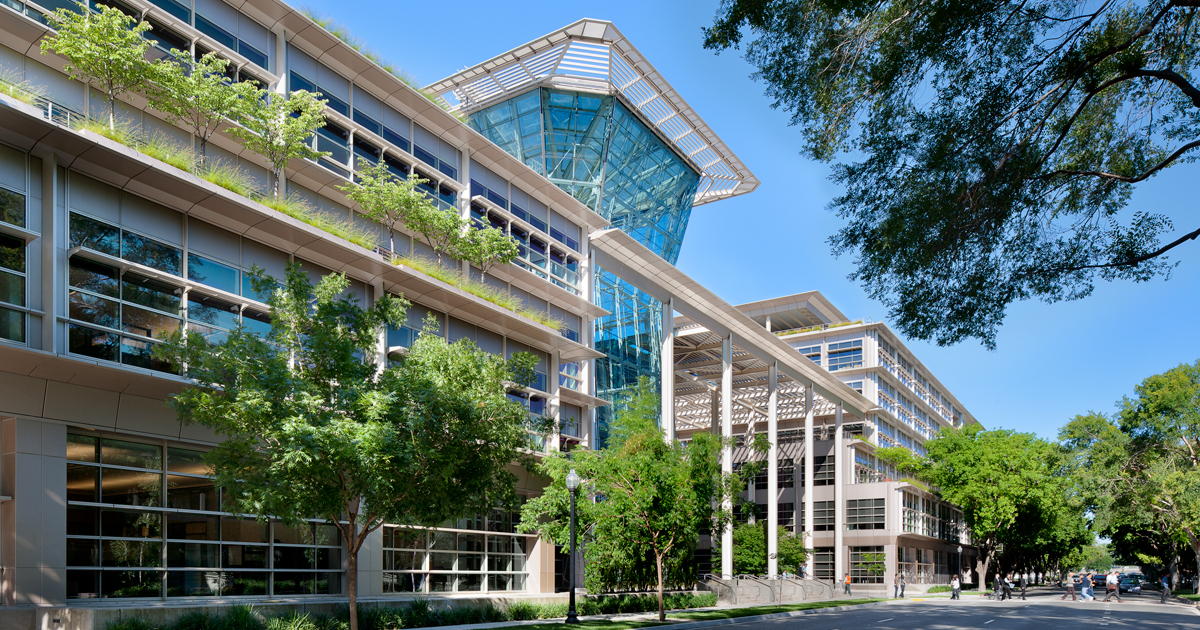
CalPERS headquarters, Sacramento. (Photo: calpers.ca.gov)
CalPERS Wants $100 Billion in Climate Bets – Taxpayers Should Ask for the Scorecard
A board that can’t measure an allocation can’t show it met a standard built on the word ‘solely’
By Jay Rogers, November 13, 2026 6:00 am
CalPERS has put $71 billion into climate investments, and its own staff says the early results on its newest private funds don’t yet tell anyone much. The nation’s largest public pension fund announced the total on Nov. 9, up $11 billion in a year, with a goal of $100 billion by 2030. The board meets Nov. 16 and 18. Before it commits more, California taxpayers and the more than 2 million members who rely on the fund should see a return measured against a benchmark the board has adopted in writing.
I’ve spent thirty years in institutional investing and sixteen running my own consulting firm. When I ask my bank for a larger credit line, the banker wants updated financials. Nobody asked my thoughts about weather patterns. The bank wanted numbers measured against something, which seems fair when the money belongs to someone else. Even the sharks on Shark Tank ask about margins before they ask about purpose. Public pension trustees hold far more than my credit line, and what they hold belongs to state workers, school employees and public agency staff.
California’s Constitution sets the test. Article XVI, Section 17 requires retirement board members to act “solely in the interest of, and for the exclusive purposes of providing benefits to, participants and their beneficiaries, minimizing employer contributions thereto,” and says that duty “shall take precedence over any other duty.” CalPERS members work for the state, schools and public agencies, so those governments are the employers, and taxpayers fund their contributions. Minimizing those contributions is a taxpayer interest written into the state Constitution.
CalPERS makes a serious case, and it deserves a fair hearing. Peter Cashion, the fund’s managing investment director of sustainable investing, said in the same announcement that physical climate risk “is likely to grow across our portfolio,” which is why the targets include investments meant to make assets, communities and supply chains more resilient. Weighing a risk that bears on returns is ordinary investment practice, and physical damage to property and supply chains qualifies. That makes the climate program a claim about risk and return, and claims about return can be checked.
The program review posted for the Nov. 16 Investment Committee offers the best test. It tracks a composite index built from environmental and clean-energy equity benchmarks against the cap-weighted index. From July 2024 through June 2026 the composite returned 65.2%, against 44.3% for the broad index. It also swung harder, with volatility of 20.2% against 13.0%, and its Sharpe ratio, which measures return per unit of risk, came in at 1.41 against 1.55. It won on raw return and lost on risk-adjusted return. The companion Climate Transition Index returned 40.0% and, according to the staff, trailed in the first half of 2026. A risk-reduction argument predicts steadier results per unit of return, and over these two years the composite delivered less return per unit of risk than the plain index. Two years can’t settle the question, but they tell the board what to watch.
Courts are reaching for the same tool. In Anderson v. Intel, argued at the Supreme Court on Oct. 6, the question is whether workers suing over underperformance must name a meaningful benchmark. The Ninth Circuit said Intel’s own composite benchmarks would have qualified. ERISA exempts governmental plans, so the case doesn’t bind CalPERS, but the lesson carries: a custom benchmark adopted in advance protects the fund as much as the member.
The private side is thinner. The same review says CalPERS has committed more than $3.3 billion to 14 climate-focused funds since 2024 and that its analysis can’t yet offer meaningful insight, because most of those investments are still marked at cost and the funds sit in the J-curve phase. Marked at cost means the books carry what CalPERS paid rather than a measured return, and the J-curve is the early stretch when fees arrive ahead of gains. Both are normal. Still, $3.3 billion is about 5% of the $71 billion (my calculation), and I couldn’t find in the review a return for the total or a breakdown showing what the rest has earned. That’s the figure to request.
CalPERS knows how to keep a ledger when it wants one. Its consultant, Wilshire Associates, estimates that the tobacco, firearms, Iran and thermal coal divestments reduced the fund’s value by about $1.475 billion since the March 2021 affirmation, or 0.23% of a fund Wilshire puts near $635.4 billion. Tobacco and Iran cost money. Firearms and coal made some back. For programs that small, the board gets dollars, program by program. The climate effort is about 11% of the fund (my calculation, $71 billion against $635.4 billion) and has nothing comparable.
Nobody has to be the bad guy for this to happen. A trustee who backs a climate target collects credit for visible commitment, and nobody loses a seat over an unmeasured private fund. Staff reports what the policy asks for. The incentives point toward deployment, so deployment is what gets reported.
The legal question is untested. No court has decided whether a pension board breaches Section 17 by scaling a mission-labeled allocation without a stated, benchmarked return, and I’m not claiming a breach. I’m saying a board that can’t measure an allocation can’t show it met a standard built on the word “solely.”
The fix is short. The board should adopt a written benchmark for the private climate funds, publish net-of-fee returns against it each year in the format Wilshire uses for divestment, and pause new commitments toward the $100 billion goal until the first report is public. Funds that clear the bar will have proof in hand. Funds that miss will have been caught while the total is $71 billion instead of $100 billion. A $100 billion target without a return benchmark tells members how much CalPERS plans to spend, and Section 17 asks whether they come out ahead.
Jay Rogers is President of Alpha Strategies and a financial professional with more than 30 years of experience in private equity, private credit, hedge funds, and wealth management. He writes about issues in finance, constitutional law, national security, human nature, and public policy.


- CalPERS Wants $100 Billion in Climate Bets – Taxpayers Should Ask for the Scorecard - November 13, 2026
- A Going-Away Gift for Death Row - November 9, 2026
- The Trustee Problem - November 8, 2026
RELATED ARTICLES
-
 April 11, 2022
-
 September 25, 2018
-
 October 18, 2024