

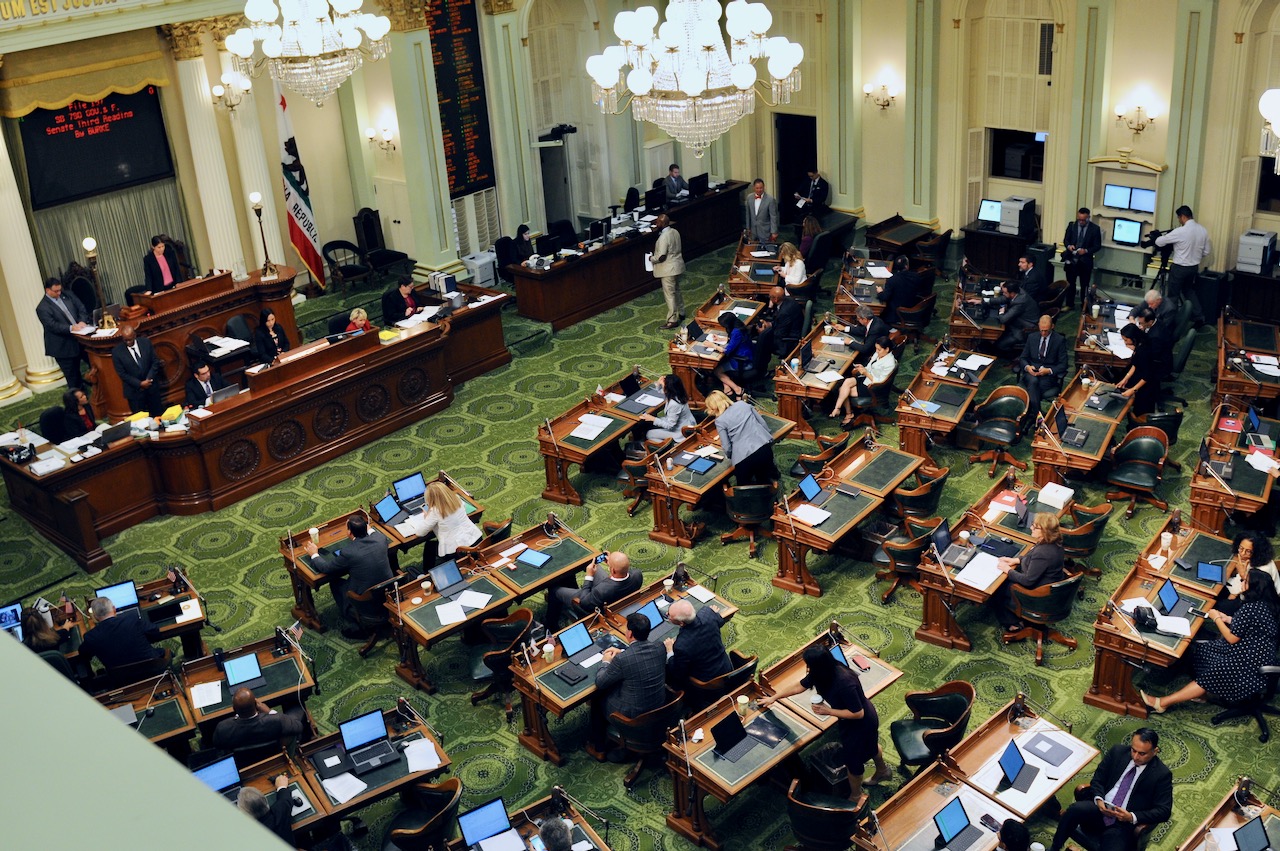
California State Capitol. (Photo: Katy Grimes for California Globe)
Exploring Grammatical and Punctuation Canons
Budget trailer bills, and last-minute ‘gut-and-amend’ maneuvers, statutes are assembled like patchwork quilts by competing lobbyists, committee consultants, and legislative counsel
By Chris Micheli, November 20, 2026 2:00 pm
Grammatical and punctuation canons of statutory construction in California operate on a core fiction. They assume a single, unhurried author drafted a statutory sentence with surgical precision. However, in California’s legislative reality, especially during end-of-session omnibus bills, budget trailer bills, and last-minute “gut-and-amend” maneuvers, statutes are assembled like patchwork quilts by competing lobbyists, committee consultants, and legislative counsel under intense time pressure.
When a floor amendment splices a new noun or modifier into an existing list right before Proposition 54’s 72-hour print deadline, two competing canons collide: First, the Rule of the Last Antecedent, which states that qualifying words or phrases modify only the immediately preceding word or phrase, unless separated by a comma; and, the Series-Qualifier Canon, which is when a straightforward, parallel list of nouns or verbs is followed by a trailing modifier, that modifier applies to the entire series.
Because rushed floor drafters rarely recalibrate punctuation when inserting late compromises, these two rules routinely produce opposite legal outcomes. Here are two interesting recent examples:
The Warehouse Siting Compromise: AB 98 (2024) & SB 415 (2025)
In the final five days of the 2024 Legislative Session, lawmakers executed a sweeping gut-and-amend of AB 98 to impose strict statewide design, setback, and truck-routing mandates on warehouse developments. Because the language was negotiated behind closed doors and rushed into print, its hastily grafted lists immediately triggered modifier disputes across California cities.
AB 98 imposed strict zero-emission small off-road engine mandates on “logistics use developments within 900 feet of a sensitive receptor that either are 250,000 square feet or larger; or require a zone change…” Similarly, its definition of “logistics use” and its sensitive-receptor lists combined multiple facility types and spatial qualifiers in dense, hurriedly amended clauses.
How did the canons collide? Developers and municipalities clashed over whether spatial and size thresholds modified only the final item in a compound clause (Last Antecedent) or carried backward across every listed facility type and expansion scenario (Series-Qualifier). Furthermore, AB 98 defined “sensitive receptors” using a series of facilities—schools, homes, daycares, nursing homes, hospitals, and parks—followed by property-line setback rules, leaving local planners uncertain whether ancillary facilities or mixed-use manufacturing sites triggered the entire chain of restrictions.
Rather than wait for years of appellate litigation, the Legislature had to pass a dedicated cleanup bill in 2025 (SB 415) specifically to break apart AB 98’s run-on lists, separate manufacturing from warehousing, and clarify which qualifiers applied to which developments.
The CEQA Budget Trailer Rush: AB 130 & SB 131 (2025)
In June 2025, the Legislature used the budget trailer bill process, which bypasses standard policy-committee vetting and takes effect immediately, to pass AB 130 and SB 131, a massive California Environmental Quality Act (CEQA) overhaul. Both bills were negotiated in a late-June sprint and remained in print for less than a week before enactment.
To secure last-minute votes, drafters bolted complex procedural carve-outs and timelines onto existing CEQA and Housing Accountability Act (HAA) cross-references. In AB 130’s infill exemption “shot clock” and SB 131’s “near miss” provisions, trailing clauses governing tribal consultation and consistency determinations were appended to multi-part statutory triggers.
How did the canons collide? Under a strict Last Antecedent reading, a trailing procedural deadline or environmental exclusion attached only to the final statutory condition in the sentence. Under the Series-Qualifier Canon, the same trailing phrase modified the entire sequence of agency determinations—creating immediate confusion over whether local agencies had 30 days from tribal consultation alone or 30 days from the later of multiple statutory milestones.
Within three months of enactment, lawmakers were forced to pass SB 158 (2025) as an emergency “technical clean-up” trailer bill to untangle the sequence of modifiers and explicitly rewrite the shot-clock triggers.
When the Legislature does not pass a cleanup bill, California courts must referee the wreckage. Recent California appellate and Supreme Court decisions highlight how unreliable punctuation rules become when applied to heavily amended text. Here are two recent examples:
Yahoo Inc. v. National Union Fire Ins. Co. (2022) 14 Cal.5th 58
Examining the phrase “oral or written publication, in any manner, of material that violates a person’s right of privacy,” the California Supreme Court rejected a mechanical application of the Last Antecedent Rule. The lower federal court had used the canon to rule that “that violates a person’s right of privacy” modified only the immediately preceding noun (“material”), rather than the broader phrase (“publication… of material”). The Supreme Court reversed, holding that the rule is not an inflexible command and that basic syntax allowed the modifier to apply to the broader series/phrase.
Assn. for L.A. Deputy Sheriffs v. County of L.A. (2023) 94 Cal.App.5th 764
Interpreting statutory language governing “civil actions and proceedings,” the Court of Appeal invoked the Series-Qualifier Canon over the Last Antecedent Rule. The court noted that restricting the prepositive adjective “civil” only to the nearest noun (“actions”) while leaving “proceedings” unmodified would create an anomalous result that contradicted the statute’s broader structure.


- Exploring Grammatical and Punctuation Canons - November 20, 2026
- Mechanics of Budget Bills Junior - November 20, 2026
- Workers Comp Medical Issues - November 20, 2026
RELATED ARTICLES
-
 November 11, 2026
-
 November 18, 2026
-
 May 17, 2026