
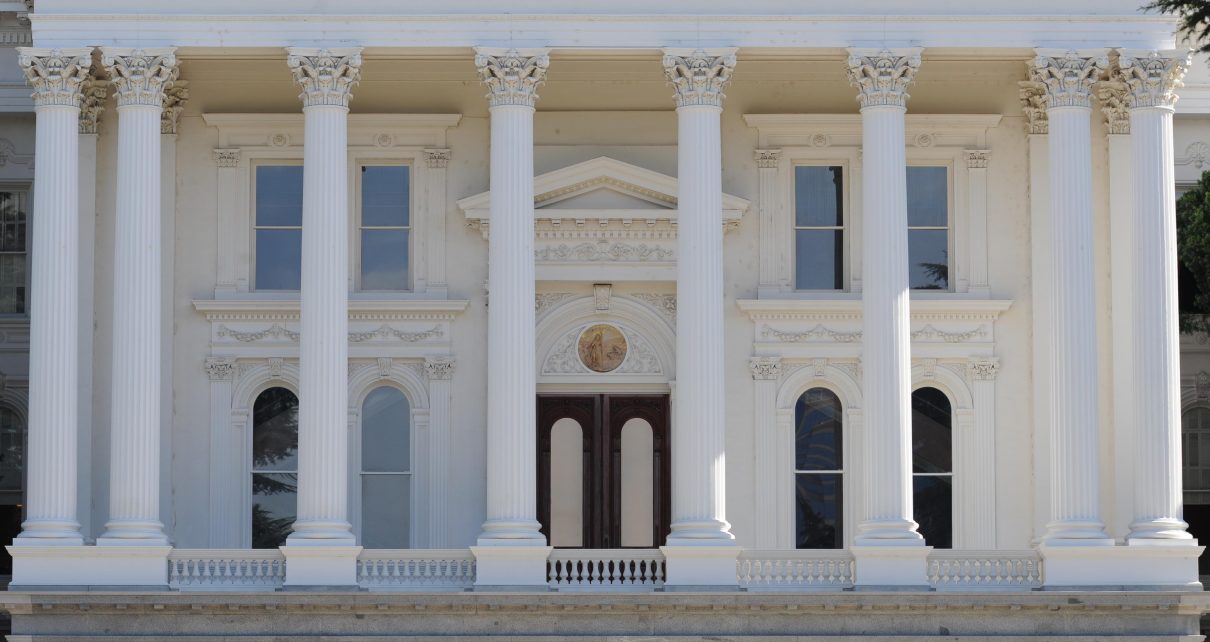
California State Capitol. (Photo: Kevin Sanders for California Globe)
General Principles of Nuisance
Contains the general principles of nuisance in this state
By Chris Micheli, October 17, 2026 2:00 pm
Title 1 of Part 3 of Division 4 of the Civil Code contains the general principles of nuisance in this state.
Section 3479 provides that anything which is injurious to health, including the illegal sale of controlled substances, or is indecent or offensive to the senses, or an obstruction to the free use of property, so as to interfere with the comfortable enjoyment of life or property, or unlawfully obstructs the free passage or use, in the customary manner, of any navigable lake, or river, bay, stream, canal, or basin, or any public park, square, street, or highway, is a nuisance.
Section 3480 explains that a public nuisance is one which affects at the same time an entire community or neighborhood, or any considerable number of persons, although the extent of the annoyance or damage inflicted upon individuals may be unequal.
Section 3481 says that every nuisance not included in the definition of the last section is private.
Section 3482 explains that nothing which is done or maintained under the express authority of a statute can be deemed a nuisance.
Section 3482.1 defines the following terms: “person,” “sport shooting range,” “range,” “indoor shooting range,” and “nighttime.”
A person who operates or uses a sport shooting range in this state is not subject to civil liability or criminal prosecution in any matter relating to noise or noise pollution resulting from the operation or use of the range if the range is in compliance with any noise control laws or ordinances that applied to the range and its operation at the time construction or operation of the range was approved by a local public entity having jurisdiction in the matter, or if there were no such laws or ordinances that applied to the range and its operation at that time.
A person who operates or uses a sport shooting range or law enforcement training range is not subject to an action for nuisance, and a court may not enjoin the use or operation of a range, on the basis of noise or noise pollution if the range is in compliance with any noise control laws or ordinances that applied to the range and its operation at the time construction or operation of the range was approved by a local public entity having jurisdiction in the matter, or if there were no such laws or ordinances that applied to the range and its operation at that time.
Except as otherwise provided in this section, this section does not prohibit a local public entity having jurisdiction in the matter from regulating the location and construction of a sport shooting range after the effective date of this section.
Section 3482.5 provides that no agricultural activity, operation, or facility, or appurtenances thereof, conducted or maintained for commercial purposes, and in a manner consistent with proper and accepted customs and standards, as established and followed by similar agricultural operations in the same locality, is or will become a nuisance, private or public, due to any changed condition in or about the locality, after it has been in operation for more than three years if it was not a nuisance at the time it began. The term “agricultural activity, operation, or facility, or appurtenances thereof” is defined.
Section 3482.6 specifies that no agricultural processing activity, operation, facility, or appurtenances, conducted or maintained for commercial purposes, and in a manner consistent with proper and accepted customs and standards, is or will become a nuisance, private or public, due to any changed condition in or about the locality, after it has been in continuous operation for more than three years if it was not a nuisance at the time it began. The terms “agricultural processing activity, operation, facility, or appurtenances thereof,” “continuous operation,” and “proper and accepted customs and standards” are defined.
Section 3482.8 states that any building or property used for the purpose of willfully conducting dogfighting or cockfighting is a public nuisance.
Section 3483 says that every successive owner of property who neglects to abate a continuing nuisance upon, or in the use of, the property, created by a former owner, is liable therefor in the same manner as the one who first created it.
Section 3484 states that the abatement of a nuisance does not prejudice the right of any person to recover damages for its past existence.
Section 3486 explains that, in order to abate the nuisance caused by illegal conduct involving a controlled substance purpose on real property, the city prosecutor or city attorney may file an action for unlawful detainer against any person who is in violation of the nuisance or illegal purpose provisions of the Code of Civil Procedure, with respect to that controlled substance purpose.
Prior to filing an action pursuant to this section, the city prosecutor or city attorney is required to give 30 calendar days’ written notice to the owner, requiring the owner to file an action for the removal of the person who is in violation of the nuisance or illegal purpose provisions with respect to a controlled substance purpose. This notice must include sufficient documentation establishing a violation of the nuisance or illegal purpose provisions of law. The notice is required to contain the specified language.
The owner is required, within 30 calendar days of the mailing of the written notice, to either provide the city prosecutor or city attorney with all relevant information pertaining to the unlawful detainer case, or provide a written explanation setting forth any safety-related reasons for noncompliance, and an assignment to the city prosecutor or city attorney of the right to bring an unlawful detainer action against the tenant.
Upon the failure of the owner to file an action pursuant to this section, or to respond to the city prosecutor or city attorney, or having filed an action, if the owner fails to prosecute it diligently and in good faith, the city prosecutor or city attorney may file and prosecute the action, and join the owner as a defendant in the action. This action shall have precedence over any similar proceeding thereafter brought by the owner, or to one previously brought by the owner and not prosecuted diligently and in good faith.
In any proceeding brought under this section, the court may, upon a showing of good cause, issue a partial eviction ordering the removal of any person, including members of the tenant’s household if the court finds that the person has engaged in the activities described. Persons removed pursuant to this section may be permanently barred from returning to or reentering any portion of the entire premises.
The court may further order as an express condition of the tenancy that the remaining tenants cannot give permission to or invite any person who has been removed pursuant to this subdivision to return to or reenter any portion of the entire premises. The term “controlled substance purpose” is defined.
In an unlawful detainer action filed pursuant to this section, the court is required to make one of the three specified orders. This section applies only in the County of Los Angeles to a court having jurisdiction over unlawful detainer cases involving real property situated in the City of Los Angeles.


- General Principles of Nuisance - October 17, 2026
- Guidance on California Judicial Branch - October 17, 2026
- Sales Tax Presumptions - October 17, 2026
RELATED ARTICLES
-
 May 17, 2026
 -
 August 22, 2024
 -
 April 1, 2025