
Louisiana v. Callais, redistricting case.
US Supreme Court Issues Huge Ruling On Voting Rights Act; Et Tu California?
What about California’s racial gerrymander with Supreme Court declaring Louisiana congressional map an ‘unconstitutional racial gerrymander?’
By Katy Grimes, April 29, 2026 8:49 am
The United States Supreme Court just ruled Wednesday that drawing Congressional districts based on race under the Voting Rights Act is unconstitutional, 6-3.
The Reader’s Digest condensed version: Democrats can no longer rig maps based on race.
“Section 2 of the Voting Rights Act of 1965, 52 U. S. C. §10301 et seq., was designed to enforce the Constitution—not collide with it. Unfortunately, lower courts have sometimes applied this Court’s §2 precedents in a way that forces States to engage in the very race-based discrimination that the Constitution forbids,” Justice Samuel Alito wrote in the majority opinion, joined by Justices Kavanaugh, Thomas, Roberts, Barrett and Gorsuch.
Justices Kagan, Sotomayor, and Jackson dissented.
While the Court did not strike down Section 2 of the Voting Rights Act entirely, it specified that drawing districts solely based on race is unconstitutional.
🚨 In a 6-3 vote, the Supreme Court strikes down Louisiana's new congressional map that added a second majority-black district, holding that it constitutes a racial gerrymander.
The Court narrows its previous interpretation of the Voting Rights Act. pic.twitter.com/rqy3POxauJ
— SCOTUS Wire (@scotus_wire) April 29, 2026
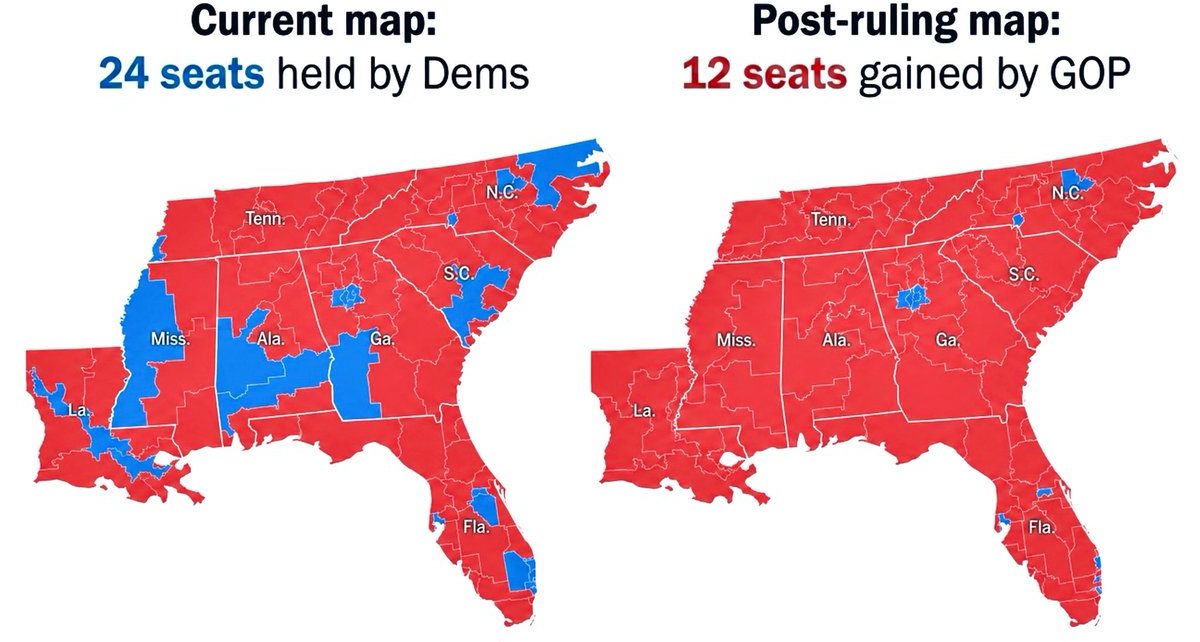
Without racial gerrymandering in the southern states, Republicans could gain at least a dozen seats.
Republicans can gain 12 seats in the House with the new Supreme Court ruling against racially-based maps
Time to get moving, fast pic.twitter.com/C3maxSAiLp
— End Wokeness (@EndWokeness) April 29, 2026
“The Court dealt a blow to a key provision of the Voting Rights Act of 1965, siding with Louisiana Republicans and President Donald Trump’s administration by blocking an electoral map that created a second majority-Black congressional district,” the Daily Caller reported.
Louisiana v. Callais was centered on whether Louisiana’s 2024 congressional map, which had added a second majority-Black district, amounted to an unconstitutional racial gerrymander.
“Section 2 of the Voting Rights Act of 1965, 52 U. S. C. §10301 et seq., was designed to enforce the Constitution—not collide with it.
Louisiana must not only redraw its congressional map, this decision could lead to racially drawn districts in all states being thrown out.
What does this mean for California’s mid-decade racial redistricting scheme?
In an effort to influence the 2026 midterm elections, California Governor Gavin Newsom and Attorney General Rob Bonta announced their intentions to blow up California’s independent redistricting commission, effectively tampering with the state’s electoral maps mid-decade… because TRUMP.
In August, California’s legislative Democrats kicked the voter approved independent California Citizens Redistricting Commission to the curb for the next few elections, when they introduced their package of three bills, SB 280, AB 604, and ACA 8, to redraw California’s congressional districts mid-decade, described in detail by California Globe contributor Chris Micheli here, the Globe reported.
The maps were drawn by the Democratic Congressional Campaign Committee (DCCC), “which is not even a registered lobbyist,” Assemblyman Carl DeMaio noted. “How much money was paid to Paul Mitchell, who boasted that he had a team of eight people” working with him. Mitchell is drawing the new districts for the governor, the Globe reported.
In January, Attorney Mark Meuser filed an emergency application with the U.S. Supreme Court to temporarily block California’s redistricting scheme while his state appeal played out. He explained:
The Constitution is clear: states may not sort voters into districts based on race. Yet the record in this case contains unusually direct evidence that race was used in drawing multiple districts. The mapmaker who drew the map publicly stated that districts were designed to “bolster” Latino voting strength and to hit specific racial targets. Legislators echoed those goals, and internal materials presented race as a factor in drawing lines.
Our Emergency Application explains why that approach cannot be squared with decades of Supreme Court precedent. Constitutional violations do not become lawful simply because they are put to a popular vote. We also explain why California cannot satisfy strict scrutiny even if race was used. The State made no showing that these race-based districts were required by the Voting Rights Act. In fact, the evidence shows that minority-preferred candidates routinely win in California and that no racial bloc voting exists that would justify sorting voters by race. Timing is critical. Candidate filing for the 2026 elections begins on February 9th. Once candidates and voters are forced to operate under unconstitutional districts, the harm cannot be undone. That is why we are seeking narrow, temporary relief now, to preserve the status quo while the appeal proceeds.
Next up: US Supreme Court Ruling Puts an End to Democrats Rigging Maps Based on Race
This is a breaking news story. Please check back for updates.

A California native and Navy mom, Katy lives in Sacramento, CA.
- Xavier Becerra Backs Out of Another Debate with Steve Hilton - October 13, 2026
- El Cajon Mayor Bill Wells’ DSA Opponent Scrubs DSA Website of Endorsement - October 12, 2026
- ‘DEI Bike Lanes’ – Sacramento City Council Inflates Bicycling Numbers for Federal Taxpayer Grants - October 12, 2026
RELATED ARTICLES
-
 December 20, 2022
 -
 July 10, 2020
 -
 November 16, 2018
Seems pretty common sense. “…it specified that drawing districts solely based on race is unconstitutional…”
Let’s hope! It’s pretty clear-cut, but we do know CA and its lawlessness, don’t we.
Fingers crossed.
Question: “But Governor Brown (and by extension, any member of the single party that is currently running California) – Don’t you know the bill you just signed into law is unconstitutional?”
Reply – “So sue me.”
No kidding, Ted.
But we’ll see what happens.
Hopeful but not confident we will get change in California.
It will be interesting to see how this directly affects California.