

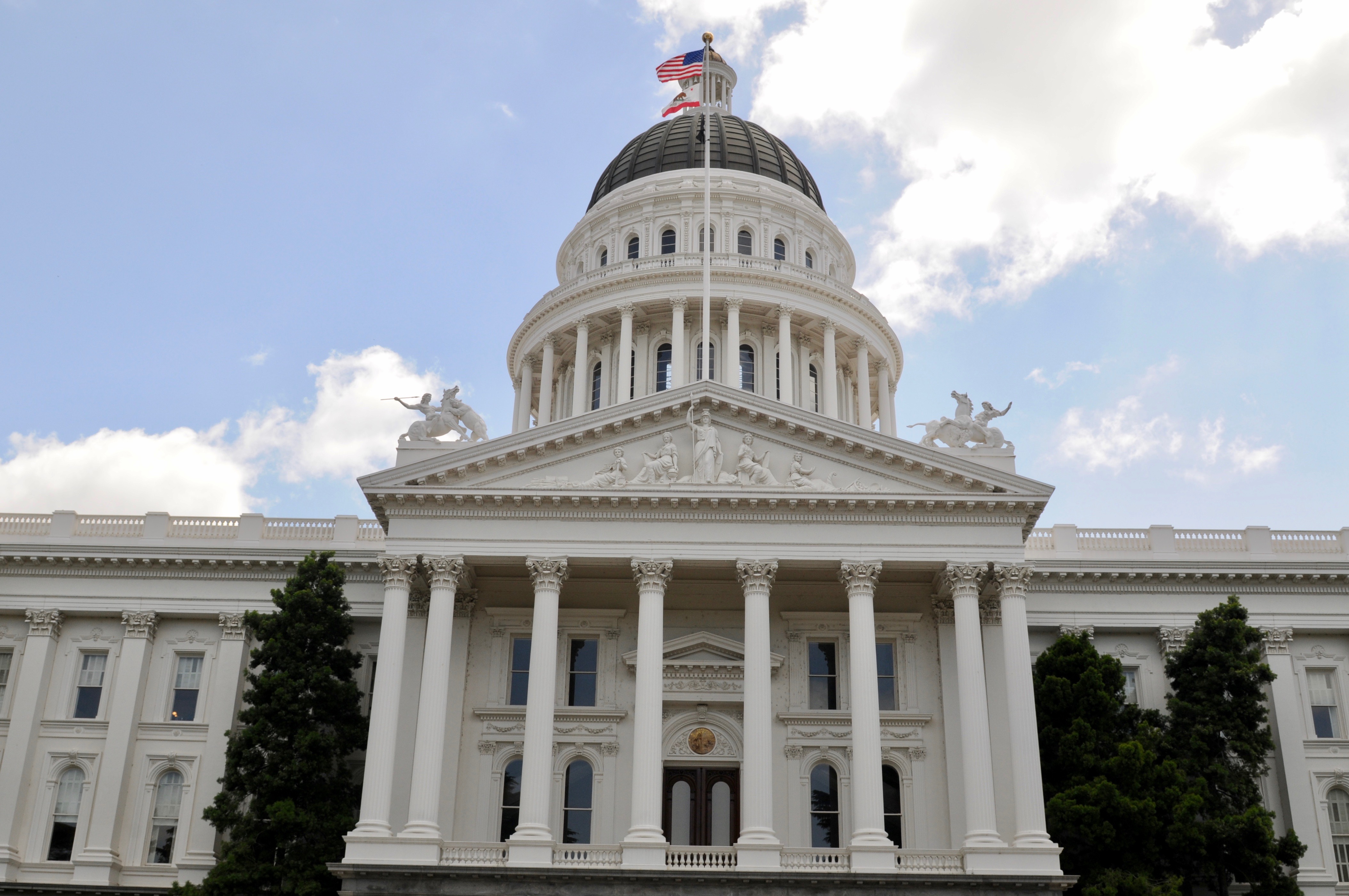
California State Capitol. (Photo: Katy Grimes for California Globe)
What Happens When a California Statute Has Grammatical Ambiguity?
There are a number of California appellate court decisions addressing these types of statutory issues
By Chris Micheli, November 16, 2026 2:00 pm
When the California Legislature misses a comma or misplaces a modifier, courts apply textual and linguistic canons to determine whether the syntax alters the legal requirement. There are a number of California appellate court decisions addressing these types of statutory issues.
For example, in White v. County of Sacramento (1982) 31 Cal.3d 676, the court had to interpret a section of the Public Safety Officers Procedural Bill of Rights Act (Gov. Code, § 3303), which defined punitive action as “any action which may lead to dismissal, demotion, suspension, reduction in salary, written reprimand, or transfer for purposes of punishment.” The county argued that a reassignment/demotion was not punitive unless it was explicitly “for purposes of punishment,” applying that qualifying phrase to the entire list.
The California Supreme Court invoked the Rule of the Last Antecedent, which dictates that a qualifying phrase applies only to the word or phrase immediately preceding it. However, the court emphasized a vital punctuation corollary: the presence or absence of a comma. Because there was no comma before the phrase “or transfer for purposes of punishment,” the qualifying phrase applied only to transfers. If the legislature had intended the qualification to apply to the whole list, it would have inserted a comma before the coordinating conjunction.
When drafting lists, always use structural punctuation intentionally. If a qualifying phrase applies to the entire series, separate it with a comma (e.g., “A, B, or C, subject to condition X”). If it applies only to the last item, omit the comma before the modifier.
In the case of Renee J. v. Superior Court (2001) 26 Cal.4th 735, the Welfare & Institutions Code statute allowed the court to bypass reunification services if parental rights to a sibling had been permanently severed, “unless the parent… has subsequently made a reasonable effort to treat the problems that led to removal of the sibling.” The ambiguity was whether “subsequently” meant subsequent to the removal or subsequent to the permanent severance of rights.
While a strict grammatical reading suggested “subsequently” modified the immediate clause of removal, the California Supreme Court ruled that grammatical rules must yield to prevent a statute from becoming self-defeating or absurd. The court looked to the broader statutory scheme and harmonized the timeline to mean subsequent to the severance, preventing a loophole where a parent could claim credit for ancient, failed treatment efforts.
Relying purely on adverbs like “subsequently” or “thereafter” without a clear anchor date creates hazardous ambiguity. Specify precise chronological markers (e.g., “subsequent to the date of the final order of termination”).
The following chart sets forth several cases and the nature of the grammatical issue and how the judiciary resolved the matter:
| Case Name & Citation | Nature of Structural / Integration Issue | Judicial Resolution / Construction Method | Practice Takeaway for Drafters |
| Save Lafayette Trees v. City of Lafayette (2018) 30 Cal.App.5th 657 |
Conflicting Statutes of Limitations: Gov. Code § 65009 sets a 90-day window to challenge local zoning, while CEQA (Pub. Res. Code § 21167) allows different timelines. A local land-use decision triggered both simultaneously. | Specific-Governs-General (Lex Specialis): The court held that CEQA’s specific environmental timeline controlled over the general municipal planning statute. | Explicitly clarify whether specialized administrative timelines defer to or override general procedural defaults. |
| People v. Coronado (1995) 12 Cal.4th 145 |
Uncoordinated Sentence Enhancements: Overlapping language across separate Penal Code amendments created ambiguity about whether a single prior conviction could trigger multiple stacked enhancements. | Absurdity Doctrine: The Supreme Court departed from a literal text interpretation, noting that uncoordinated code integration cannot be read to produce irrational disparities. | When amending specialized codes, include express anti-duplication or non-cumulation language to govern overlapping categories. |
| Halbert’s Lumber, Inc. v. Lucky Stores, Inc. (1992) 6 Cal.App.4th 1233 |
Defective Cross-References: Mechanics’ lien statutes cross-referenced specific code subsections that had been renumbered and repealed in previous sessions. | Statutory Evolution & Legislative Digests: The court bypassed the broken text entirely, reconstructing the legislature’s intent via continuous statutory history and committee records. | Avoid hardcoding static subdivision letters or numbers if concurrent legislation is moving through the state assembly. |
The following is a checklist for drafting:
- Examine whether a critical modifier is separated by an Oxford comma or a trailing comma to trigger or defeat the Last Antecedent Rule.
- If two bills amended the same statute in the same year, verify which bill was signed last by the Governor. Under California law, the later bill “chapters out” (supersedes) the earlier one unless a specific cross-reconciliation clause is present.
- If cross-references are broken, utilize the uncodified portion of the bill and the official Legislative Counsel summary to establish the intended framework.
- Do not place modifiers at the end of a long list of nouns unless you explicitly intend for them to apply to every item.
- Avoid terms like “the same,” “said,” or “such” when referencing previously listed entities. Instead, repeat the specific noun or define it clearly.


- What Happens When a California Statute Has Grammatical Ambiguity? - November 16, 2026
- Petitions for California Rulemaking: An Underutilized Tool for Regulatory Change - November 16, 2026
- Textualism v. Purposivism in California Courts - November 16, 2026
RELATED ARTICLES
-
 October 29, 2026
-
 June 28, 2024
-
 October 31, 2026