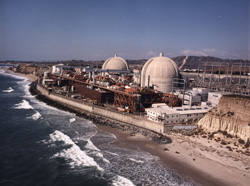
San Onofre nuclear power plant. (Photo: Wikipedia/Songscommunity.com)
When the Lights Dim: Electricity Prices, Nuclear Reality, and the Price of Delay
California would still have a plant that produced 8% of its power… that road was open but policy closed it
By Jay Rogers, November 16, 2026 1:00 pm
I live a few miles from the San Onofre Nuclear Generating Station. For years the twin domes stood beside the freeway while I coached youth sports, served on local boards, and managed capital for families who work hard for what they have. A small steam generator leak shut Unit 3 on January 31, 2012, and Edison retired both units in June 2013. Nobody was hurt. The bill arrived later.
Economists Lucas Davis and Catherine Hausman tallied it. SONGS had supplied about 8% of California’s electricity, and Hausman reports that generating costs rose by $350 million in 2012 as gas plants filled the hole. Carbon emissions climbed by 9 million tons in the first twelve months. The plant also sat between Los Angeles and San Diego, so its loss squeezed transmission and kept cheaper power from reaching Southern California. I’m no engineer, but I know a bad trade when I see one.
Now demand is climbing. U.S. consumption set a record of 4,195 billion kilowatt-hours in 2025, and the Energy Information Administration expects new records in 2026 and 2027, led by data centers. Supply can’t answer that fast. PJM’s July auction for 2028/29 cleared at its $325 per megawatt-day cap and landed 6,831 MW short of its reliability requirement, a 14.7% reserve margin against a 20% target. Without the cap, the price would have topped $550. Thomas Sowell wrote that “The first lesson of economics is scarcity.” Households read that lesson on their bills. The national residential price averaged 18.16 cents per kilowatt-hour in August, up 3.4% from a year earlier, and California paid 29.75 cents, about 64% more. Nuclear doesn’t explain all of it. California’s Legislative Analyst points to wildfire costs and state climate programs, and I’d rather give those their due than pretend one fix covers everything.
Nuclear Power in Plain Numbers
The numbers favor nuclear. The IPCC puts its median lifecycle emissions near 12 grams of CO2-equivalent per kilowatt-hour, roughly level with onshore wind and far below solar PV or any fossil source. Our World in Data calculates about 0.03 deaths per terawatt-hour for nuclear, against 24.6 for coal and 18.4 for oil. The U.S. fleet ran at a 91% capacity factor in 2025, higher than any other plant type. The industry’s trade group says a 1,000-megawatt reactor needs about 1.3 square miles.
Newer designs push further. The Department of Energy says TRISO fuel particles can’t melt in a high-temperature reactor under design-basis conditions, and the NRC’s 2023 rule lets small and advanced reactors scale their emergency planning zones to the consequences of an accident instead of a fixed 10-mile radius. Regulators still argue over how small those zones should shrink, and they should.
Who Says No, and Why It Matters
The opposition is organized and open about it. The Sierra Club’s policy calls fission “a uniquely dangerous energy technology”, and Greenpeace, as NPR reported, never softened its opposition. Hollywood helped. The China Syndrome opened on March 16, 1979, twelve days before Three Mile Island, and the two fused in the public mind. No one was hurt at Three Mile Island, yet the fear outlived the facts, and the country went decades without building a new reactor.
Skeptics land a fair punch on cost. Vogtle Units 3 and 4 arrived seven years late and $17 billion over budget. Anyone who has priced a first-of-a-kind deal knows how that goes, and Georgia customers are on the hook for $7.56 billion of it. The fifth copy of a design costs less than the first, and the case for repetition and faster permitting has to be made on the numbers.
Fashion has its own record. Ivanpah, the Mojave Desert solar-thermal plant, opened in 2014 on a $1.6 billion federal loan guarantee. Biologists estimated about 3,500 birds died in its first year, and the plant burns natural gas to start up each day. Last December the California Public Utilities Commission rejected PG&E’s deal to close it, effectively keeping two of three units running. Even a plant both the Biden and Trump administrations wanted shut stays on because the state needs capacity.
Diablo Canyon makes the same point from the other direction. The NRC relicensed both units through 2044 and 2045 on April 2, 2026, yet state law caps their operation at 2030. PG&E says the plant supplies nearly 20% of the state’s clean energy. Sacramento relicensed a workhorse and then told it when to quit.
Supply, Demand, and the Monthly Bill
Permitting is the choke point. Berkeley Lab counts about 2,061 gigawatts of proposed projects in interconnection queues, roughly 1.5 times the 1,374 GW already installed, though most will never get built. The median project that reached operation in 2025 waited 61 months, up from 22 months in 2008. Of the capacity requested from 2000 to 2020, only 13% has come online.
Run the counterfactual. With faster permitting, fewer litigation delays, and more firm generation built over twenty years, supply would flex when load rises and the Pennsylvania auction wouldn’t hit its ceiling. California would still have a plant that produced 8% of its power. That road was open. Policy closed it.
Practical Steps Forward
Start with permitting. Set shot clocks for generation and transmission reviews and keep the safety reviews intact. Keep existing reactors running where the economics hold and clear the way for standardized advanced designs so builders can repeat what they learn. Make data centers pay for the generation and wires they require so households don’t subsidize them. None of that needs a new theory of government. It needs the discipline to count costs honestly.
As a track coach, I told sprinters the race is won in practice, long before the gun. A relay team that skips handoff drills drops the baton, and enthusiasm won’t pick it back up. The grid is running the same drill. We can fix the handoffs between demand, permits, and steel in the ground, or we can keep paying a premium to relearn the lesson.


- When the Lights Dim: Electricity Prices, Nuclear Reality, and the Price of Delay - November 16, 2026
- CalPERS Wants $100 Billion in Climate Bets – Taxpayers Should Ask for the Scorecard - November 13, 2026
- A Going-Away Gift for Death Row - November 9, 2026
RELATED ARTICLES
-

-
 February 23, 2023
-