

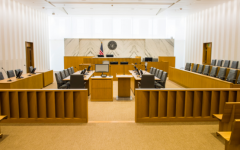
California State Capitol. (Photo: Kevin Sanders for California Globe)
Workers’ Compensation Arbitration
Concerns arbitration in the workers’ compensation laws of California
By Chris Micheli, April 18, 2026 2:30 am
Division 4, Part 3.5 concerns arbitration in the workers’ compensation laws of California.
Section 5270 provides that this part does not apply in cases where an injured employee or dependent is involved unless the employee or dependent is represented by an attorney.
Section 5270.5 requires the presiding workers’ compensation judge at each district office to prepare a list of all eligible attorneys who apply to be placed on the list of eligible arbitrators. Attorneys are eligible to become arbitrators if they are active members of the California State Bar Association and are one of the four specified individuals. No attorney is included in a panel of arbitrators, if he or she has served as a judge in any proceeding involving the same case, or has represented, or whose firm has represented, any party in the same case.
Section 5271 states that the parties to a dispute submitted for arbitration may select any eligible attorney from the list prepared by the presiding workers’ compensation judge to serve as arbitrator. However, when the disputed issue involves insurance coverage, the parties may select any attorney as arbitrator upon agreement of the parties.
If the parties cannot select an arbitrator by agreement, either party may request the presiding workers’ compensation judge to assign a panel of five arbitrators selected at random from the list of eligible attorneys. No more than three arbitrators on a five-member panel may be defense attorneys, no more than three may be applicant’s attorneys, and no more than two may be retired workers’ compensation judges or appeals board commissioners.
Section 5272 requires arbitrators to have all of the statutory and regulatory duties and responsibilities of a workers’ compensation judge, except as specified.
Section 5273 states that, in disputes between an employee and an employer, the employer is required to pay all costs related to the arbitration proceeding. In all other disputes, the costs of the arbitration proceedings, including the arbitrator’s compensation, are be paid as specified. Disputes regarding the costs or fees for arbitration are within the exclusive jurisdiction of the appeals board, and are determined initially by the presiding judge of the district office.
Section 5275 requires disputes involving the two specified issues must be submitted for arbitration.
Section 5276 explains that arbitration proceedings may commence at any place and time agreed upon by all parties. If the parties cannot agree on a time or place to commence arbitration proceedings, the arbitrator is required to order the date, time and place for commencement of the proceeding. Unless all parties agree otherwise, arbitration proceedings are to commence not less than 30 days nor more than 60 days from the date an arbitrator is selected.
Ten days before the arbitration, each party is required to submit to the arbitrator and serve on the opposing party reports, records and other documentary evidence on which that party intends to rely. If a party intends to rely upon excerpts of records or depositions, only copies of the excerpts must be submitted to the arbitrator.
Section 5277 requires the arbitrator’s findings and award to be served on all parties within 30 days of submission of the case for decision. The arbitrator’s award must comply applicable laws and be filed with the appeals board office pursuant to venue rules published by the appeals board.
The findings of fact, award, order, or decision of the arbitrator is required to have the same force and effect as an award, order, or decision of a workers’ compensation judge. Use of an arbitrator for any part of a proceeding or any issue cannot bind the parties to the use of the same arbitrator for any subsequent issues or proceedings.
Unless all parties agree to a longer period of time, the failure of the arbitrator to submit the decision within 30 days must result in forfeiture of the arbitrator’s fee and vacate the submission order and all stipulations. The presiding workers’ compensation judge may submit supplemental proceedings to arbitration pursuant to this part.
Section 5278 explains that no disclosure of any offers of settlement made by any party are to be made to the arbitrator prior to the filing of the award.


- Employee Notices - October 18, 2026
- Advice on Navigating the California Rulemaking Process - October 18, 2026
- Some Suggestions for Those New to the California Constitution - October 18, 2026
RELATED ARTICLES
-
 April 13, 2026
 -
 February 9, 2026
 -
 January 21, 2026