
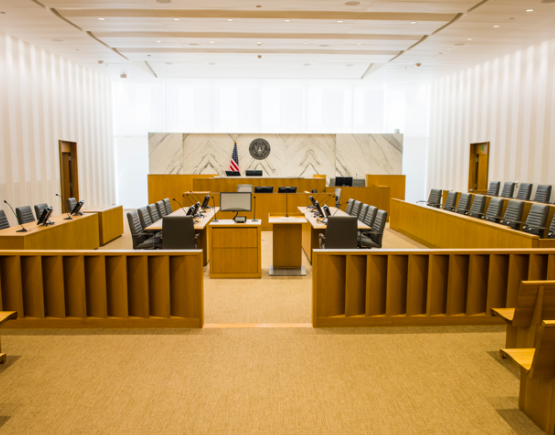
Central District of California in Los Angeles courtroom. (Photo: uscourts.gov)
Workers’ Compensation Hearings
Deals with hearings in workers’ compensation proceedings
By Chris Micheli, April 13, 2026 2:20 pm
Chapter 5 of Part 4 of Division 4 of the Labor Code deals with hearings in workers’ compensation proceedings.
Section 5700 provides that the hearing on the application may be adjourned from time to time and from place to place in the discretion of the appeals board or the workers’ compensation judge holding the hearing. Any hearing adjourned by the workers’ compensation judge is to be continued to be heard by and be concluded and the decision made by the workers’ compensation judge who previously heard it. Either party may be present at any hearing, in person, by attorney, or by any other agent, and may present testimony pertinent under the pleadings.
Section 5701 authorizes the appeals board to cause testimony to be taken, or inspection of the premises where the injury occurred to be made, or the timebooks and payroll of the employer to be examined by any member of the board or a workers’ compensation judge appointed by the appeals board.
Section 5702 allows the parties to a controversy to stipulate the facts relative thereto in writing and file the stipulation with the appeals board. The appeals board may make its findings and award based upon the stipulation, or may set the matter down for hearing and take further testimony or make the further investigation necessary to enable it to determine the matter in controversy.
Section 5702 authorizes the appeals board to receive as evidence either at or subsequent to a hearing, and use as proof of any fact in dispute, the ten specified matters, in addition to sworn testimony presented in open hearing.
Section 5703.5 allows the appeals board, upon the agreement of a party to pay the cost, direct an unrepresented employee to be examined by a qualified medical evaluator selected by the appeals board, within the scope of the qualified medical evaluator’s professional training, upon any clinical question then at issue before the appeals board.
Section 5704 provides that transcripts of all testimony taken without notice and copies of all reports and other matters added to the record, otherwise than during the course of an open hearing, must be served upon the parties to the proceeding, and an opportunity be given to produce evidence in explanation or rebuttal thereof before decision is rendered.
Section 5705 specifies the burden of proof rests upon the party or lien claimant holding the affirmative of the issue. The five specified actions are affirmative defenses, and the burden of proof rests upon the employer to establish them.
Section 5706 states that, where it is represented to the appeals board, either before or after the filing of an application, that an employee has died as a result of injuries sustained in the course of his employment, the appeals board may require an autopsy. The report of the physician performing the autopsy may be received in evidence in any proceedings theretofore or thereafter brought.
Section 5707 allows the appeals board, if the body of a deceased employee is not in the custody of the coroner, to authorize the performance of an autopsy and, if necessary, the exhumation of the body. If the dependents of any such deceased employee, having the custody of the body refuse to allow the autopsy, it cannot be performed.
Section 5708 provides that all hearings and investigations before the appeals board or a workers’ compensation judge are governed by this division and by the rules of practice and procedures adopted by the appeals board. In their conduct, they are not bound by the common law or statutory rules of evidence and procedure, but may make inquiry in the manner, through oral testimony and records, which is best calculated to ascertain the substantial rights of the parties and carry out justly the spirit and provisions of this division.
Section 5709 states that no informality in any proceeding or in the manner of taking testimony will invalidate any order, decision, award, or rule made and filed as specified in this division.
Section 5710 allows the appeals board, a workers’ compensation judge, or any party to the action or proceeding, to cause, in any investigation or hearing before the appeals board, the deposition of witnesses residing within or without the state to be taken in the manner prescribed by law for like depositions in civil actions in the superior courts of this state. To that end the attendance of witnesses and the production of records may be required.
Depositions may be taken outside the state before any officer authorized to administer oaths. The appeals board or a workers’ compensation judge in any proceeding before the appeals board may cause evidence to be taken in other jurisdictions before the agency authorized to hear workers’ compensation matters in those other jurisdictions. If the employer or insurance carrier requests a deposition to be taken of an injured employee, or any person claiming benefits as a dependent of an injured employee, the deponent is entitled to receive in addition to all other benefits five specified payments.


- Can California’s Prop 40 Apply to Non-Billionaires? - October 27, 2026
- Credit for Taxes Paid - October 27, 2026
- Key Court Decisions in California Statutory Interpretation - October 27, 2026
RELATED ARTICLES
-
 February 9, 2026
 -

-
 March 22, 2021