
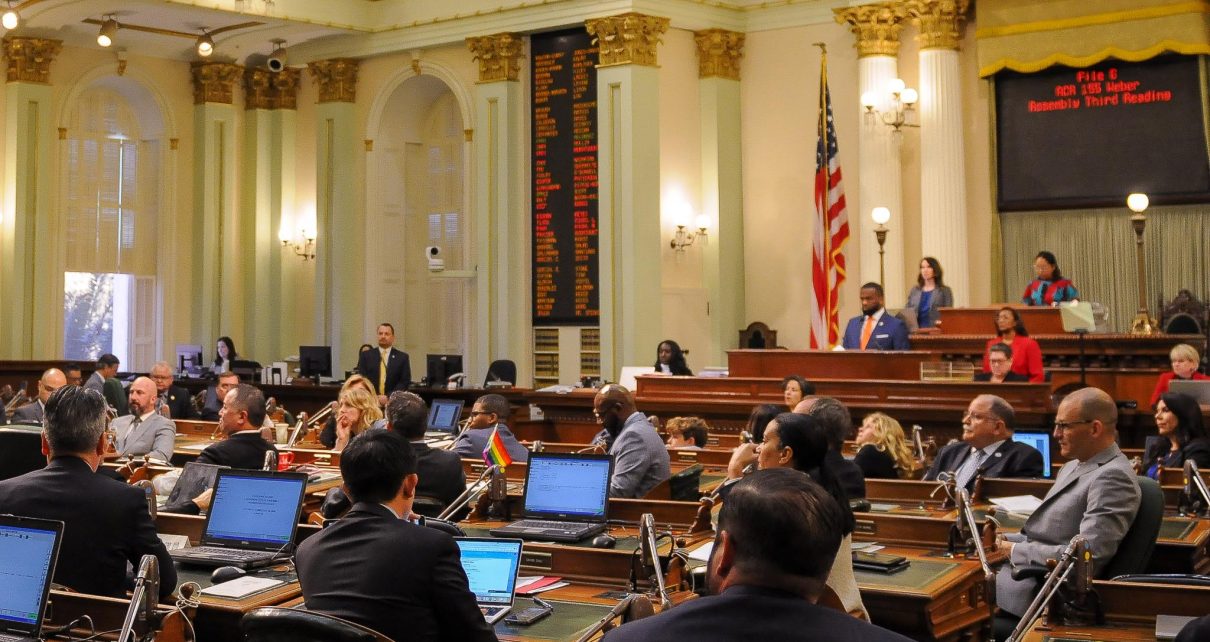
California State Assembly. (Photo: Kevin Sanders for California Globe)
Instructing the Courts on Interpretation
Should the statute in review be liberally construed or liberally interpreted?
By Chris Micheli, May 29, 2026 2:00 pm
In reviewing some recent legislation in the 2026 California Legislative Session, I have come across several bills that contain “liberally construe” language, as well as one that used “liberally interpret” language. In other words, this language is directed at state agencies and the judicial branch that the statute in review should be liberally construed or liberally interpreted.
This raised the question with me: Which is the better language to use?
First, I wanted to research the use of these phrases in state statutes. I found that there are thousands of California statutes that use the standard language “liberally construed.” However, there are also many state statutes that use the less common “liberally interpreted.”
How many of each appear in state law?
- Liberally construed: 4,630
- Liberally interpreted: 1,432
Second, this caused me to raise the question: What about the other 150,000 statutes in California Codes that do not include either phrase? How should those statutes be construed or interpreted by the courts because they lack this “guidance” language that 6,000 statutes have?
Third, do the courts even apply this phrase? Or do they follow the plain language of the statute? While the courts in this state only resort to considering extrinsic language when the statutory language is ambiguous, would this be considered extrinsic language? The answer is no. It is intrinsic language to the statute itself. This guidance language is contained in the statute being interpreted. So, it would be applied as guidance.
It is not binding on the state’s courts because they are the final arbiter of what a statute means, regardless of how much “guidance” the legislative branch provides. As a result, while the courts may apply this interpretative language, they are not bound by it.
Fourth, should either phrase be used? Or is there better language that should be used instead? While the above language is common to not only California statutes, but also federal ones, it is not the only interpretation guidance that can be used.
For example, what about using this phrase instead: “This article should be liberally interpreted by the courts of this state to effectuate the intent of the Legislature.” Of course, shouldn’t that be the case in all instances? Recall that California courts first determine whether the plain meaning of the statutory language can be interpreted. It is only when there is ambiguity that courts look for guidance or follow common statutory interpretation principles.


- Significant Natural Areas - October 23, 2026
- Common Latin Terms in Statutory Construction - October 23, 2026
- Frogs in California - October 23, 2026
RELATED ARTICLES
-
 November 3, 2024
 -
October 22, 2024
-
 December 30, 2024