
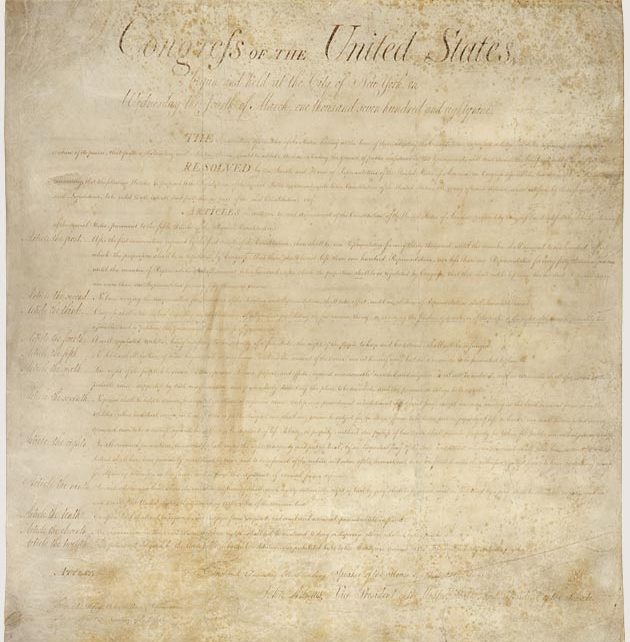
United States Constitution. (Photo: archives.gov)
Can States Abolish the Electoral College Without Amending the Constitution?
The implications extend well beyond presidential elections themselves
By C.D. Michel, November 24, 2026 3:27 pm
An effort to fundamentally change how Americans elect their president is gathering momentum. What makes it particularly consequential is that its supporters hope to accomplish the change without amending the Constitution.
The vehicle is the National Popular Vote Interstate Compact, an agreement among states to award their presidential electoral votes to whichever candidate wins the national popular vote, regardless of which candidate actually wins the election in those states. In practical terms, the compact would render the traditional state-by-state operation of the Electoral College largely irrelevant.
The compact has already been enacted by 18 states and the District of Columbia, representing 222 electoral votes. It takes effect when participating jurisdictions collectively control at least 270 electoral votes, the number needed to elect a president. Following the November 2026 elections, Democrats will control the governorships and legislatures in five additional states—Arizona, Michigan, Nevada, Pennsylvania, and Wisconsin—that collectively possess 61 electoral votes. If those states joined the compact, the total would rise to 283, enough to activate the arrangement.
Whether those legislatures will actually approve the compact remains uncertain. But the possibility is now sufficiently real that Americans should understand what is being proposed and why the Constitution’s Framers established the system its supporters seek to change.
The Electoral College would technically survive. Presidential electors would still be appointed, meet, and cast their votes. Congress would still count those votes. But the central mechanism would be transformed. The states participating in the compact would agree to disregard their own statewide election results whenever those results differed from the national popular vote. The constitutional question is whether states can collectively accomplish something so consequential through an agreement among themselves, rather than through the amendment process the Constitution provides.
The Compromise That Made the Constitution Possible
The controversy reaches back to one of the most important disputes at the Constitutional Convention of 1787: how to distribute political power between states with large populations and states with relatively few residents. Under the Articles of Confederation, each state possessed one vote in Congress. Larger states regarded that arrangement as unfair because their considerably larger populations received no greater representation than the smallest states. Smaller states, however, viewed equal representation as essential to preserving their political independence.
The Virginia Plan, introduced by Governor Edmund Randolph on May 29, 1787, and largely developed by James Madison, proposed a stronger national government with a bicameral legislature. Representation would be based on population or financial contributions, giving larger states greater influence in both chambers. Delegates from smaller states immediately recognized what that could mean. If legislative power were allocated entirely according to population, the larger states could dominate the new government. Smaller states would be surrendering authority to a national government in which their interests could routinely be overwhelmed.
William Paterson of New Jersey offered a competing proposal on June 15. The New Jersey Plan would preserve equal state representation in a single legislative chamber while expanding certain powers of the national government.
Neither side was prepared to accept the other’s proposal. The disagreement was so serious it threatened the Convention’s success and the founding of the United States of America.
The solution was the Great Compromise, also known as the Connecticut Compromise, advanced by Roger Sherman and Oliver Ellsworth. Adopted on July 16, 1787, it established the arrangement we recognize today: representation in the House of Representatives would be apportioned according to population, while every state would receive two senators regardless of its population.
This was not some incidental political accommodation. It was an essential part of the bargain that made the new constitutional government acceptable to both large and small states. Indeed, the Framers considered equal representation in the Senate so important that they placed an extraordinary protection in Article V. Although the Constitution may ordinarily be amended with the approval of three-fourths of the states, Article V provides that no state may be deprived of its equal suffrage in the Senate without its consent.
The Electoral College emerged from separate debates over how to select the president, but its structure incorporates the same balance between population and state equality. Each state’s electoral votes equal its number of representatives in the House plus its two senators.
California currently has 54 electoral votes, reflecting its 52 representatives and two senators. Wyoming has three, reflecting its single representative and two senators. The two additional votes attributable to each state’s Senate representation give smaller states somewhat greater electoral influence per resident than they would receive under a strictly population-based system.
That arrangement reflects the federal structure the Framers deliberately created. The United States was not designed simply as a national democracy in which all political power would be distributed according to population. It was established as a constitutional republic in which the states retained distinct political identities and important protections against domination by more populous states.
The Framers were very much aware of the competing demands of democratic representation and state sovereignty. They spent months negotiating how to accommodate both.
A Different Way to Elect the President
The National Popular Vote Interstate Compact would not alter the number of electoral votes assigned to any state. Instead, participating states would agree to award all their votes to the candidate who wins the national popular vote, regardless of their own voters’ preferences.
Consider California. Suppose its voters favor one presidential candidate by several million votes, but that candidate narrowly loses the national popular vote. Under the compact, California’s 54 electoral votes would go to the candidate who lost California. Supporters regard this as a virtue, not a defect. Their position is that the candidate receiving the most votes nationwide should become president and that each individual vote should have equal weight. They also contend that the existing system causes presidential campaigns to devote disproportionate attention to competitive states while largely ignoring states whose electoral outcomes appear predictable.
Those arguments deserve consideration. But so does the fundamental change the compact would make to the relationship between states and the federal government.
The Electoral College makes states important political units in presidential elections. The compact would replace that state-based mechanism with a nationwide aggregation of votes. Smaller states would retain their representation in Congress, but the electoral advantage associated with their two Senate-based electors would no longer affect which presidential candidate wins.
Whatever one’s view of that change, it is hardly a minor adjustment to election administration and to the influence of lower-population states.
Why Democrats Are Pursuing the Change
The movement toward a national popular vote has attracted prominent Democratic supporters, including former Secretary of State and presidential nominee Hillary Clinton. Clinton publicly advocated abolishing the Electoral College following the 2000 presidential election, when Al Gore won the national popular vote but George W. Bush secured the presidency through the Electoral College. She renewed that position after her own defeat in 2016, when she received nearly 2.9 million more votes nationwide than Donald Trump but lost the electoral-vote contest. She again called for a national popular-vote system in 2020.
More recently, in a July 2026 conversation with Democratic election lawyer Marc Elias, Clinton specifically discussed the interstate compact and the possibility of its reaching the 270-electoral-vote threshold. She also suggested congressional legislation to support the arrangement and protect it against constitutional challenges.
The political history is relevant. In both 2000 and 2016, Democratic presidential nominees won more popular votes than their Republican opponents but failed to win the presidency. Those elections understandably increased Democratic interest in changing the rules. That does not necessarily establish that partisan advantage is every supporter’s principal motivation. Advocates also make a longstanding democratic argument for electing presidents by national popular vote, and support for Electoral College reform has not been exclusively Democratic.
Nevertheless, the political incentives surrounding the proposal are difficult to ignore. Changes in the composition of state legislatures can now bring the compact closer to activation without any corresponding change to the Constitution’s text. Clinton’s suggestion that Congress intervene is revealing for another reason. It reflects an awareness that the compact remains vulnerable to constitutional challenge. Whether congressional approval, short of a constitutional amendment, would resolve those challenges is far from certain.
What Would This Mean for Smaller States?
Critics of the compact worry that a national popular vote would increase the political influence of the country’s most populous regions, including California and New York, while diminishing the relative influence of smaller states. The concern requires some precision. A national popular vote would count individual votes, not award entire states’ votes to one party. Millions of Californians and New Yorkers vote Republican, just as millions of Texans and Floridians vote Democratic. Those votes would all count toward the national result.
Nevertheless, population would determine electoral influence more directly than it does today. The distinct constitutional role of states in selecting the president would be reduced, and political coalitions concentrated in populous regions could become increasingly important to national campaigns.
The implications extend well beyond presidential elections themselves. Presidents appoint federal judges and executive officials, direct federal agencies, establish regulatory priorities, and exercise substantial influence over national policy. Changes in the electoral coalitions that select presidents can therefore affect federal policies governing everything from taxation and environmental regulation to criminal justice and constitutional rights. Residents of smaller states could find themselves subject to policies favored by national electoral largely urban majorities whose political preferences differ sharply from their own. Of course, that possibility exists under the current system as well. The relevant question is whether the Constitution’s state-based electoral structure provides a measure of protection for less populous states that the compact would effectively eliminate.
This was precisely the kind of tension the delegates confronted in Philadelphia. The Framers understood that the states had different populations, economies, interests, and political priorities. They concluded that a workable national government required more than simply allowing the largest states to prevail in every dispute. Although that history does not conclusively determine how presidential electors must be selected today, it explains why federalism remains central to the debate.
Can States Accomplish This Without a Constitutional Amendment?
The compact’s supporters rely primarily on Article II, Section 1, which directs that each state appoint presidential electors in the manner determined by its legislature. The Supreme Court has recognized broad state authority over the appointment of electors, and proponents contend that using a national popular-vote tally is simply another permissible method of exercising that authority.
That is a serious constitutional argument. But it does not end the inquiry.
Article I, Section 10 provides that states may not enter into an agreement or compact with another state without congressional consent. The Supreme Court has interpreted that requirement to permit some interstate agreements without consent, particularly where they do not threaten the federal balance of power. Whether this compact falls within that exception is disputed. Unlike agreements concerning water rights, transportation, or administrative cooperation, the National Popular Vote Interstate Compact concerns the selection of the nation’s chief executive. Once activated, it would affect the operation of presidential elections even in states that never agreed to participate.
Opponents also contend that the compact attempts to accomplish indirectly what should require a constitutional amendment. Article V establishes a demanding process for making fundamental changes to the constitutional structure. The Electoral College has been altered through that process before, most notably by the Twelfth Amendment, which changed the manner in which electoral votes are cast for president and vice president.
Supporters respond that no amendment is necessary because the Constitution already permits states to determine how their electors are appointed. Opponents answer that the collective exercise of that authority cannot be used to circumvent constitutional limitations on interstate agreements or effectively displace a constitutional institution.
The dispute is not resolved merely by invoking the broad language of Article II or the demanding requirements of Article V. The constitutional text, the Court’s Compact Clause precedents, and the practical effect of the arrangement must all be considered.
The Supreme Court May Have the Final Word
If the compact reaches the 270-electoral-vote threshold, constitutional litigation is likely. The Supreme Court would not automatically acquire jurisdiction, and questions involving standing, timing, and the availability of judicial review could complicate any challenge. But a dispute affecting how the president is selected would plainly raise questions of exceptional national importance.
The Court’s composition could matter. It currently consists of six justices generally identified as conservative and three generally identified as liberal. That division, however, provides no reliable answer to how the justices would approach the compact. A justice emphasizing the original meaning of Article II might give considerable weight to the broad discretion granted to state legislatures. Another might emphasize the constitutional restrictions on interstate compacts and the structural protections of federalism. Those principles do not necessarily align neatly with contemporary political affiliations.
The Court’s 2020 decision in Chiafalo v. Washington adds another dimension. There, the justices upheld state laws requiring presidential electors to honor their pledges. The decision confirms substantial state authority over electors, but it did not decide whether states may enter into a binding agreement to award their electoral votes according to a national tally.
Congressional consent presents still another question. If the Compact Clause requires such consent, Congress might be able to supply it. But congressional approval would not necessarily dispose of every constitutional objection to the arrangement.
The legal issues are sufficiently substantial that the result cannot be predicted from the Court’s ideological composition alone.
There is also a practical danger in allowing the compact to become operative before its constitutional status is settled. A challenge arising during a closely contested presidential election could produce disputes over which electoral votes should be counted, whether participating states must honor the compact, and whether courts can resolve those questions before the constitutionally prescribed deadlines.
The country hardly needs another disputed presidential election made more complicated by unresolved questions concerning the method of choosing its president.
The Stability of the Union
The Framers’ compromises reflected a concern that remains relevant today: a federal system depends upon the willingness of its constituent states to accept the legitimacy of their shared institutions. Imagine an election in which the compact produces a different winner than the traditional state-by-state Electoral College calculation. Residents of states that never joined the agreement might reasonably question how other states acquired the authority to change the practical rules governing a national election.
The existence of that disagreement would not itself establish that the compact is unconstitutional. But the resulting conflict could be politically serious, particularly if the national vote were close or the validity of ballots and recount procedures became disputed. Critics have warned that diminishing the political influence of smaller states could intensify demands for greater autonomy and, at the extremes, revive discussion of secession.
Those consequences are speculative, and the Supreme Court’s decision in Texas v. White makes clear that states cannot simply withdraw unilaterally from the Union. But the broader concern about political legitimacy should not be dismissed. The original Constitutional Convention nearly collapsed over disputes concerning the distribution of power between large and small states. The Great Compromise was necessary precisely because agreement on a durable federal government required protections acceptable to both.
The nation established in 1787 was a product of negotiation among states that understood the dangers of permitting national political power to be exercised without adequate regard for their differing interests. Those concerns have not disappeared merely because modern political leaders disagree about the Electoral College. In fact, they are just as pronounced as ever.
Changing the Constitution Without Amending It?
The Electoral College is not immune from criticism, and the Constitution does not prohibit reform. Americans may reasonably disagree about whether presidential elections should continue to depend upon the distribution of electoral votes among the states or instead be decided by a single national popular-vote tally. But disagreement with a constitutional institution is not the same thing as possessing authority to change it. The central legal question is whether the compact represents a permissible exercise of state legislative power or an effort to transform the presidential election system through an agreement that exceeds the states’ constitutional authority.
The Framers provided a process for changing the Constitution. They also established a federal structure that deliberately balances representation according to population with protections for the states as distinct political communities. The National Popular Vote Interstate Compact now places those principles in tension. If enough states enact it, the Supreme Court may ultimately have to decide whether the proposed change is consistent with the Constitution.
The question is not simply whether Americans would prefer to elect their president by national popular vote. It is whether state legislatures possess the constitutional authority to bring about that result through a compact, without the broader agreement required to amend the Constitution.
That distinction deserves to be resolved before an election depends upon the answer.


- Can States Abolish the Electoral College Without Amending the Constitution? - November 24, 2026
- The Trace Doubles Down on Stupid: Still Misinterpreting ATF Gun-Tracing Statistics for Gun Control Advocacy - November 19, 2026
- The Social Utility of Firearms, Revisited - November 3, 2026
RELATED ARTICLES
-
 October 18, 2019
-
-
 September 17, 2019