
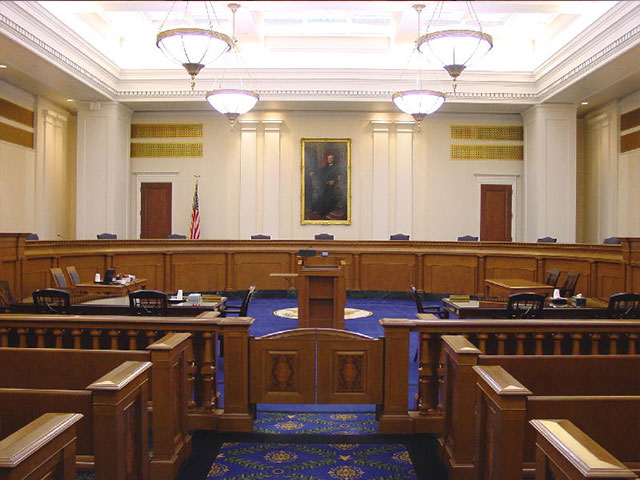
Courtroom (Photo: public domain)
Federal Court Upholds California’s Prop 50 Congressional Maps, Dismisses Racial Gerrymandering Claims
The California GOP will seek an emergency injunction from the U.S. Supreme Court; the DOJ is ‘reviewing all legal options’
By Megan Barth, January 15, 2026 11:13 am
In a significant blow to Republican efforts to challenge California’s mid-decade redistricting, a federal three-judge panel ruled 2-1 on Wednesday to deny a preliminary injunction against the state’s new congressional maps approved by voters through Proposition 50. The decision allows the maps, designed to favor Democrats in five key districts, to proceed for the 2026 midterm elections. This ruling comes amid ongoing national debates over gerrymandering.
The panel, convened in the U.S. District Court for the Central District of California, rejected claims by plaintiffs—including Assemblyman David Tangipa (R-Fresno) and the California Republican Party, joined by the U.S. Department of Justice under Attorney General Pam Bondi—that the maps constituted unconstitutional racial gerrymandering.
In the majority opinion authored by U.S. District Judge Josephine L. Staton, an Obama appointee, the court emphasized that Proposition 50 was “exactly what it was billed as: a political gerrymander designed to flip five Republican-held seats to the Democrats.” The judges found insufficient evidence that race was the predominant factor in drawing the districts, stating: “The record contains a mountain of statements reflecting the partisan goals of Proposition 50, from which Challengers have culled a molehill of statements showing race consciousness on the part of the mapmaker and certain legislators. But that is not enough to make the necessary showing that the relevant decisionmakers—here, the electorate—enacted the new map for racial reasons.”
Judge Staton, joined by U.S. District Judge Fred W. Slaughter, a Biden appointee, concluded that the plaintiffs “failed to show that racial gerrymandering occurred,” and thus there was “no basis for issuing a preliminary injunction.”
In a dissenting opinion, U.S. District Judge Kenneth K. Lee, a Trump appointee, argued that race played a key role in at least one district, designed “to curry favor with Latino groups and voters.” Lee’s dissent highlighted public comments by redistricting consultant Paul Mitchell, who drew the maps, as evidence of racial considerations.
The ruling is a victory for California Democrats, including Governor Gavin Newsom, who defended Proposition 50 as a direct response to Republican gerrymandering in Texas, aiming to counter GOP gains elsewhere and potentially help Democrats regain control of the U.S. House.
Plaintiffs expressed disappointment but vowed to appeal. Corrin Rankin, chairwoman of the California Republican Party, stated: “Although the majority of the three-judge panel did not side with our challenge to the Prop 50 map, we appreciate the thoughtful and timely work of all three judges. The well-reasoned dissenting opinion better reflects our interpretation of the law and the facts, which we will reassert to the Supreme Court. The map drawer’s plain statements acknowledging that he racially gerrymandered the Proposition 50 maps, which he and the legislature refused to explain or deny, in addition to our experts’ testimony, established that the courts should stop the implementation of the Prop 50 map. We look forward to continuing this fight in the courts.” Rankin confirmed the party will seek an emergency injunction from the U.S. Supreme Court.
California Attorney General Rob Bonta reacted that “he was not surprised” by the ruling.
.@CAGOP Chair @CorrinRankin announces the party "will be seeking an emergency injunction from the Supreme Court of the United States. Although the majority of the three-judge panel did not side with our challenge to the Prop 50 map, we appreciate the thoughtful and timely work of… https://t.co/KE7Esq2ZDn
— Eytan Wallace (@EytanWallace) January 15, 2026
Attorney General Pam Bondi, representing the Trump administration’s involvement in the suit, echoed Rankin’s sentiment in a post on X: “We disagree with yesterday’s 2-1 ruling on California’s redistricting map. California impermissibly drew its new congressional map based on race. That’s unconstitutional. We are reviewing all legal options.”
We disagree with yesterday’s 2-1 ruling on California’s redistricting map. California impermissibly drew its new congressional map based on race. That’s unconstitutional. We are reviewing all legal options.
— Attorney General Pamela Bondi (@AGPamBondi) January 15, 2026
The Globe has explored the potential for the U.S. Supreme Court to intervene, noting historical interpretations of the Voting Rights Act that could deem such maps unconstitutional:
A case currently with the U.S. Supreme Court about racial gerrymandering could nullify California’s just-passed Proposition 50, the mid-decade redistricting scheme Governor Gavin Newsom and Democrats cooked up ahead of the 2026 midterm elections to secure more Democrat seats in Congress by redrawing district maps, or “gerrymandering” numerous California Republicans out of their congressional districts.
The Supreme Court will decide in Louisiana v. Callais whether the state’s intentional consideration of race to create these voting districts violates the Constitution’s Equal Protection Clause. The Supreme Court could also invalidate Section 2 of the Voting Rights Act and require race-neutral maps.
The Voting Rights Act of 1965 is a landmark U.S. federal law that prohibits racial discrimination in voting, aiming to protect the voting rights of all citizens, particularly racial minorities.
The high court appears ready to strike down Louisiana’s 2024 congressional map as unconstitutional racial gerrymandering – a violation of the 14th Amendment’s equal protection clause.
Elections Law attorney Mark Meuser explained in detail that “The Supreme Court could soon change how every congressional map in America is drawn, including California.”


- LA Democrats Advance Charter Reform to Abolish City Controller’s Office Amid Massive Fraud Scandals - February 27, 2026
- Ninth Circuit Delivers Blow to Federal Unions, Upholds Trump Executive Order on National Security Exemptions - February 27, 2026
- Fresno City Council Candidate Rene Campos, a Registered Sex Offender, Enters District 7 Race - February 26, 2026
RELATED ARTICLES
-
 October 14, 2025
 -

-

-
 October 21, 2025
 -
 October 21, 2025
 -

At NO TIME was the racial emphasis of the redistricting disclosed in their public advertisements and those same commercials were LADEN with lies, omissions and should be compared directly against Paul Mitchell’s social media postings.
Take this one ALL THE WAY to the Supreme Court as this election was a farce, and the “dominion” voting systems have security exploits in their databases and security features that enable manipulation of the voting tabulation systems. It’s in the PDF from the Colorado-based security firm that evaluated the system for Padilla before he skated to D.C. to backfill Kamala’s Senate seat….
CriticalDfence9, this will go up to the 9th Circuit first. I expect Prop 50 to be overturned there. Only Judge Lee, who dissented, is a member of the 9th Circuit Court of Appeals. If the 9th fails, then yes take it up to SCOTUS.