
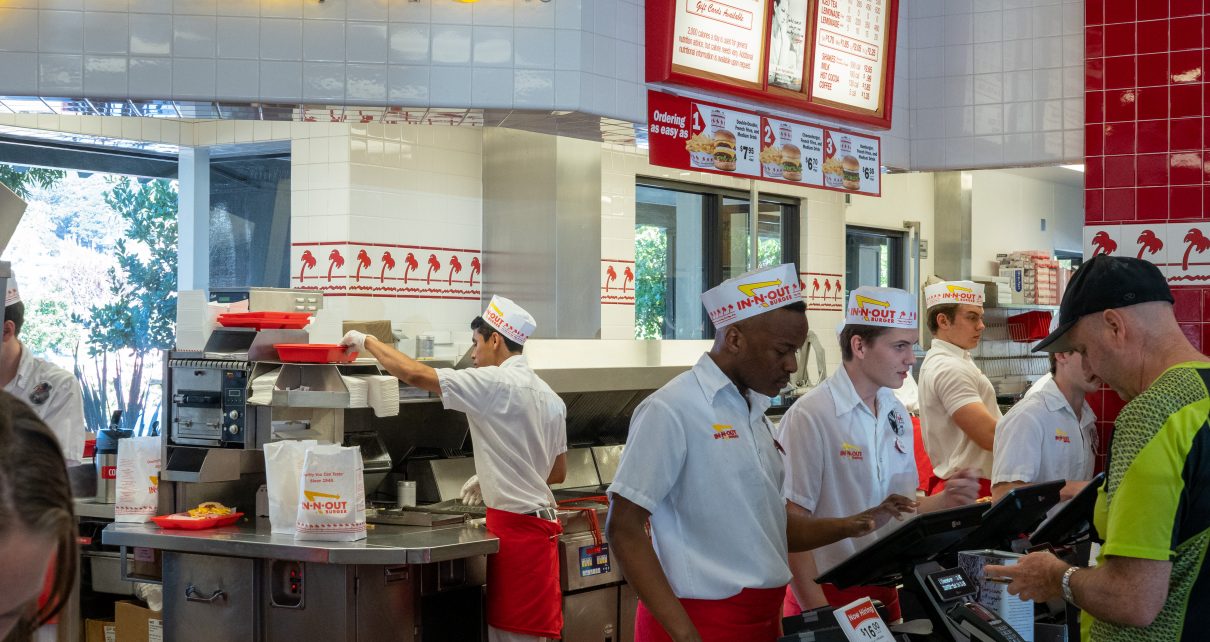
Mill Valley, CA: Workers at In-N-Out location behind counter take orders. (Photo: David Tran Photo, Shutterstock)
$25 Federal Minimum Wage to Cost 5 Million Jobs, New Report Finds
New report comes as policymakers and Senate hopefuls, like Florida’s Angie Nixon, tout $25 wage policies
By Katy Grimes, August 20, 2026 11:28 am
The majority of research over three decades finds minimum wage increases reduce employment. Just look at California’s $20 per hour fast food minimum wage.
In addition to the latest news that Kentucky Fried Chicken has permanently closed 44 restaurants across California in less than a year, thousands of fast food employees lost jobs, employees’ hours were cut, and business owners had to do more with less. Notably, KFC is intentionally expanding into other states, so this isn’t because of a failing business model.
California’s two-year anniversary of the ill-advised $20 fast food minimum wage, AB 1228, found that it cost non-tipped restaurant workers 250 hours of work annually, equating to up to 7 weeks of lost work – up to $4,000 in lost potential income, the Globe reported.
In March, a paper from economists at UC Santa Cruz confirmed what the Employment Policies Institute (EPI) has been warning from the start–these drastic wage hikes will hurt workers by costing jobs, increasing inflation, and increasing automation of employee tasks.
The UCSC findings serve as a warning to lawmakers and advocates across the country pushing for $25 and $30 an hour minimum wage laws, which will only result in more economic decline.
The researchers studied the records for Burger King locations of at least one franchise owner in coastal markets, which reported a more than 21% decline in shift work for employees from October 2023 to October 2024.
Across 18 McDonalds franchise locations in the Central Valley, total labor hours declined by nearly 12% across equal 12-month periods from April 2023 to March 2025, equivalent to a loss of 62 full time jobs for a year.
Now, a new report from EPI finds that five million jobs are at stake if a newly proposed federal $25 per hour wage law passes, authored by U.S. Senator Chris Murphy. The purpose of the study is to estimate the employment effects of proposed minimum wage increases across the U.S. using methodology consistent with the Congressional Budget Office and economists Dr. William Even and Dr. David Macpherson.
According to the EPI report:
A new model developed by the Employment Policies Institute (EPI)–based on methods developed by the nonpartisan Congressional Budget Office (CBO) and other American labor economists – compiles the latest economic data to estimate what this means for workers under the latest
proposed minimum wage hike.3 Using these established methods and the latest Census Bureau data on workers across the country, EPI estimates the federal $25 proposal will cost 5.01 million jobs nationally, significantly impacting the hospitality sector, tipped restaurant workers, and teens.
Senator Murphy’s bill is proposing a 245% increase in the federal minimum wage.
The top industry with the most job losses is food services and drinking establishments.
Key Findings:
- A $25 federal minimum wage will cost more than 5 million jobs nationwide.
- Fifty-two percent of those losses are in the 16-24 year old age bracket.
- More than one-third of the losses are concentrated in the restaurant industry, including 1.2 million tipped workers.
- States hit the hardest would be: Texas, Pennsylvania, Georgia, North Carolina, Ohio, and Florida.
- Women would make up the majority of lost jobs, with projections estimating well over 2.9 million female workers impacted.
California’s failure ought to be a wake-up call for Congress.
Some details about the fast food minimum wage from EPI:
- Since the law was signed in September 2023, BLS quarterly data shows California’s fast food industry lost 19,102 jobs (-3.3% loss), including 15,988 fast food jobs lost since the law went into effect in April 2024.
- California’s fast food job loss rate (-3.3% of jobs lost) more than doubled the losses in fast food restaurants nationally (-1.6% of jobs lost) since September 2023.
- California’s fast food restaurants accounted for a quarter (25.3%) of all fast food industry job losses in the nation over this period.
- California’s fast food industry job loss also outpaced total private industry job losses in the state (-1.3% of jobs lost), and represents nearly 10% of all statewide job losses just in fast food over this period.
- After the implementation of the $20 minimum wage law, an EPI survey found that a majority of restaurants say they had raised menu prices (98%), reduced employee hours (89%), limited employee shift pick-up or overtime opportunities (73%) and reduced staff or consolidated positions (70%) as a result of the minimum wage law.
- Additionally, a majority of restaurants surveyed said in the next year they will have to raise menu prices (93%), reduce employee hours (87%), reduce staff or consolidate positions (74%), and limit employee shift pick-up or overtime opportunities (71%).
- An EPI analysis of U.S. minimum wage studies shows a $1 increase in the minimum wage could trigger price increases of up to 5.5%.
- Studies estimate that a $1 increase in the federal minimum wage could increase the likelihood of robot adoption by up to 11%.
- Other states are heeding California’s lessons. Rhode Island recently decided to hold on a proposed $20 an hour wage hike, Chicago’s City Council voted to halt a wage hike for restaurant workers. In 2024, Massachusetts voters rejected an $18 an hour minimum wage, and workers and business owners are warning against Mandami’s $30 an hour wage in New York.


A California native and Navy mom, Katy lives in Sacramento, CA.
- MIA on the Campaign Trail, Xavier Becerra’s Tone-Deaf Remarks on Black Californians on Radio Show - October 19, 2026
- President Trump is Unleashing American Energy While Gov. Newsom Tries to Restrict Offshore Drilling - October 19, 2026
- Voters’ Prop 36 Delivers Accountability: Repeat Thief Sentenced to 9 Years in State Prison - October 17, 2026
RELATED ARTICLES
-
 March 24, 2023
 -
 November 6, 2021
 -
The reason the minimum wage issue continues to work for the democrats is that the younger generations have been taught to think of themselves first in all situations. They are not taught logic to calculate what greed does to the economy.
Logic is “mean” to these people….