
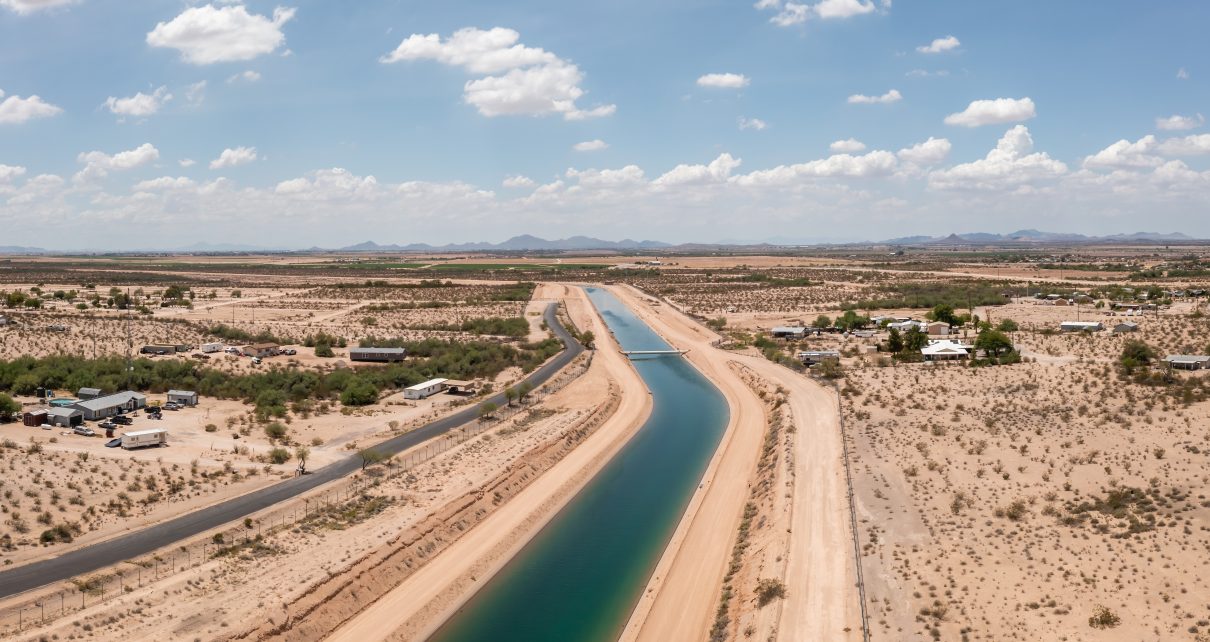
The Central Arizona Project (CAP), designed to bring 1.5 million acre-feet of Colorado River water per year to Pima, Pinal and Maricopa counties. (Photo: Manuela Durson/Shutterstock)
California, Arizona & Nevada Scramble To Stabilize Colorado River System With Temporary Agreement
California agreed to reduce its Colorado River usage by approximately 13 percent under the proposal, while Arizona and Nevada would continue taking substantially reduced allocations from the river system
By Matthew Holloway, May 12, 2026 8:48 am
California, Arizona, and Nevada announced a new temporary agreement this week to reduce water consumption from the Colorado River through 2028 as federal officials warn that worsening drought conditions and historically low runoff threaten the long-term stability of the river system that supplies water to roughly 40 million people across the West.
Under the proposal, the three Lower Basin states would conserve up to 1 million additional acre-feet of water on top of existing reductions already agreed to under prior drought contingency plans. According to the Associated Press, the combined reductions would total approximately 3.2 million acre-feet through 2028.
The agreement comes amid mounting concern over rapidly declining water levels at Lake Mead and Lake Powell, the Colorado River system’s two largest reservoirs.
Federal forecasts released this month projected historically low inflows into Lake Powell following one of the driest winters on record in parts of the Rocky Mountains. Reuters reported that projected runoff into Lake Powell between April and July could reach only 13 percent of the historical average, potentially marking the lowest inflow levels since the reservoir was created in the 1960s.
The Bureau of Reclamation has already begun emergency measures intended to stabilize reservoir elevations, including reducing water releases downstream from Lake Powell and authorizing additional releases from Flaming Gorge Reservoir in Wyoming and Utah. Federal officials warned that the actions are necessary to preserve hydroelectric generation capacity at Glen Canyon Dam.
The temporary conservation agreement announced by California, Arizona, and Nevada is intended to serve as a short-term “bridge” while negotiations continue over long-term operating rules for the Colorado River system after current federal agreements expire in 2026.
“We have kind of a crisis situation that this past winter has created,” Arizona’s lead negotiator, Tom Buschatzke, told the AP. “We need to do everything we can, and that’s what our plan does, to find a short-term fix.”
Colorado’s lead negotiator described the plan from the Lower Basin states as positive, but stressed that it doesn’t adequately protect Lake Powell. “While the Lower Division States have made progress, more is needed to protect the Colorado River System now and into the future,” she told the outlet. “These differences highlight the urgent need to come back together with the help of a mediator.”
The negotiations have exposed growing divisions between the river’s Upper Basin states, Colorado, Utah, Wyoming, and New Mexico, and the Lower Basin states of California, Arizona, and Nevada. Upper Basin officials have argued the Lower Basin states historically consumed disproportionate amounts of Colorado River water and should bear greater responsibility for reductions.
According to the AP, California agreed to reduce its Colorado River usage by approximately 13 percent under the proposal, while Arizona and Nevada would continue taking substantially reduced allocations from the river system.
“With this proposal, the Lower Basin is putting forth real action to stabilize water supply along the Colorado River. We’re putting forward additional measurable water contributions for the system. Without that, the system will continue to decline,” JB Hamby, the chair of California’s Colorado River Board, said in a statement.
According to The Guardian, the plan is pending the approval of the Arizona legislature and the Arizona Department of Water Resources.
The Colorado River system has experienced more than two decades of drought conditions compounded by rising temperatures and declining snowpack levels across the Southwest. The Washington Post reported this week that climate conditions and chronic overuse have significantly reduced the amount of water available in the river compared to the allocations established under century-old interstate agreements.
California remains the single largest user of Colorado River water. According to CalMatters, the river supports agriculture throughout the Imperial Valley and provides imported water to millions of Southern California residents through the Metropolitan Water District.
The Lower Basin proposal still requires approval from federal officials and state agencies before implementation. Negotiations among the seven basin states over permanent post-2026 operating rules remain ongoing.


- Arizona Seeks To Join Colorado River Lawsuit After Failed Negotiations, GOP Criticism Of Hobbs - October 21, 2026
- Former AZ State Prison Closed by Governor Hobbs Set To Reopen As ICE Detention Center - October 20, 2026
- Federal Audit Reveals Backlog, Unmanageable Workloads in Missing Indigenous Persons Unit - October 17, 2026

Maybe we’d get more rain if those super high altitude planes weren’t criss crossing the skies leaving “contrails” that thin and dissipate, rather than DISPERSING….