
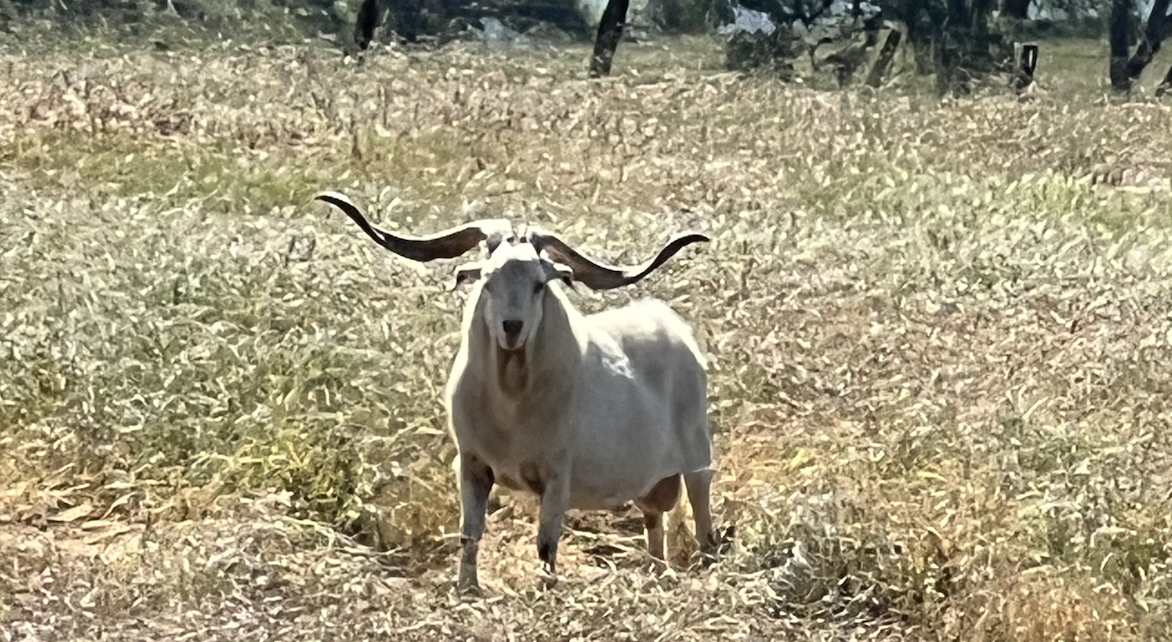
Billy Goat, Amador County. (Photo: Katy Grimes for California Globe)
California Labor and Democrats Driving Wildfire Reducing Goat Herders Out of Business
Labor groups are wagging the dog as California is right in the middle of wildfire season
By Katy Grimes, July 14, 2026 6:30 am
After many failed attempts to unionize more agricultural workers in California, Gov. Jerry Brown instead signed into law Assembly Bill 1066 in 2016 by then-Assemblywoman Lorena Gonzalez (D-San Diego), and sponsored by the United Farm Workers (UFW) labor union, to require overtime pay of time-and-a-half for farm and agriculture employees working more than eight hours a day or 40 hours a week, and double pay for those working more than 12 hours a day.
Gonzalez left the California Legislature in July 2023 to become the Chief Officer of the California Labor Federation, but not before gifting labor unions more members.
Assembly Bill 1066 included a gradual rollout—starting earlier for larger employers with more than 25 employees, and fully applying to smaller ones by 2025.
AB 1066 “Defines a full workday as 8 hours, and 40 hours as a workweek,” the bill arrogantly claims.
Not all “workdays” are 8 hours.
“Agriculture does not follow a fixed schedule. Crops don’t wait for an eight-hour workday. Harvests occur when they are ready, driven by weather, timing, and risk. When a crop is ready, every hour counts. When it isn’t, there might be no work at all,” Hector Barajas wrote for the Globe. “For generations, California understood that reality. Farmworkers can work longer hours during peak seasons, not as a loophole, but as a lifeline. Those weeks of intense work made it possible to earn enough to support their families through the rest of the year.”
Now, the remaining tentacles of that business-killing labor bill are coming for goat herders.
“Green Goat Landscapers in Gilroy, which uses about 1,000 goats to clear vegetation that can fuel wildfires, said the law could threaten the future of grazing operations that play a role in wildfire prevention across the state,” ABC7 reported this past weekend.
The California company said its herders come from around the world and are compensated through a combination of salary, housing and other benefits. They live in trailers on-site with their herds while they are working.
However, effective July 1, 2026, the final change to California labor rules for goat herders is causing major issues for goat grazing businesses, which are widely used for wildfire prevention and vegetation management. A new state law requires goat herders to be paid on a 24-hour-per-day, seven-day-per-week hourly basis rather than through the current monthly salary system. Sheep herders are exempt from the requirement.
Goat herders were previously covered by a temporary exemption under Senate Bill 143, in the 2023 budget bill, allowing them the same alternative minimum monthly wage as sheep herders, roughly $64,000 per year with benefits.
That exemption expired on July 1, 2026. Goat herders now fall under standard agricultural worker rules: hourly minimum wage of $16.90 for farmworkers plus overtime for hours over 8 hours a day or 40 per week.
Because herders live on-site and are on-call 24/7 monitoring for predators, animal health, etc., this effectively means paying for all hours, increasing annual costs per herder to at least $240,000 – up from $64,000 annually.
Sheep herders remain exempt with the special monthly rate. Green Goat Landscapers and Western Grazers say they can’t absorb the costs.
They are facing potential layoffs of herders, selling herds amounting to hundreds to thousands of goats for slaughter, business closures or bankruptcy, and in California with its extended “wildfire season,” reduced wildfire prevention grazing across the state – goats clear brush in areas inaccessible to machinery.
This affects targeted grazing operations that manage 20% of the state’s goats for fire risk reduction.
A 2023–2026 temporary fix via SB 143 included a required study on herder wages, which was released in 2026. Recommendations included aligning sheep and goat rules permanently, as the work is similar. But that did not happen.
What Happened?
AB 1099 by Assemblywoman Megan Dahle (R-Bieber) attempted to create permanent exemptions for goat herders, or even special wage rules for them, but it failed, largely due to opposition from labor groups. Her bill died in committee without a hearing or vote.
SB 801 by Senator Hurtado attempted to narrow agricultural overtime definitions or exempt sheep and goat range herders from AB 1066 requirements. It did not receive a vote and failed to advance.
Labor groups opposed permanent exemptions, arguing for consistent overtime and minimum wage “protections” across agricultural workers rather than industry-specific carve-outs.
Supporters of the bills including ranchers, grazing companies for wildfire prevention and landscaping highlighted the unique 24/7 remote nature of the work, H-2A visa reliance, high costs (labor often 30–50% of expenses), and the overall serious risk to these herding businesses, which could lead to business closures, goat culls, or reduced vegetation management that helps mitigate wildfires, the Sacbee.com reported.
The California Legislature can still act as the legislative session goes through August 2026. But what a mess, with labor groups wagging the dog as California is right in the middle of wildfire season, with several active fires. And what about costs to agriculture?

Goats are natural browsers, as they prefer eating shrubs, vines, weeds, and woody plants over grass, making them highly effective where machinery struggles or chemicals are undesirable. They can access steep slopes, rocky areas, and dense brush without causing soil compaction or erosion like heavy equipment does. And goats will consume 60 percent or more of their diet on browse as compared to cattle’s 10 to 15 percent.
Opponents of the legislation that created this disaster said it would end up hitting many agricultural workers in their wallet as agriculture employers would be forced to pay higher overtime costs during peak season.
Notably, this is the list of big labor cohorts who supported Lorena Gonzalez’s AB 1066:
United Farm Workers (Sponsor)
Alameda Labor Council
Alliance San Diego
American Civil Liberties Union of California
American Federation of State, County and Municipal Employees
Asian Americans Advancing Justice – California
California Catholic Conference
California Employment Lawyers Association
California Immigrant Policy Center
California Labor Federation
California Rural Legal Assistance Foundation
California State Conference of the National Association for the Advancement of Colored People
California State Treasurer, John Chiang
Center of Policy Initiatives
Coalition for Humane Immigrant Rights of Los Angeles
Consumer Attorneys of California
Courage Campaign
Dolores Huerta Foundation
Don Saylor, Yolo County Supervisor
Equality California
Farmworker Justice
Food Empowerment Project
Kern, Inyo, and Mono Counties Central Labor Council
La Cooperativa Campesina de California
Latino Coalition for a Healthy California
League of United Latin American Citizens – California Chapter
Mayor Eric Garcetti, City of Los Angeles
Mexican American Legal Defense and Education Fund
National Association of Social Workers – California Chapter
Religious Action Center of Reform Judaism
Sacramento Central Labor Council
Service Employees International Union
United Food & Commercial Workers Union – Western States Council
Western Center on Law and Poverty

A California native and Navy mom, Katy lives in Sacramento, CA.
- California Voters: Howard Jarvis Taxpayers Association’s 2026 Voting Guide - October 23, 2026
- Newsom Gaslights Over California’s Bad Student Test Scores - October 22, 2026
- How the DMV Enabled Voter Fraud in California - October 21, 2026
RELATED ARTICLES
-
 May 19, 2023
 -
 January 24, 2024
 -
 June 1, 2023
Leave it to California Dumbocrats to screw up even goat herding. Let’s see you try to get a tractor on the side of a steep hill to clear brush.
There is a large herd of goats currently devouring the waist-high overgrowth alongside Lindero Canyon Road in Westlake Village this very day…
Leave it to the dumbass Democrats and their usual cast of progressive unions and bleeding heart liberals to screw up wildland fuel mitigation procedures….
Ahhh right, goats aren’t unionized and dont pay dues that fuel the Democrat campaign coffers….
Guess Democrats would rather burn your home down than prevent it, under the guise of “protecting labor “….
Just like their $20 minimum wage in fast food cost thousands of workers their jobs….
STOP VOTING DEMOCRAT – THEY ARE DUMB PEOPLE without any cause and effect abilities!!!!
When will under represented counties (State Of Jefferson) ever be able to “get the goat” of radical coalitions of unions, religious organizations, academic institutional cadres, and communist parties that rule over Democrats? Their intent on eradicating rural work ethics and enterprises of production by choking communities with legislative shortages, regulations and infrastructure neglect is effectively killing the CALIFORNIA REPUBLIC and its sovereignty.
Central Planning vs The Kulaks
SEIU
Beware of the large women in purple tee shirts
The goat herders should just leave CA and let us burn. Nothing will get the voters attention until something serious happens!
But wait. Looking thru the lens of global warming. How much methane do goats emit. Maybe that’s the reason for them waging war on the goat herders. Theres has to be ALOT of goats in this state emitting co2 and methane. Pair them with the cows and good lord. Maybe the cows and goats can unionize. I think it would be better for them . Democrats destroying ANOTHER industry. Just another day in Cali. Unbelievable.
Joining this to how the state of califonia runs its firefighting efforts, they must want another palisades fire. Other than that, goats are pretty cool creatures, spend some time with them and they’ll like you. They are also little houdinis, they can be ingenious about escaping a pen. Also, never park your car where goats can get to it, it will be jumped on and they’ll clatter all over it, especially the young ones.
Of course the Dems want another Palisades-style fire. And they also probably work for the UN and its REWILDING of the USA. THERE IS A MAP OF THE USA which shows most of the USA map in red with Most Humans RESTRICTED from the USA land and just small pockets with human population density in those UN SMART CITIES aka 15-MINUTE-CITIES. This is definitely planned out and I don’t know why the Republicans Leaders don’t stop this.
What do vastly over-paid and bloated first responders do anyway, when there are no more first responses respond to? Do we hand out tin cups to all the “first responders” if we have no more fires? Gotta have fires. Big fires, devastating fires, fires worth supporting the total collective value of all fire departments in this state .
Count the collective value if all fire departments in your own district on Transparent California. Surely there must be some overlapping dependencies, when you have (1) city, (2) special districts, and (3) county fire services all covering the exact same areas. All within cell phone reach from each other.
Those same areas that are already covered by state funded Cal Fire support, and who are the first people local fire agencies call anyway. While the bloated local fire agencies “direct” local Cal Fire operations a safe distance from the actual front fire lines.- the real dirty work “first responders” are Cal Fire. Not those local yokels at $400K plus who demand we call them heroes, after Cal Fire does all the real work.
Get DOGE working on the overlaps and redundancies current our multitude of fire response agencies.
#WakeUp
#WalkAway
#NEVERVoteDemocratAgain
Californians Against DemoNcrats!
#VoteRepublican2026
Democrats are intent on destroying California. This is asinine. Bernie Sanders talks about oligarchs, the unions are the oligarchs in California. Do not vote for any democrat. They are all of the same corrupt hive mind.
Thanks for the list of rogues gallery Democrat “interest groups” who predictably show up to raid this state 24/7.
All on one page. Mark them for future reference if anyone still does not understand what happened to California. Where the most voracious beasts devouring this entire state are now all on one list. Too bad these current goat weed eaters cannot be trained to eat the real weeds clogging up this state and creating the major dumpster fire burning down this state.
There they are folks, all listed together and ready for instant obstruction of any and all innovative, cost-cutting, pragmatic solutions that …….do not require MORE UNION JOBS. What more proof do we need?
Knowledge is power. Anything they are for, be sure to vote against it.
Many years ago I was fiercely anti union before I hired into a large corporate business and got a good idea of how much the company thought it owned me and what they would do if there were no local union between me and the company. I will add that the local union I belonged to was nothing like the SEIU or teachers’ unions. Everyone just worked without engaging in political bs. The hall focused on fillng jobs and representing workers, with the exception that when election season came around they would sound like communists for a couple months because the international expected it, and when the election ended everything went back to normal – political discussion was minimal and rare. However, I think there should be no such thing as a government union, with the government unions campaigning for those who hire them and all the cash that boomerangs from government payroll to union dues collected to leftist political campaigns. It’s like divided loyalties and conflicts of interest when unions and politicians scratch each other’s backs
It’s worse than that. Wages are only about 30% of the cost of a wholly-legal employee in California. So the actual cost of a goat herder in the field won’t be $240,000 — it will actually be about $800,000. Who can afford that for clearing brush??
@Reziak, explain how your figures work, not a adversarial question. It used to be that a shepherd was paid by the month and originaly had use of a wagon then a trailer. There were also the highly trained dog(s). I’ve seen videos of middle eastern and south american goat herding. The videos depicting goats clearing brush were informative for me, but they were all filmed in heavy brush of the eastern US. It seems brush clearing operations were largely family businesses. There were paths cut through the brush for temporary fences, and the goats were turned loose in the large enclosure, whereupon the goats picked the area clean. The goats were moved from place to place in pickup towed stock trailers, and the goats were eager to get in the trailer when called. I don’t know how it would work in california, would the area be fenced or a traditional goatherd be employed, and I’m not sure if a dog would be necesary as for sheep. There might be an interminal and costly permit application for fencing, and for all of it there will surely be some bureaucratic panic that some common, invasive weed might be consumed along with environmental impact studies…
The Henry Miller I referred to was a 19th century trade unionist, not the 20th century novelist.
Anything to destroy a natural solution to a problem that can’t be done reliably by huge farm equipment or humans that can’t work in extremely high heat and sun. Just ask a firefighter about that last part. 80+ pounds of equipment on their backs in 100 degree heat, no bueno. Goats are a fantastic way to take down vegetation that burns homes down and destroys lives…..this is all about the Marxist Dems again taking over our lives and saying it’s all for our “good”. If the illegal farm workers, voting illegally for those same politicians can’t do it, put a real working industry out of business.