
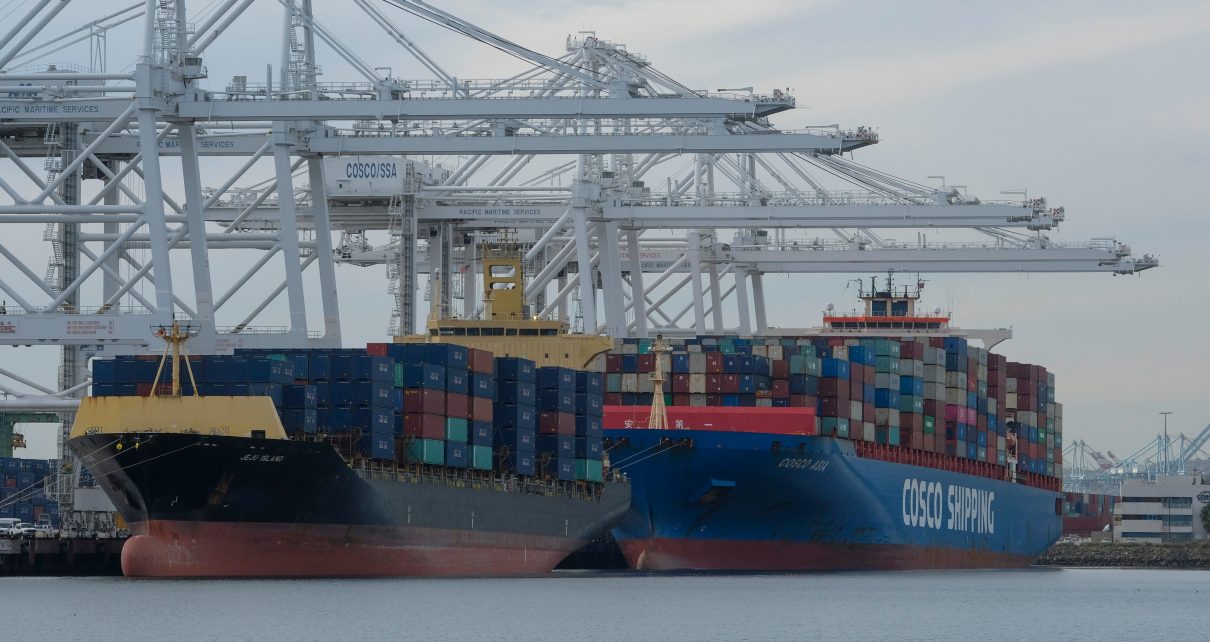
Cargo ships stacked with shipping containers are docked at the Port of Long Beach. Calif., Jan. 2022. (Photo: Ringo Chiu, Shutterstock)
California’s State of Emergency for Transportation Fuels
California’s reliance on foreign refineries poses a serious national security threat to America
By Mike Ariza, May 30, 2026 8:00 am
By Mike Ariza and Ronald Stein
California is the fourth-largest economy in the world and an “energy island” that is separated from the other 49 States by the Rocky and Sierra Nevada Mountain ranges. There are no pipelines over these prestigious mountains. Until recently, California’s in-state refineries have historically met nearly all of the state’s massive transportation fuel demand.
- Jet fuel: With all 145 airports, including nine international airports and 30 military airports, the demand is 13 million gallons of aviation fuel every day. Several of those airports have direct pipelines to local refineries. In 2019, California consumed 16.7% of the national total of jet fuel, making it the largest consumer of jet fuel in America.
- Gasoline: For its 30 million vehicles, California is the second-largest consumer of motor gasoline among the 50 states– consuming 42 million gallons a day, just behind Texas.
- Diesel: Diesel fuel is the second-largest transportation fuel used in California, consuming 10 million gallons a day of diesel to support the state’s highway transportation and trucking of products from three of the busiest shipping ports in America.
- Bunker Fuel for the ships in three of the busiest ports in America, located in California, consumes about one million barrels of bunker fuel annually. The Port of Los Angeles had more than 1,800 vessel arrivals in 2024, which includes cruise and merchant ships. Port of Long Beach handled over 9.6 million container units in 2024, indicating a very high volume of ship activity, plus cruise ships. The Port of Oakland, which also handles significant cargo volumes, contributes to the total number of cruise and merchant ships needing fuel.
Thus, if California refineries cannot manufacture the transportation fuels, the fuels must come from somewhere. California is the only state in the nation forced to import transportation fuels from foreign refineries to replace shuttered in-state capacity and meet the massive energy demands of the world’s fourth-largest economy.
As stated by Chevron CEO Andy Walz during an Ashley Zavala KCRA 3 Interview, March 6, 2026: “I am extremely worried! I do believe we should declare a state of emergency in the state of California.”
Millions of families across California, Nevada, and Arizona are already struggling financially. Adding to their burden, nearly 40% of California’s transportation fuels are now imported from Asia — primarily South Korea, China, India, and Singapore. Ongoing instability in Iran has disrupted crude oil supplies to Asian refineries, forcing many of those facilities to cut production. As a result, these countries have sharply reduced or halted fuel shipments to California.
The effects of this are clearly detailed in a recent California Globe report titled “California Gasoline Supply Outlook: A Disaster in the Making“, co-authored by USC Professor Michael Mische and UC Berkeley Professor James Rector.
The professors note: “These Asian refiners (notably India and South Korea) curtailed most exports as of March 15 but the corresponding decline in arrivals to California has only just begun due to shipping times of 25 – 45 days across the Pacific Ocean. Over the next one to two weeks, gasoline imports are expected to drop off sharply, reflecting cargoes that were never loaded or diverted. This will mark the point at which the import shock becomes fully visible in terminal supply and, ultimately, at the gas pump.”
Another serious scenario is now unfolding that could have major consequences for the West Coast. In his own words, refinery CEO Andy Walz recently warned: “If you close a refinery, it doesn’t come back. Closing a refinery is not a reversible decision. So if we close, we do not come back.”
Walz made the comments in response to a question from KCRA 3’s Ashley Zavala regarding a recent letter Chevron sent to Governor Newsom and the California Air Resources Board (CARB). Along with PBF and Marathon, Chevron warned that it is seriously considering shutting down its California refineries and leaving the state. The companies cited proposed amendments to the state’s Cap-and-Invest program, which would impose hundreds of millions of dollars in new fees on California refiners while foreign competitors pay nothing.
When asked specifically in the same interview about the possibility of Chevron shutting down, Mr. Walz replied: “If they add this burden of a tax on our refineries, I think it’s just a matter of time. It’s not whether or not they’ll close, it’s just when.”
Walz reiterated these concerns in a March 9, 2026 interview with Fox News’ Stuart Varney, who asked him the same question about the future of California’s refineries. Walz responded: “We think the policies they are putting in place will eliminate all refining in the state of California.”
If these corporations shut down their refineries, California will lose six of the remaining seven that are currently online. The state would then be forced to import massive volumes of fuel from foreign refineries: approximately 13 million gallons of aviation fuel per day, 42 million gallons of gasoline per day, 10 million gallons of diesel per day, and roughly 1 million barrels of bunker fuel annually for merchant ships.
The loss of jet fuel would immediately threaten operations at California’s nine international airports and approximately 30 military airfields.
Less obvious, but equally critical, is the impact on diesel. Most California cities maintain only a three-to five-day supply of food on grocery store shelves at any given time. A severe diesel shortage could trigger a rapid breakdown in the trucking and logistics network that delivers food across the state. The nation’s busiest container port, The Port of Los Angeles, could face shutdowns, leading to widespread food shortages in major cities within one to two weeks.
Adding to the growing alarm, state officials and major media outlets have reported in recent weeks that California’s reserves of transportation fuels may now stand at just four to six weeks.
It is time for Governor Newsom, the Democrat-controlled Legislature, and the CARB to step back and consider the bigger picture. California, along with neighboring Nevada and Arizona, now faces a serious energy crisis. Cap-and-Invest policies are crippling the state’s refining industry. Governor Newsom and state lawmakers must summon the courage to make the difficult decisions necessary to avert this disaster. If they fail to act, the only remaining option may be for President Trump to broadly invoke the Defense Production Act to protect California’s military installations and its residents.
Please share this information with teachers, students, and friends to encourage Energy Literacy conversations at the family dinner table.
Mike Ariza is a US Navy veteran with over twenty years of experience in the refining industry. His refining experience extends from the Chevron Refinery in Richmond California, the Flying J refinery in Bakersfield, and the Valero Refinery in Benicia. Mike held the positions of number one control board Operator at Flying J and Senior Refinery Control Board Supervisor at Valero. He was an instructor of both operator field and control board classes. Among his peers he is often referred to as one of the top ten control board operators in the country.
Ronald Stein, P.E., is an engineer, columnist on energy literacy at America Out Loud NEWS, and advisor on energy literacy for the Heartland Institute and CFACT, and co-author of the Pulitzer Prize-nominated book “Clean Energy Exploitations.” He is also the recipient of an unsolicited Tribute to Ronald Stein from Stephen Heins.
Click this Link to Sign up for Energy Literacy from Ronald Stein


- The Pride of Benicia: The 57-Year Legacy of a Refinery and Its People - June 23, 2026
- California’s State of Emergency for Transportation Fuels - May 30, 2026
- Understanding California Refineries: The ‘Turnaround’ - May 4, 2026
RELATED ARTICLES
-
 July 9, 2025
 -
 September 15, 2020
 -
 August 3, 2020
The Democrats want chaos. That’s their plan to create an authoritarian government.
Our only hope is getting a Republican governor in the next election.