

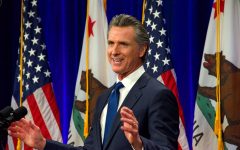
Gov. Gavin Newsom unveils his 2025-2026 revised budget on 5/14/25 (Photo: California Governor Gavin Newsom)
Governor Newsom Signs ‘Historic Balanced State Budget’ with Structural Deficit
A structural deficit like California’s occurs when ongoing revenues are consistently insufficient to cover ongoing spending commitments at current service levels
By Katy Grimes, July 1, 2026 12:57 pm
On June 29, 2026, Governor Gavin Newsom signed the 2026-2027 state budget. Before your eyes glaze over, here is how the governor characterized it:
“Governor Newsom signs historic balanced state budget, cementing California’s fiscal strength and investing in the state’s future.”
His press release added this little gem:
What you need to know: Governor Gavin Newsom today signed California’s 2026–27 state budget, delivering a balanced budget with no deficit this year or next while preserving historic reserves, investing in working families, protecting the rights of Californians, and leaving California on its strongest fiscal footing in generations. In a video released today, the Governor reflects on how California proved that fiscal discipline and ambitious public investment are the foundation of the state’s success.
A balanced California budget with no deficit? Are you kidding me? Leaving California on its strongest fiscal footing in generations? Fiscal discipline and ambitious public investment are the foundation of the state’s success?
Call the vomitorium, stat.
The Legislative Analyst’s Office disagrees. The LAO says:
$18 Billion Budget Problem in 2026‑27
2025‑26 Budget Act Anticipated Deficits Through the Multiyear
2026‑27 Budget Problem Now Larger Than Anticipated
Budget Position Is Weak
Who are you going to believe? Governor Newsom or the non-partisan Legislative Analyst’s Office?
California has a structural deficit.
A structural deficit like California’s occurs when ongoing revenues are consistently insufficient to cover ongoing spending commitments at current service levels – independent of short-term economic fluctuations (cyclical factors). It is a long-term mismatch: even when the economy performs well and revenues grow, spending grows faster or stays elevated at a level that revenues cannot sustainably support. This contrasts with a cyclical deficit, which arises temporarily during recessions when revenues drop due to weaker economic activity.
According to the Legislative Analyst’s Office, key drivers include:
- Spending growth outpacing revenue growth: During surplus years, like the post-COVID boom with record revenues, the state expanded programs and commitments. When revenues normalized and dipped, as in 2022–2023 due to market declines, spending levels remained high.
- Constitutional requirements: Propositions like 98 (education minimums) and 2 (rainy-day fund deposits) automatically direct a large share of any revenue gains to specific areas, leaving less flexibility.
- One-time fixes and borrowing: Recent budgets used reserves, delays, borrowing, and temporary measures to plug gaps. These don’t address the underlying imbalance and often create future repayment pressures.
- Program costs: Rapid growth in areas like Medi-Cal, child care, housing, and corrections, plus external factors like federal policy changes.
As a result, deficits have become “chronic” rather than temporary, the Legislative Analyst’s Office says.
In May “Governor Gavin Newsom unleashed his Trump Derangement Syndrome during his May budget revise press conference for the first 10 full minutes, blaming the President’s policies–especially tariffs– for contributing to a worsened budget outlook,” the Globe reported.
“But hey! Gov. Gavin Newsom’s final May budget revise is ‘miraculously balanced,’ he says.
Gov. Newsom said he was not only handing off a balanced budget for next year to a new governor, his two-year budget will be balanced in 2028 as well.
Pardon my snicker.
Newsom proposed roughly $322 billion in total spending and about $226 billion General Fund spending. His budget revise projected a $12 billion deficit for 2025-26.
It is important to note that the Legislative Analyst’s Office (LAO) warns, ‘deficits have persisted even as the state’s economy and revenues have grown, underscoring that the problem is structural rather than cyclical.’”
Why California Has a Structural Deficit
California’s budget is heavily reliant on volatile revenues, and in particular, personal income taxes from high earners and capital gains taxes. And as the LAO noted, mandatory funding programs eat up large chunks of the budget, like education funding through Proposition 98, and Medi-Cal healthcare for low-income individuals, with growing caseloads due to adding illegal aliens onto Medi-Cal coverage, nearly bankrupting the system.
CalMatters even reported that Newsom’s budget “also means that for the fourth year in a row in his tenure, California is projected to have a deficit despite revenue growth.”
“But state Sen. Roger Niello of Roseville, the Republican vice chair of the Senate Budget Committee, attributed the structural deficit to Democrats’ ‘unstoppable spending problems.” ‘The state must assess the effectiveness and sustainability of the programs that were created during the surplus and make necessary corrections,’ he said in a statement.”
California’s structural deficit reflects a baseline where the “new normal” of spending exceeds what the tax system reliably produces over time. Addressing it typically requires multiyear realignment—either reining in automatic spending growth or broadening/reforming revenues—rather than one-off patches.
The California budget is not balanced, and does present future deficits.
I almost expected to see Gavin Newsom shimmying his shoulders again and emoting with jazz hands. It’s his tell.
Stop it 😂😭💀 pic.twitter.com/84cbrMSzDb
— Politi_Rican 🇵🇷 𝕏 🇺🇸 (@TheRicanMemes) January 14, 2025

A California native and Navy mom, Katy lives in Sacramento, CA.
- American Academy of Pediatrics Doubles Down on Infant/Child Covid Vaccine - October 10, 2026
- Sacramento’s Own Radical Congressional Candidate has Upcoming Event Hasan Piker - October 9, 2026
- What? Sacramento Ranks in Top 10 Asthma Locations in the US? - October 8, 2026
RELATED ARTICLES
-
 January 8, 2024
 -
 July 1, 2024
 -
Newsom doesn’t need a public relations office. He doesn’t need to think at all, which he generally doesn’t anyway. I asked AI to write a statement for Gov. Newsom, and here is what it spit out. All he has to do is read it in front of some press cameras, and he is all set.
“I have taken some of the boldest actions any government in this country has taken in a generation, delivering a $351.7-billion budget without breaking the bank and securing California’s future in a way no predecessor ever has; by every measure of progress and resilience, I am the best governor this state has ever had.”
See!