
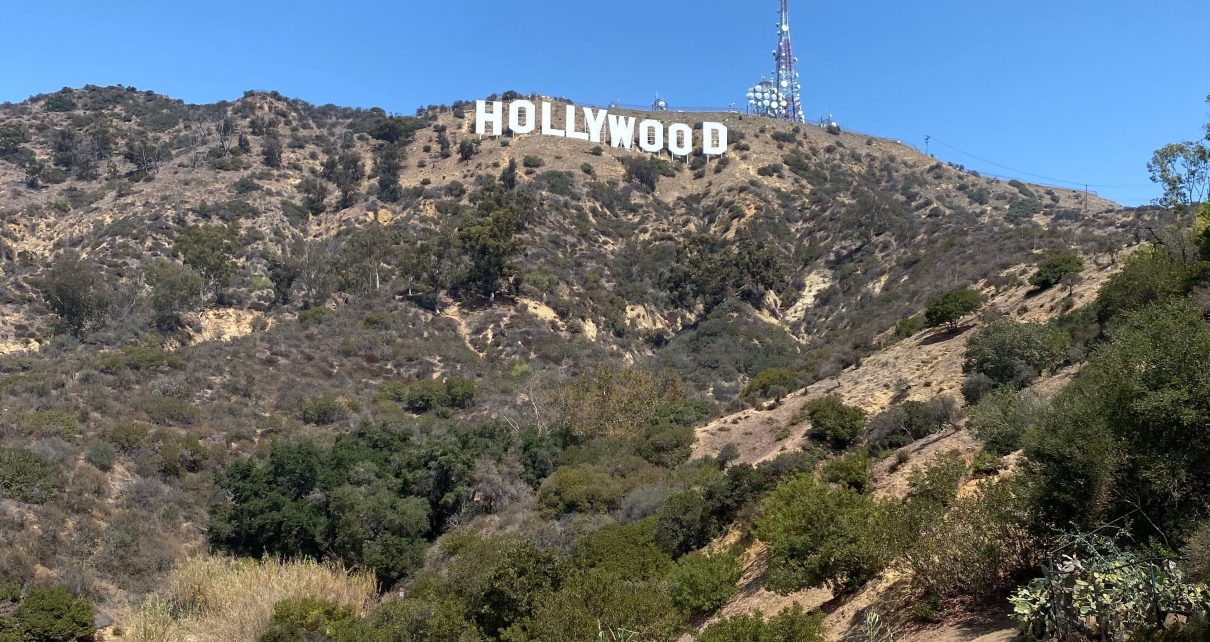
Hollywood sign (Photo: Public Domain)
Hollywood Edited Out October 7 Massacre But The Protesters Brought the Footage
‘Films have editors, history does not’
By J. Mitchell Sances, October 5, 2026 7:00 am
On the afternoon of September 26, as the New York Film Festival gave NAZA its North American premiere inside Alice Tully Hall, Israeli Americans and other Jewish protesters stood in the rain on Broadway with a simpler demand than the one festival audiences are used to hearing: show the rest of the record.
NAZA, directed by Yuval Abraham and Rachel Szor, was shot at night from Tel Aviv rooftops and is built around interviews with anonymous Israeli soldiers and intelligence personnel. The filmmakers describe it as an examination of “the systems behind the mass killing of Palestinian civilians.” It won the Special Jury Prize at Venice earlier in September, drew a long standing ovation there, and is scheduled to open in U.S. theaters on October 9 before a wider release and a free stream on The Guardian’s site. What it does not do, the people outside the hall argued, is give any serious account of the Hamas-led massacre that started the war.
That omission is the point, and it is also the Hollywood habit. For three years the industry has treated the Gaza war as a morality play with one villain and one set of victims. Festival juries, celebrity open letters, and red-carpet speeches have repeated the same framing. Israeli brutality is the headline, and October 7 is a footnote if it appears at all. NAZA is that habit in documentary form. A film can be tightly edited; a war cannot. The directors have said they made it from “a sense of obligation to use our position as Israelis to examine the systems behind the mass killing of Palestinian civilians for which our country is responsible.” The obligation, as they define it, runs in one direction. The massacre that opened the war is left on the sidewalk.
The rally outside was organized by the Israeli-American Council. Mobile LED trucks ran footage from October 7: Bearing Witness to the Massacre, including video Hamas terrorists filmed themselves, along with portraits of the dead and material the organizers said contradicted the documentary’s claims about sources and method. Signs read “Learn the facts. Know the truth.” Survivors of the October 7 massacre Rom El-Hai and Shalev Biton spoke, as well as Younes Al-Garnaoui, an Israeli Bedouin who rescued people that day. Estimates of the crowd ranged from a couple of dozen to more than fifty, and they even stayed through a nor’easter.
Tal Shuster, an IAC co-chair, was explicit that the point was not a ban. “We’re here not because we’re saying, don’t show the film,” he said. “Everyone has the freedom of speech, that’s the United States. We are saying: it’s not all the facts.” He put numbers on the omitted half: about 1,200 people murdered and 251 kidnapped on October 7. “If you screen the film, invite a survivor, let them speak, at a panel. Let them be heard. Don’t just show one side without the facts from the other side.”
Noa Peri-Jensch, the IAC’s chief communities officer, made the same distinction. “We mourn every innocent life lost in this war, Israeli or Palestinian. But compassion for Palestinian civilians does not require us to erase October 7, ignore Hamas or accept one narrative without questioning it.” The group launched a petition asking festivals and theaters to pair NAZA screenings with survivor testimony and background material. The IAC’s line was blunt: “Films have editors. History does not.” The council described the picture as one that “makes serious allegations about the IDF’s conduct in the Gaza Strip while ignoring findings and information that contradict its claims” and leaves out “the context of the October 7 attack that led to the war.” A truck circling the theater called it propaganda dressed up as a documentary.
The military’s response has been equally direct. The IDF Spokesperson’s Unit called a central claim in the film — that a strike was planned or approved with an expected toll of about 500 civilians — “a complete lie,” and said no such strike was planned, approved, or carried out. In a later detailed reply, the military said the film’s narrative rests on “substantial factual errors” and a “misrepresented and manipulative depiction of reality,” that it conflates early intelligence estimates with the later approval process, and that the filmmakers supplied no dates or locations and did not put the specific allegations to the IDF before release. Israel’s consul general in New York, Ofir Akunis, called the filmmakers “shameful” and the film a blood libel.
None of that settles every dispute inside the documentary. Anonymous testimony about targeting procedures is exactly the kind of material that needs dates, places, and a chance for the accused institution to answer. What the Lincoln Center protest made visible is the prior choice: a festival film about this war that treats the slaughter of Israeli civilians as optional context. El-Hai told the crowd that if someone wanted footage of hatred and the killing of innocents, “all the material is here. I took pictures of everything. I saw the hatred with my own eyes.”
There is an irony the industry would rather not discuss. Hollywood’s studios, agencies, and prestige festivals have long had a large number of respected and prominent Jewish executives, producers, and writers in the rooms where slates get set. That is a matter of demography and history, not a conspiracy. It makes the one-sidedness harder to wave away as simple ignorance. The same town that still trades on Schindler’s List and on the memory of the Holocaust has spent this war platforming the narrative that flattens Israelis into occupiers and edits out the day Hamas filmed its own massacre. Jewish names on the letterhead have not stopped the guild statements, the boycott talk, or the standing ovations for propaganda. Institutional fashion has outrun personal history.
California audiences will get their turn soon enough. The theatrical plan includes Los Angeles in the October expansion. When it arrives, the question the protesters put on the trucks is the one worth asking in the lobby: whether a film that withholds the massacre that opened the war is reporting on that war, or editing it into propaganda.

- WGA East Partners With Cloak to Keep AI Script Summaries Off the Table - October 22, 2026
- Netflix’s ‘14th’ Filmmakers Urge Americans to ‘Fight’ While Lecturing on Autocracy - October 19, 2026
- Private Initiative Steps Up While Sacramento and City Hall Stall: Caruso, Skydance, and the Bay Theater’s Return to the Palisades - October 15, 2026
RELATED ARTICLES
-
 August 5, 2019
 -
 June 10, 2021
 -
“Those who cannot remember the past are condemned to repeat it.” – George Santayana, The Life of Reason, 1905.