
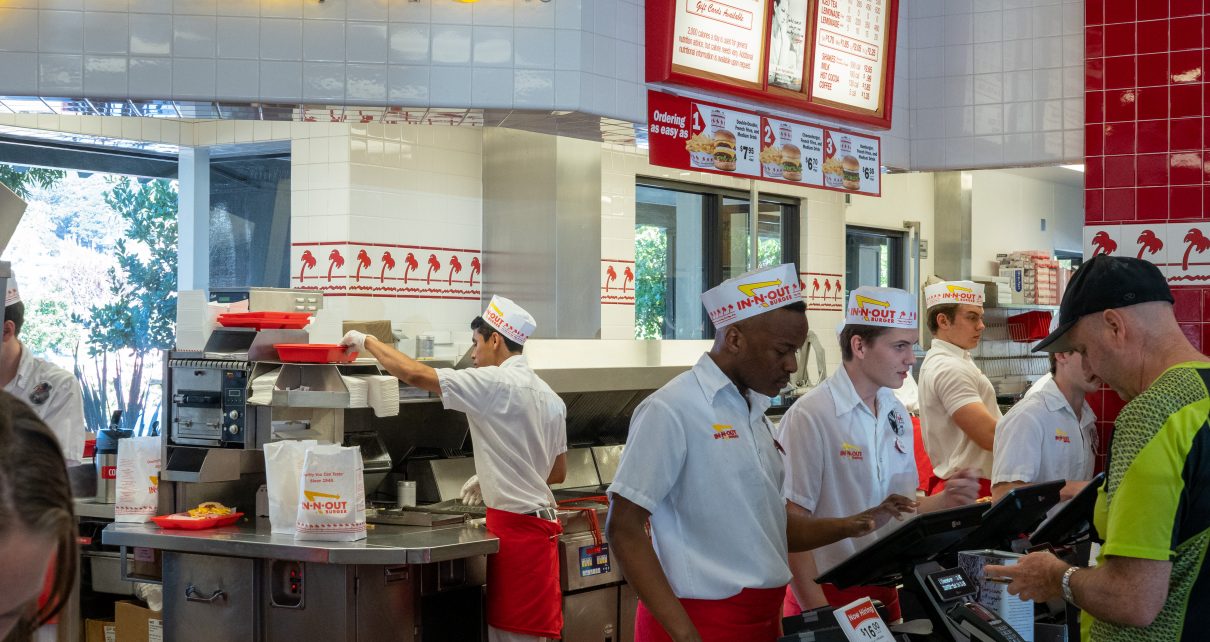
Mill Valley, CA: Workers at In-N-Out location behind counter take orders. (Photo: David Tran Photo, Shutterstock)
New Economic Study Finds California’s $20 Fast Food Minimum Wage Caused 18,000 Job Losses
National Bureau of Economic Research examines California’s fast food sector
By Katy Grimes, July 14, 2025 7:24 am
“New data from the federal Bureau of Labor Statistics was released Thursday, revealing a staggering 36,565 fast food jobs have been lost since September 2023 when the $20 per hour minimum wage law, AB 1228, was signed into law,” the Globe reported in June.
There is yet another new study out, this one is by the National Bureau of Economic Research in Cambridge Massachusetts:
In unadjusted data from the Quarterly Census of Employment and Wages, we find that employment in California’s fast food sector declined by 2.7 percent relative to employment in the fast food sector elsewhere in the United States from September 2023 through September 2024. Adjusting for pre- AB 1228 trends increases this differential decline to 3.2 percent, while netting out the equivalent employment changes in non-minimum-wage-intensive industries further increases the decline. Our median estimate translates into a loss of 18,000 jobs in California’s fast food sector relative to the counterfactual.
“AB 1228 increased wages substantially in California’s fast food sector,” the new economic study by the National Bureau of Economic Research finds. But the study finds something else as well:
California’s non-minimum-wage-intensive employment was on a slower growth trend than the rest of the United States prior to the implementation of its fast food minimum wage. Once again, the estimates using non-changing states as a comparison is larger in absolute value, with a simple triple-difference estimate of -2.6 percent and a detrended triple-difference estimate of -3.9 percent.
The study also says “it is possible that AB 1228 has led full-service restaurants to have more difficulty attracting workers, or that those employers anticipate future minimum wage increases in their sector as well.”
Every food service employee now wants $20 per hour.
The study concludes:
We document that AB 1228 increased wages substantially, with a roughly 8 percent increase in California’s fast food sector relative to the fast food sector elsewhere in the country. With respect to employment, we first show that California’s fast food employment was on a similar path as the rest of the United States prior to AB 1228’s enactment. Following AB 1228’s enactment, employment in the fast food sector in California fell substantially, with estimates ranging from 2.3 to 3.9 percent across specifications, even as employment in other sectors of the California economy tracked national trends.
Combining the wage and employment effects we estimate, the implied own-wage em- ployment elasticities range from -0.29 to -0.49. These elasticity estimates exceed the median own-wage elasticity in the literature as summarized by (Dube, 2019). Because CA’s statewide fast food minimum wage rose by 25% (i.e., from $16 to $20), the implied elasticities of fast food employment with respect to the minimum wage range from -0.09 to -0.16.12 These are lower bounds on the effect of a sector-wide minimum wage increase of 25 percent, how- ever, for two reasons. First, several large jurisdictions within California had minimum wages in excess of $16 at the time of AB 1228’s implementation. Second, many limited-service restaurants were not affected by AB 1228 due to its focus on large chains. Put differently, the effective increase in California’s statewide fast food minimum wage was smaller than the statutory increase and only part of the sector was affected, indicating that the implied elasticities on affected restaurants was larger.
The Employment Policies Institute released data in May showing AB 1228, California’s $20 wage law for fast food workers, cost non-tipped restaurant workers 250 hours of work annually, equating to up to 7 weeks of lost work – up to $4,000 in lost potential income, the Globe reported.
As the Globe warned, thousands of fast food employees lost jobs, employees’ hours were cut, and business owners had to do more with less.
The data comes just over one year after AB 1228’s implementation, and as Los Angeles considers a drastic union-backed $30 wage hike for hotel and tourism workers that would follow the fast food wage law’s precedent of economic destruction, EPI reports.
The Globe reported the fast food minimum wage timeline and economic devastation:
Before the actual implementation of April 1, 2024, thousands of fast food jobs were shed by companies in anticipation for the higher costs, including Pizza Hut who let go 1,200 drivers alone. In addition, lawmakers knew that there was suddenly going to be a lot of lost jobs, and hastily brought in exemptions for fast food restaurants in airports, stadiums, theme parks and other major public areas.
Nonetheless, job losses quickly mounted after April 1st of last year when the law came online. Not only job losses either – many workers found that they were now working fewer hours or lost a shift as a result. In addition, restaurants automated what they could to avoid the higher wages, including investing in touch screen kiosks over having more traditional cashiers. Some fast food restaurants also closed, as the 25% wage increase from $16 to $20 ruined their thin profit margins.
By June 2024, Stanford University found that over 10,000 fast food jobs were already lost. The Governor’s office swiftly denounced this figure, saying that the number of fast food jobs actually went up. They even went so far as to admonish many media outlets, including the Globe, for reporting the 10,000 job loss figure. While the Governor’s office tried for a few more months to convince Californians that AB 1228 actually brought about fast food job gains, they stopped by the fall when it became apparent that federal data wasn’t on their side. By November, the losses stemming from AB 1228 irked voters so much that they voted soundly against Prop 32, which would have raised the minimum wage statewide to $18.
We hope the governor’s office puts their gaslighting PR flack back in his cage, and takes time to reflect on all of the studies that have unequivocally concluded that the fast food minimum wage increase to $20 has been a disaster.


A California native and Navy mom, Katy lives in Sacramento, CA.
- U.S. Department of Ed Finds California Violated Federal Law Hiding Students’ ‘Gender Transitions’ from Parents - January 29, 2026
- Sacramento Mayor Kevin McCarty Proposes Property Tax on ‘High-Priced’ Homes to fund Homeless Housing - January 29, 2026
- Pacific Legal Foundation Files Federal Lawsuit Over Oil Setback Law Banning Owners from Accessing Resources in their Mineral Estate - January 28, 2026
Hey guys, I have good news and bad news.
The good news; Fast food minimum wage just went up to $20/hour.
The bad news; You’ll be working zero hours.
That’s been the story of minimum wage, going all the way back to its inception.
Yet the Left champions such laws.
My partner and I have dinner out a lot, and we have observed two phenomena as a result of the $20.00 minimum wage:
1. Leaner staffing everywhere, not just in fast food restaurants, because employers and employees know that staff can get $20.00 per hour at a fast food job;
2. Quantity and/or quality has gone down. For instance, at a renowned local gourmet burger chain, the hamburger patties are thinner and the quality of the meat doesn’t seem quite as good. Also, the hot dogs are definitely smaller and the chicken breasts for the chicken sandwiches are about half the size of what they were.
bs. if this is real why not say the name of this renowned burger chain. and is this a nationwide chain? do they make special patties for California? I doubt you’re even a real person
you’re an idiot. so by that logic we should allow businesses to pay people one penny an hour. 2.7 percent is nothing. it’s margin of error territory. nothing is cited in this study for the reasons in jobs supposedly lost, or among which entities. Get back to us when you have actual data, not reaganpmics.
Let’s hope the employees that didn’t get fired Don’t eat at the restaurants they work for because the average cost at those restaurants haves gone up over 14%. Which pretty much negates the raise..
yeah they went up 2 years ago. how many fast food joints do you know of that are struggling to survive?
Jeremy is spot on.
read the data Jeremy and don’t be stupid, no one will work for 1 cent an hour no matter how big the tips are. and don’t blame the demp
ocrats they are not the ones driving prices up ie. TARIFFS!
It’s all about tips, from the hole in the wall 10 seat counter diner with a flat top grill on the wall behind behind the counter to high end restaurants regular people can’t afford. You figure on a busy day with 5 tables turning over every 30 to 40 minutes with a $4.00 tip per table, it adds up.
For 3%, yes.
For 97%, “Hey guys the good news is you’re making $150 more per week, so you don’t have to sleep in your car.”
If you want to call that a disaster, go ahead – it merely shows how your head is screwed on.
Yeah, who cares about that 18,000 people. Or the fact that the costs at the restaurants who were forced to implement the minimum wage, have gone up about 14% on average. For everybody, which more or less Negates the wage increase for the people that didn’t get fired.
A lot of restaurants I frequent have also cut down their operating hours due to not being able to attract workers. That means less profits, and eventual CLOSURE of more businesses, which will deplete the tax base the democRATS in Sac love to raid. Keep voting failure and disaster.
I’m no democRat but if republican policies are so great why are they always the poorest states? hmmm the logic isnt logic-ing with you, is it? you must be from a red state and a failed third grade education with an argument like that.
That’s only ranked on GDP. Take california as an example, which supposedly has the fourth largest economy in the world. But is also almost two trillion dollars in debt and has more homeless than any other state in the country…
amen
doesn’t even make sense. the businesses not being able to attract workers stands in direct opposition to the claim businesses cant afford to pay workers. and way to go anecdotal dude, yes the applebees you go to is definitely the end all be all economic indicator. next tell us about the future of the stock market based on a billboard advertisement for a Money Market account you saw.
Why not bring back slavery? It would solve so many problems, wouldn’t it?
Illegal alien indentured servitude, isn’t good enough for you?
A lot of has to do with finding hires that are interested in learning their jobs, show some hustle and won’t call off if they just don’t feel like coming in that day. In my direct observations, you will rarely, if ever, find a white american working in a mexican national owned restaurant. Some of that has to do with mexican racism and sticking with the familiar (one mexican waitress quoted her boss as hating white people to me), but another mexican waitress told me that the white girls are lazy, which I believe has a grain of truth for the younger ones. One the other hand, I know a couple owners from central and south mexico who are color blind, most of the kids they have hired since covid haven’t a clue how to work (I’ve personally seen it there) and have problems with no shows. One of owners told me it was galling that if they trim the deadwood they were paying percentage of the unemployment checks (on top of what they already pay edd during employment) for people who no longer work there, and I know for a fact that if you’re fired it just takes longer to get your unemployment benefit than if you were laid off.
Cultural things to consider: the casualness of many mexicans, if a mexican says “I’ll do that right now” chances are that person will become distracted, forget, and get involved doing something else, or is blowing you off.
Wait for it.
Gav’s P.R. office will come out with a news flash that contradicts all of the facts in this article.
It happens every time this article shows up!
Thank you, oh so much, Katy Grimes and the Globe, for bringing us —- not SOME of the best —- but really the BEST coverage I’ve seen on the effects of this disastrous fast-food $20 an hour minimum wage law. And with links to the timeline of this slow-motion catastrophe.
So there you have it, as recounted and updated again by Katy Grimes: This HAS been an unmitigated disaster, easily foreseen but ignored, brought to us by the whorish politics of then-Asm Chris Holden, supervised and blessed and signed into law by the Worst Governor Ever, Gavin Newson, both doing the bidding of their donor special interests, namely the powerful CA unions, and now we have a really bad mess on our hands. If this damaging law were miraculously repealed, the flattened fast-food and other affected industries would still have to rebuild, and who even knows if that could happen or how long it would take.
By the way, I recently found by accident that Chris Holden, who is based in Pasadena, but now no longer in the state legislature or in any other political seat, has now landed a cushy job as a “consultant” for one of the law firms that is handling the recent fire disaster in Altadena. Nice work if you can get it —- right? —- after you’ve run out of options and been drummed out of politics as a special interest politician for all of your adult life.
Disgusting. May Chris Holden’s name live in infamy.
“National Bureau of Economic Research examines California’s fast food sector”
The hell you say. The very first page says: The views expressed herein are those of the authors and do not necessarily reflect the views of the National Bureau of Economic Research.”
The NBER had zero to do with this study but for publishing it on their website. Once a hack, always a hack, I guess.
Here is what the very first page also says:
We analyze the effect of California’s $20 fast food minimum wage, which was enacted in September 2023 and went into effect in April 2024, on employment in the fast food sector. In unadjusted data from the Quarterly Census of Employment and Wages, we find that employment in California’s fast food sector declined by 2.7 percent relative to employment in the fast food sector elsewhere in the United States from September 2023 through September 2024. Adjusting for pre- AB 1228 trends increases this differential decline to 3.2 percent, while netting out the equivalent employment changes in non-minimum-wage-intensive industries further increases the decline. Our median estimate translates into a loss of 18,000 jobs in California’s fast food sector relative to the counterfactual.
Jeffrey Clemens
University of California, San Diego Department of Economics
and NBER
jeffclemens@ucsd.edu
Olivia Edwards
Texas A&M University olivia.edwards@tamu.edu
Jonathan Meer
Texas A&M University Department of Economics and NBER jmeer@econmail.tamu.edu
Nice try in deflecting, but you literally say national bureau of economic research and Cambridge researched and wrote this, but the first paragraph says “The views expressed herein are those of the authors and do not necessarily reflect the views of the National Bureau of Economic Research.
NBER working papers are circulated for discussion and comment purposes. They have not been peer-reviewed or been subject to the review by the NBER Board of Directors that accompanies official NBER publications.” In other words, this article could be spouting lies and you’re writing propaganda.
The report says whatever it says, Ms. Grimes. That you will not acknowledge the NBER’s disclaimer — “The views expressed herein are those of the authors and do not necessarily reflect the views of the National Bureau of Economic Research” — tells everyone all we need to know about your journalistic ethics and integrity, i.e. they’re non-existent. You mislead your readers into believing that the study has NBER’s imprimatur when, in fact, it clearly does not. Of course this plays with folks who don’t care about facts, but some of us do. You, of course, know exactly what you’re doing but don’t care, which is shameful.
Gee, Bill Henley, kinda smells like you are working for the “Newsom for Prez” campaign or are on the Gov’s staff. Readers here know they have a habit of calling quality journalists “hacks,” for one thing. If I were you I’d be careful of the “tells” that reveal your interests.
gee, I better believe these facts and stats you present in the same piece you say “We hope the governor’s office puts their gaslighting PR flack back in his cage”. I’m sure those stats and facts are totally unbiased.
😁🌻✊🏽🤝🇺🇲
Bill, why is this such a surprise for you? When you go to McDonald’s, and order a Quarter Pounder with fries and a milkshake, and you get a bill for $18, what did you think was going to happen? It’s called price elasticity, Bill. Look it up.
This is just one of many absolute failures by Newsom and Democrats. They just don’t get it.
You really think paying people more means prices go up? Where have you been the last 5 years? Never heard of greed? Never compared Danish mcdonalds prices compared to Danish wages?
Keep digging for more lies just like the ignorant leaders in California. Twit. The studies data are readily available even though we all know people like you just prefer to make things up instead of educating yourself. You are also the reason those disclaimers exist on articles and such. Because you cannot handle reality and like to sue when someone disagrees.
AND – sorry, folks… NO TIPS for you “fast food workers”… your benevolent masters have given you your tips…
No kidding, CD9. The “tips” in the present environment would be more like, “better find another job — if you can — before yours disappears.”
It’s being done on purpose. The one party rulers in Sacramento doesn’t like anything about the fast food industry in a manner a little less hateful than the way they hate Trump. They can’t just write up a bill saying “begone, you discable varlets,” but they can jack the industry’s costs by pretending to improve the lot of fast food workers. It’s like the electrical vehicle push, they don’t care if if you can’t afford an EV or whether you ride the bus or not, they want to take away your vehicular freedom of movement, and the faux concern about climate is a tool to excersize control over the poulation. It’s like the argument against the early train system in England: “it will allow the lower class to needlessly move about.” So, they make automobiles and fuel so expensive no one can afford it and people stay put – where it’s easier to keep an eye on them so the ruling class can “kidnap” and “disappear” dissenters.
Global eminent economist Dr. Milton Friedman:
“When you arbitrarily raise the cost of something, you end getting less of it.”
Cutting work hours, raising food prices. If that fails to stop the bleeding? Layoffs!!!
I hope the one’s who know what, no onions please or tea with no sugar please, means and then totally ignored the request were the first fired.
The dining out scene sucks. Restaurants that used to be open till 9pm now close at 2pm, and they mostly all taste the same because they get their pre-prepped food trucked in from the same food service company. It seems that most places that are open after 2 are pseudo mexican / texmex joints and a couple chinese buffet style food lines, food reposing in a tray under a heat lamp. About the best you can say for eating in a restaurant anymore is that you pay a lot of money to produce a turd.
Fast food jobs are not good jobs anyway. These are the kind of jobs we should lose to automation. This law only applies to companies with certain numbers of employees so smaller businesses can have a chance at some of those employees. Y’all always looking on one side of things
What are you talking about?
Fast food jobs are either entry level jobs for teeagers or easy jobs for elderly who need a few more bucks to get by. How much skill does it take to put prepackaged food into a microwave, stuff it into a bag and shove it out a driveup window? As for automation in fast food, I don’t like it for the same reason I don’t go through self checkout in big box establishments- I want people to have jobs, as menial and mind numbing as some of those jobs are. What if everyone was on welfare, who would pay the taxes for that? No one, because there would be no economy. And, commandering “the means of production” has never worked and never will, you need producers motivated by self interest.
Not sure who all these people commented are and where they live.. I live in San Francisco for the past three years and frequently traveled to both South Bay and East Bay. I love and frequent In-n-out and can not remember any time the places were not packed, including dinner hours.. Behind the counter and in the kitchen (visible to me) there always at least 15 workers.. busying around appeared happily..
So my conclusion is the $20 minimum wage law may hurt the weaklings by driving workers to the more successful ones.. isn’t this what capitalism is all about?
Still not getting your point.
What is Blinky’s point?
In and out is good for its purpose, but what kind of sustained, dailyeating is that? Also, since the fascist response to covid a good percentage of non fast food restaurants have cliosed or drastically cut down on hours and menu (becoming breakfast and lunch joints), the price of menu meals has drastically gone up while meal quality is down (business costs to operator are up, cutting corners), traditional american comfort food dinners have been severely cut back, and the list goes on. The no tax on tips will help restaurant staff for a while, but as the economy gets better restaurant managers will resist giving raises. As it was and even more now, restaurants are a tough way to make way to make money, and I think one has to be either a genious or a crook to prosper beyond merely keeping the business alive.
Just this evening it’s my understanding that In and Out is moving its headquarters from California to Tennesee. Reasons cited by the company president is the difficulty of doing business in California, crime in California and the president’s personal difficulty of raising her children in California. In and Out will change gears from being california centric to opening their fast food restaurants in other states.
Restaurants are not down 2.7%. They are down 20% to 30% while wages have gone up 25% along with other costs of doing business. This is drastic and detrimental.
Where do these people get their figures from, please report true figures.
I totally get some of the comments, why pay anyone a living wage? it’s a waste! I prefer the poors fight amongst themselves, never have healthcare and be put in jail when they can’t afford houses. I say let the capital owning class, based, melt the poors.. oh wait! but that’s the slave class making it able to exist soo melt only some poors? God I love capitalism. 🇺🇸🇺🇸🇺🇸
Fast food jobs are not supposed to be a “living wage”. They are entry level jobs, for teenagers and those who want to make a little extra money. If you are an adult trying to support a family on minimum wage, you’ve made some really stupid decisions in life. This article is spot on; fast food workers have lost hours and shifts. everything the Democrats do here in CA makes it worse, not better.
3% drop in employment. And 97% people now at a living wage – which trickles down to everything from rent to groceries to baby shoes. That extra cash permeates through the community and makes people’s lives much more livable.
For people whocelebrate DOGE, acting like a 3% drop in employment in a low wage sector is disastrous is purely hypocrisy.
Wow, are you saying hours and jobs are cut for position that require no experience and are usually filled by highschool/collage students? All because of a mandated increase to wages that are a unheard of record high? Omg stop the press we need to…. gtfo California, what did you think was gonna happen? What about the people who work a real job? The kind of work that takes either experience/education or the willingness to work long hours? They don’t get an increase in wages do they? We sacrifice something to get the positions we have or have deal with the element of danger as a risk for the pay we take home and you’re telling me a burger flipper is going to be compensated better (relative to the said job by comparison) for not doing their due diligence of getting the skills required in order to make a decent living? Get your S*** together you lousy Californian politicians.
Once upon a time I shoveled dirt all day long for $1.65 an hour… but gas was less than $.40 a gallon… I could get a decent restaurant breakfast for $1.25 plus $.10 for a cup of coffee and a few years later I managed to buy a brand new truck at a dealership at the top wage of $9.00 an hour, gas was less than $.55 a gallon. I bought my first underage bar beer at $.65 about 1973, that is now $5.00 a bottle where I live, but that was the price in walnut creek about 2000, hate to think what it is now. About that same time I believe gas was high at $1.32 where my house was, during that same time I think it was pushing $4.00 a gallon at that shell station in or around martinez, across the street from the shell refinery which was next to the docks where the oil takers offloaded crude. That has to do with retail leases in a high dollar real estate zone, I think most gas station owners rely on selling snacks and sodas to make a profit. At that same time a restaurant breakfast plate was $13.00 in martinez, the price in my locality in 2019. I can hardly get out of a local sit down breakfast meal with coffee for less than 21 bucks plus tax and tips, last fill up was cheap at 1.49, down from over 5.00 per gal. I don’t know what the regular minimum wage is now, but $20.00 for unskilled fast food labor when a full on restaurant server is busting her ass to wait on 5 full tables for somewhat less than that? Something a little off the subject but I feel I have to share it: The very best, giant, spoon tender, swimming in delicious milk gravy, chicken fried steak with eggs and potatoes was somewhere in Johnson county, Texas about 2003. You can’t get anything like that at any price in california, I don’t think. About the best you can do anymore is a small, tough steak with the coating falling off and about all the gravy you would get from someone waving a gravy coated ladle over it.
My above typo of last fillup at $1.49, the correct figure is $4.49 with gas very recently over $5.00 a gallon. The typo makes me sound like an idiot.
I don’t know how anyone can say that the people working at a typical In-n-Out, Chipotle, or Chick-fil-A aren’t “busting their ass” just as much if not more than a server with 5 full tables. Even if you’re a mediocre server with a consistent 5 tables for your whole shift, I guarantee you are making SIGNIFICANTLY more than a fast food worker since your customers massively subsidizing your pay. Also, don’t try to act like being a server doesn’t also fall into the “unskilled labor” category. You don’t need a college degree or trade school certification to move food from point A to point B.
I tried to post about the apples and oranges, wide gulf differences between fast food employees and full service restaurant employees, I kept getting a “spam deleted” message from the globe. They are related industries, but different.
Some servers can only do three tables at their best, others can practically handle the whole place by themselves. It has to do with learned efficiency, a good memory and work ethic. More than 5 tables / 20 customers is where service tends to break down with the average server, who is neither a star performer nor a slug. It’s hard work, not everyone is suited to wait on tables. Same with the back house in a cook to order restaurant.
Fast food chain jobs are design for teenagers and high school kids to start the process of learning how to make money. Its not design for long term or career jobs.
Tell that to the poor single mother of 3 who couldn’t afford higher education. Tell that to the orphan who aged out of the foster system and has no support network. Tell that to literally any person who has not been privileged enough to have things handed to them throughout their lives. EVERYONE deserves a living wage. If you work hard for your money, you at least deserve to be able to have the basic necessities of life. Who works harder than that single mother of 3 with no higher education? Certainly not the CEO of a company taking advantage of her desperation.
Bad life choices like dropping out of school, bad associates and teenage pregnancy is not the fault of anyone else.
The guy who cuts sugarcane gets the same wages as a medical doctor in cuba. You don’t see anyone in florida building a makeshift raft to paddle to cuba.
It seems like the headline for this article should be, “Businesses want to increase their profits so they fired employees, raised prices, and blamed it on the minimum wage raise”
There. Fixed it.
Restaurants of any kind are subject to a perishable product, fickle clientele, availability of quality hires, premisis lease and economic reality. Those who think money grows on trees have no clue as to what they are talking about.
A lot of the troll commenters on this article —- if it is more than one person with many names —- are also weirdly snobby and elitist in their commentary. You apparently can’t see how you come off, which is revealing. This —- and the fact that they only appear at the Globe on the Gov-backed fast-food minimum wage issue (and similar destructive issues) —- tells us that they are probably in the Gov’s office or sent out by the Gov’s office. Because who else has the same kind of stake in this? And would go so far as to comment here? The trolls need to tighten up their act if they want to blend in.