
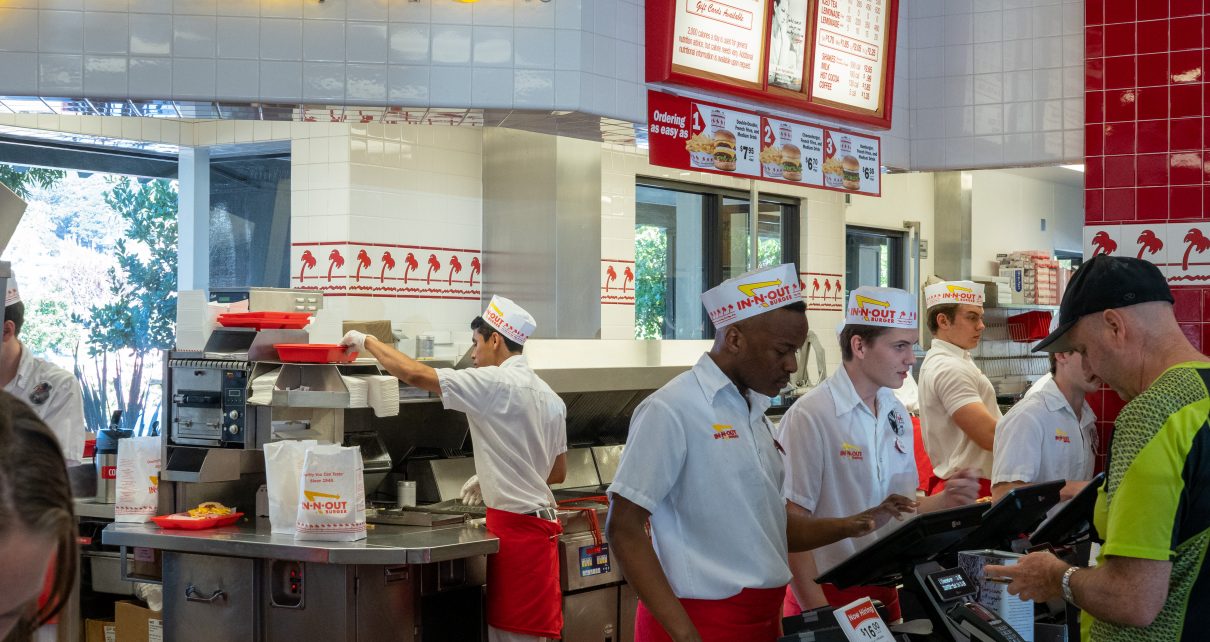
Mill Valley, CA: Workers at In-N-Out location behind counter take orders. (Photo: David Tran Photo, Shutterstock)
New January Jobs Report Blew Away Expectations
Wage hikes are the worst way to fix the affordability crisis
By Katy Grimes, February 11, 2026 12:15 pm
The Trump economy is smashing expectations. The new jobs report shows private sector hiring is up and federal employment is now lower than at any time since 1966.
The January jobs report blew away expectations.
Even CNBC reported “U.S. payrolls rose by 130,000 in January, more than expected; unemployment down to 4.3%.”
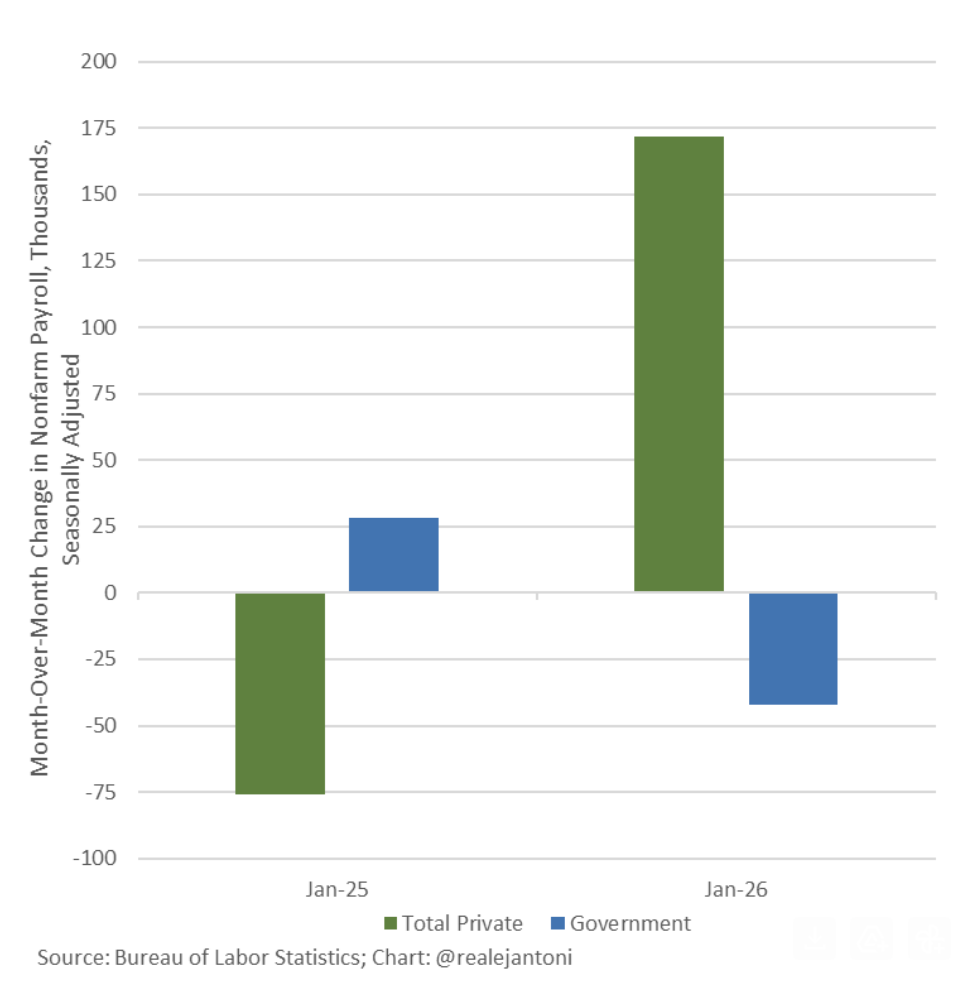
Unleash Prosperity posted: Nonfarm payrolls rose 130,000 for the month above the Dow Jones consensus estimate for 55,000, and employment surged a whopping 528,000. This was also the best labor force participation rate of 62.5% since 2001. The labor force participation rate refers to the percentage of the working-age population that is either employed or actively seeking employment. It’s a very important number.
Unleash Prosperity offered this graph:
President Donald Trump shared his joy on Truth Social:
Just in: GREAT JOBS NUMBERS, FAR GREATER THAN EXPECTED! The United States of America should be paying MUCH LESS on its Borrowings (BONDS!). We are again the strongest Country in the World, and should therefore be paying the LOWEST INTEREST RATE, by far. This would be an INTEREST COST SAVINGS OF AT LEAST ONE TRILLION DOLLARS PER YEAR – BALANCED BUDGET, PLUS. WOW! The Golden Age of America is upon us!!! President DJT

Two days ago, National Economic Council Director Kevin Hassett, was setting lower expectations, due to slower labor force growth and higher productivity. “We just saw the best jobs report we’ve ever seen, outperforming 76 out of 78 of the economists polled by Bloomberg,” Hassett said Wednesday.
“Best labor force participation rate since 2001 at 62.5%, lowest share of federal employees since 1966… everything is hitting on all cylandars because of the tariffs,” Hassett said.
But the naysayers in the alphabet media tried to throw shade on it.
ABC’s headline ahead of the report tells all: Jobs report set to show whether hiring slowdown continued in 2026. Yet the updated article headline is better: “Hiring increased sharply at outset of 2026, blowing past economists’ expectations.”
BUT… because of TRUMP, they claim last year was slow, and jobs were slashed:
The labor market slowed sharply last year, prompting interest rate cuts at the Federal Reserve and concern among some observers about the nation’s economic prospects.
The BLS provided a significant downward revision for job gains in 2025, meaning hiring came in lower than the agency had previously estimated.
The jobs report arrived weeks after a series of job cuts that slashed tens of thousands of workers combined at a handful of name-brand companies.
Few reported that California led all states last year with 175,761 job losses, according to a report from outplacement firm Challenger, Gray & Christmas. Only Washington D.C. had more job losses entirely because of federal government job cuts.
Most media fail to address that the Trump administration crackdown on illegal immigration helped dampen labor demand, CNBC said.
The Employment Policies Institute is addressing jobs and wages in a new report:
Rising costs for housing, food, and services have intensified affordability concerns across the United States. In response, minimum wage increases are frequently promoted as a way to help workers keep pace with inflation and improve affordability. However, evidence suggests otherwise.
The EPI report finds that the worst way to fix the affordability crisis is wage hikes, which increase inflation, driving up the cost of food, rent, and childcare.
The report comes as multiple states and Congress consider wage mandates up to $20-$30 an hour and as Los Angeles is working on its $30 an hour minimum wage.
EPI continues:
Economists studying wage hikes over decades have found minimum wage increases contribute to inflation by raising costs of everyday goods and services. That means wage hikes push affordability further out of reach.
A majority of American labor economists surveyed by EPI reported that higher minimum wages increase the overall cost of living, particularly for lower-income households.1 One review of U.S.
minimum wage studies, shows raising the minimum wage $1 above the current $7.25 federal rate could trigger price increases of up to 5.5%.
As the Globe reported in March 2025, “By the time California Governor Gavin Newsom signed into law the $20 minimum wage for fast food workers, he had been warned by many that it would be devastating for the industry, but he did it anyway. Now, 16,000 fast food jobs have been lost and fast food prices are up more than 14.5%. And here is why: the $20 minimum wage harms California’s least skilled and least experienced workers, as they are no more productive, but are significantly more expensive, and results in harms the business owners as well.”
Analysis from the Employment Policies Institute of quarterly data from the Bureau of Labor Statistics revealed that California lost as many as 16,000 jobs since the state’s $20 fast food minimum wage law was signed in September 2023. (The state is down nearly 14,000 jobs since the law officially took effect in April 2024.) The data includes mandatory reporting from all fast food establishments and covers the first six months since the implementation of the law.

Now EPI reports “The latest available data from the U.S. Bureau of Economic Analysis shows higher wage mandates correlate with higher costs on the state level too. In 2023, the top five states with the highest minimum wages were all among the top 10 states for highest cost of living. States with the lowest cost of living all had minimum wage set at $11 per hour or below.”

“Recent data from metropolitan areas across the country shows high minimum wages are contributing to higher cost of living. According to the U.S. Bureau of Labor Statistics’ most recent annual consumer price index data, there is a clear positive trend between higher minimum wage mandates and the rising cost of food, housing, and transportation. Statistical analysis by EPI shows that for every $1 increase in state and local wage hikes, the overall cost of living in affected metropolitan areas rose by up to 2.5% in 2025, controlling for other economic factors.”

In 2025, cities including Los Angeles, Seattle, and New York had some of the highest hourly minimum wage rates in the nation – topping $16 or more. These areas had significantly higher cost of living compared to cities with lower mandates, like Atlanta, Dallas, and Miami.
The Jobs report is great news. The affordability issue is only being made worse by blue states and blue cities.
Here is the EPI report:
260202_EPI_Minimum-Wage-Hikes-Will-Worsen-Affordability-Crisis

A California native and Navy mom, Katy lives in Sacramento, CA.
RELATED ARTICLES
-
 August 22, 2024
 -
-
Incredible “…data…shows high minimum wages are contributing to higher cost of living…”
No kidding, Jimmy. No economics courses required, right? Just the ability to see that 2+2=4. Oh, and also needed —- the guts to stick to what’s true and real when the bad guys and odious politicians repeatedly say, “No, it doesn’t, 2+2=5!”
Again, this is why we simply CANNOT have “community organizers” as legislators, as they have ZERO economics or finance experience in their social studies programs (if they even have that educational level)”
The law of unintended consequences is in play here, and the very people that Democrats purport to “help” end up being HURT… but the Dems have “a program” to take care of them, after they lose their job (and their dignity)
STOP VOTING DEMOCRAT, folks – THEY AIN’T YOUR FRIENDS – even though they say they are….
And Tom Steyer IS NOT the answer to California’s problems, either…