
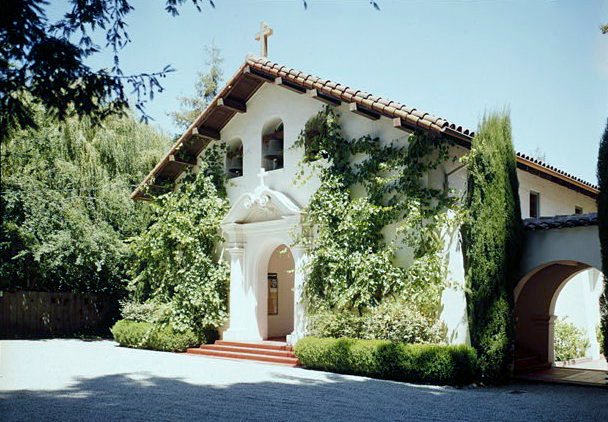
Our Lady of the Wayside Church, Portolla Valley, CA. (Photo: Public Domain)
OPINION: A Spiritual Anchor in a Divided World – What Happens When the Church Takes Sides?
The church’s power lies in its universality
By Hector Barajas, July 29, 2025 6:26 pm
In more than 25 years in politics, I’ve witnessed countless moments when churches welcomed political candidates to speak just before an election. It happens on both sides of the aisle. The subtle (or sometimes overt) implication is clear: this is an endorsement. And while the IRS’s recent green light may now make such activity explicitly permissible, the decision raises deeper concerns that go beyond the tax code.
For many Americans, including my parents, aunts, in-laws, friends, and myself, the church is a spiritual anchor. It is not a political arena, a social club, or an ideological battleground. It is a place of transformation and a refuge from the noise of the world. It is a space where we gather to hear the Word of God, not the platforms of politicians.
The IRS’s July 7 ruling, which allows churches to endorse political candidates without losing their tax-exempt status, may seem like a mere formalization of what’s already happening. But its symbolic weight cannot be overstated. What was once a line, albeit a blurry one, between pulpit and politics is now being erased.
And this erosion matters. It threatens to deepen the very divisions the church should help heal.
Within church walls, the distinctions of the outside world should fade. Whether rich or poor, liberal or conservative, longtime believer or new seeker, all are equal before God. Everyone kneels the same. Everyone hears the same scripture. The church’s power lies in its universality, in its capacity to bring people together around something higher than themselves.
But when pastors begin endorsing candidates, the unity can begin to fracture.
I’ve heard the same concern echoed over and over in recent conversations:
- I go to church to hear about the Bible, not about politics.
- I don’t know who believes what, and I don’t want to feel alienated by what’s said from the pulpit.
- What happens when the church backs someone, and half the congregation opposes?
- I might stop going altogether.
Will this transform the church, causing not just discomfort but also spiritual dislocation? Does this open the door for the church to lose its credibility, mission, and even its soul?
Small churches, already struggling to hold onto congregants, could see further declines. The bonds that hold members together, such as shared meals, community events, and the quiet comfort of worship, can unravel quickly when political agendas take center stage.
I understand that free speech and religious freedom are vital American values. But freedom also carries responsibility. I don’t want to see the church become a place where people feel silenced, judged, or divided based on party affiliation.
We live in fractured times. We desperately need places that rise above the chaos. Many people seek places that remind us of who we are beyond labels and politics. That is the gift of the church. That is its calling. And it is what we risk losing.
Let the church remain what it was always meant to be: a spiritual anchor in a divided world.

- A Second Grader Should Not Have to Ask, ‘Is He Dead?’ - March 3, 2026
- The Social Media Trial Is Missing the Real Defendant: Us - February 24, 2026
- ‘Why Would Anyone Want This Job?’ - February 23, 2026
RELATED ARTICLES
-
 September 27, 2018
 -
 March 4, 2023
 -
 December 8, 2020
100% wrong. The problem with society today is that the church has followed this course of action. The church must stand for good and oppose evil.
If your pastor endorses a candidate with evil policies the you clearly are going to the wrong church. This should expose a lot of posers masquerading as men of god.
CW, thank you for the comment. I often go back to that famous Michael Jordan quote: “Republicans buy sneakers, too.” It’s a reminder that influence, trust, and leadership shouldn’t be confined to one political lane.
It also raises an important question: when a pastor in South Central, the Central Valley, Sacramento, or the Central Coast takes a political stance, is it truly a reflection of the congregation’s values or just their own?
Some leaders cross the line. They blur the distinction between the pulpit and the podium, presenting personal views as if they speak for every parishioner in the pews.
I’ve seen it firsthand on issues like immigration. Congregants may lean left on social services and compassion for the poor, but they also oppose abortion, support school choice, and value public safety. Their views don’t always line up neatly with a political party.
So, who’s truly being represented? Are these leaders lifting up the voices of their entire congregation, or are they pushing their own politics without approval, without transparency, and often without accountability?
I agree with CW. Pastors should never express their own opinions or try to reflect the congregants’ values but should convey the values of God’s word, which is not silent on what is right and wrong, good and evil. From the foundations of this country, that’s what some churches have attempted to convey. Look into the Black Robed Regiment. Pastor Bonhoeffer was also an example of speaking up against those who want to destroy us and gave his life in that endeavor. Jesus said he came to bring a sword. A pulpit is not something to hide behind but a place to share sacred truth.
Leftist “churches” have been hyper political for many decades. The left fears being on equal ground with good people. Churches are not mercantile and if they are they should not exist as Jesus demonstrated when he ran out the vendors. Sneakers are amoral, the job of the church is to be Moral. If morality offends people that is their problem.
Great comment, you’re so right. I have seen this with candidates. It is blatant, crossing the gray line. When it was a conservative candidate speaking, they received 2-3 minutes, but for the preferred party, there was no time limit.
The reason for allowing all churches to be political is congress was faced with either a “third rail” choice of reigning in black churches or dropping the ban altogether.
Defendants of Christian apathy often say that “you can’t legislate morality” or “politics is too divisive for church”. but they do not understand that the 10 Commandments, the creation of humanity as Male and Female (not a trans spectrum), sundry laws governing family life, ARE the very foundation of law and politics, especially American civics. the Bible has much to say on all of these topics. The ungodly, for example, legalize marijuana and then 10 years later people’s conception of the drug changes from “illicit” to “perfectly permissible” because you CAN legislate morality to a certain degree. Christians who gather around the Bible should be transformed into the image of Christ, rather than being offended because they hold onto their own ideological beliefs. the Bible is a two-edged sword.
the Puritans used to preach salvation from the Bible on Sundays, and biblical/governmental lessons from the Bible during midweek. We have them to thank for our great legal system.
Our culture in California is rotting because 50% of Christian’s aren’t registered to vote. I for one, will be glad when bold pastors start educating their congregations. maybe then we can reverse some of the awful legislation that Scott Weiner et al. has written in the last 10 years- legalizing sodomizing of a minor at the age of 14 if the perp is 24 or younger; introduction of pornographic materials into public kindergartens; abortion tourism; the list goes on and on!
Thank you, CaliGirl, for the thoughtful comment. I completely agree. We need to re-engage. I want to see our communities return to foundational values: the Pledge of Allegiance back in our schools, church pews filled again, and a shared belief in right and wrong, in something greater than ourselves.
Coming from a Catholic upbringing, my concern is that the teachings in my community have, over the past few years, drifted away from discipline, self-improvement, and personal responsibility. I don’t want it to be about making excuses or depending on the government to fix everything.
thanks for the reply, Hector. Many Protestant churches choose their own pastor so the congregation and leadership often suit each other. In the Catholic Church, parishioners don’t choose their leadership, but they can choose their parish and vote with their feet and tithe slips if they see a Woke distortion of the Gospel being preached. the Catholic Church also claims to have a more systematic theology than Protestants where leaders aren’t supposed to inject their own opinions- however I understand that things have changed in recent years where you now have for example anti-death penalty catholics when the Church through the ages has found that it can be an appropriate punishment for heinous crimes following due process. I understand the “danger” in repealing the Johnson amendment, but I firmly believe that the benefits far outweigh the risks. I would recommend BiblicalCivics.com for further reading. God bless.