
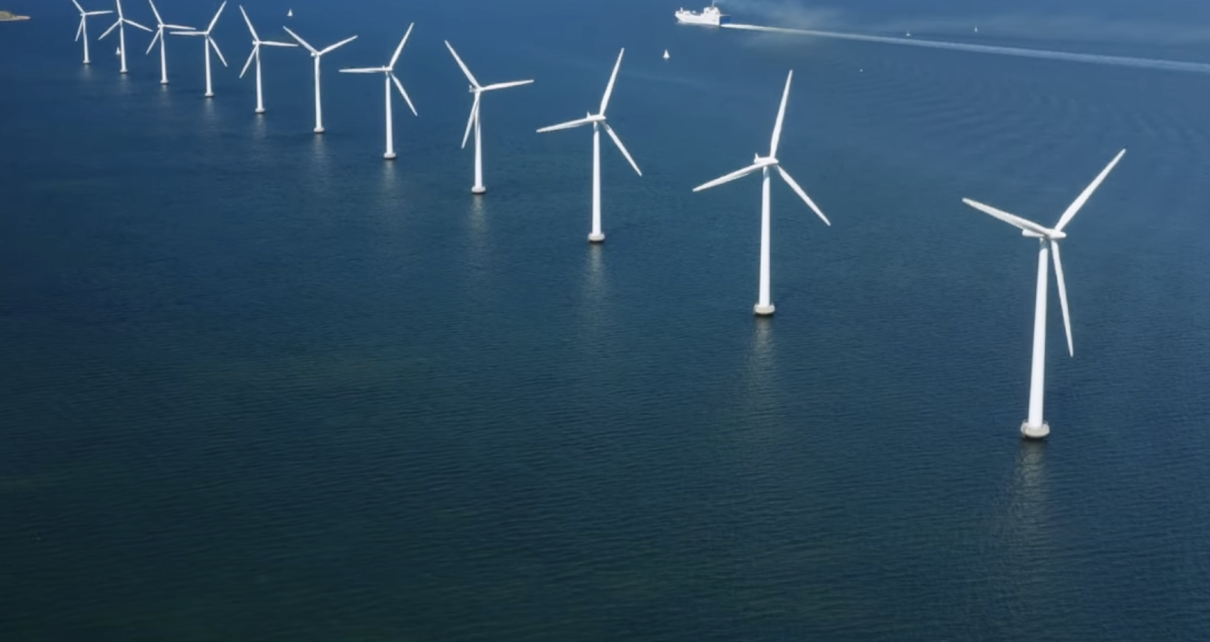
Offshore Wind farm. (Photo: Energy.ca.gov)
Ringside: Floating Offshore Wind – A Financial and Environmental Catastrophe
Achieving 25 gigawatts of capacity would require 2,083 of these monstrosities floating in the water offshore
By Edward Ring, April 9, 2026 8:00 am
Earlier this year, the California Coastal Commission released a report titled “Statewide Strategy for the Coexistence of California Fishing Communities and Offshore Wind Energy.” In addition to providing a “guiding framework” to protect California’s fishing communities, it “presents a roadmap for proposed offshore wind projects to become consistent with California’s relevant Coastal Act policies that recognize and protect marine resources.”
Before considering the immensity of that challenge, let’s review the projected total financing cost per kilowatt-hour for floating offshore wind installations.
According to the National Renewable Energy Laboratory (NREL), the cost to procure and install floating offshore wind is $7,349 per kilowatt of capacity. It is cited on pages 7, 40, and 43 in the NREL publication “NREL Cost of Wind Energy Review: 2024 Edition.” This cost is based on economies of scale, insofar as the NREL report is specifically evaluating costs for the “Pacific Coast floating project,” assuming 12 megawatt turbines.
California’s official state goal for floating offshore wind is to develop 25 gigawatts of capacity. That equals a construction cost of $184 billion dollars. Add to that the California Energy Commission’s estimate of $12 billion to construct and upgrade ports and staging areas, and, from the California Independent System Operator, $36.5 billion to install the required new transmission lines, substations, and grid interconnections. Finally, an absolute best case scenario for the necessary battery storage to achieve baseload power, based on NREL data, is another $16 billion.
Altogether, the total project cost for California’s planned offshore wind developments is $248 billion, or not quite $10 billion per gigawatt of capacity. The financing cost for this sum at 4 percent interest and a 20 year term is $18.3 billion per year. If we assume a 40 percent yield for these intermittent sources of energy (that’s optimistic, when onshore wind farm yields are closer to 25 percent), the completed project will produce 10 gigawatts of baseload power, which is equal to 87,600 gigawatt-hours per year. That is 87.6 billion kilowatt-hours, generated at an annual project financing cost of $18.3 billion, and that’s equal to $0.21 per kilowatt-hour. This is a best case wholesale price, before construction cost overruns, ongoing costs for operations and maintenance, and retail markups (adding about $0.20/kWh) to cover distribution, utility overhead, and regulatory charges.
Compare this to the financing cost per kilowatt-hour to build a modern combined cycle natural gas power plant. The latest estimates from U.S. EIA put the construction cost at $2,500 per kilowatt of capacity, and baseload natural gas power plants can easily deliver uptimes of 90 percent. Under the same terms, the financing cost for natural gas is $0.05 per kilowatt-hour, one fifth as much. As for fuel costs? They’re surprisingly low, ranging between $0.02 and $0.4 per kilowatt-hour, depending on market prices.
But offshore wind isn’t just a financial catastrophe quietly moving toward realization. At 12 megawatts per turbine, achieving 25 gigawatts of capacity would require 2,083 of these monstrosities floating in the water offshore. Each would be 800+ feet high from the waterline to the tip of a rotor blade in vertical position. Each would require tethering cables to the ocean floor, more than 4,000 feet down, as well as high voltage underwater cables to transmit electricity 20 miles to onshore substations.
It does not require an expert to appreciate the mess this is going to make, but experts have critiqued the impact of offshore wind farms. A 2024 report claims underwater noise from surveying and installation reaches 200–240 decibels, enough to deafen marine mammals and cause fatal injuries to fish. It also points to North Sea data suggesting major fishery declines following wind development, along with concerns about ocean contamination from turbine blade corrosion releasing toxic substances like bisphenol A.
A separate August 2023 report from a New England fishermen association highlights additional risks. Wind farms increase sea surface temperatures and alter upper-ocean hydrodynamics in ways scientists do not yet understand. They create wakes several kilometers in length that may disrupt phytoplankton, the base of marine food chains. Operational noise from turbines, concentrated in low frequencies (between 2-200 Hz), overlaps with the sounds fish use for communication, mating, spawning, and navigation. Electromagnetic fields from high-voltage undersea cables generate magnetic and electromagnetic fields that distort the drifting paths of haddock larvae and cause birth deformities in juvenile lobsters.
These studies primarily examine offshore wind impact in the North Sea and off the U.S. East Coast. So where are California’s powerful environmentalists? Where is Greenpeace? Where is the Surfrider Foundation? Why are they silent? How, for example, are migrating whale species expected to navigate an obstacle course hundreds of miles in extent, with thousands of underwater tethering and high voltage cables and nonstop low frequency sound? How can environmentalists who object to virtually anything affecting the earth, sea, or sky, tolerate this abominable, gargantuan industrialization of our coast and coastal waters?
In the California Coastal Commission’s recent report, 440 pages long, a search for the words “Cetacean” and “whale” came up with zero results. Yet one of this report’s stated objectives is for “wind projects to become consistent with California’s relevant Coastal Act policies that recognize and protect marine resources.”
The Coastal Commission has aggressively restricted any form of development on the California coast, and yet they take a supportive position on floating offshore wind, a project that by any reasonable assessment is an environmental and financial catastrophe.
That any state agency is still putting resources into support for floating offshore wind development is a stomach churning betrayal of everything Californians are supposed to care about, from opportunities for working families to be able to afford energy, to the precarious health of our marine ecosystems.


- Ringside: California’s Self-Destructive War on Oil - April 29, 2026
- Ringside: The Abundance Alliance - April 23, 2026
- Ringside: Why Producing More Oil In California HELPS the Environment - April 15, 2026
RELATED ARTICLES
-
 August 15, 2024
 -
August 22, 2024
-
I agree with everything you said, though “whale” is in the report 6 times…
Here is the deal.
Remember all the “environmental” damage done by WATER DAMS? What everyone should know is a TURBINE is an AIR DAM. The atmosphere at the ground and for miles before the turbine is at HIGHER PRESSURE, while air after and above the air dam will be lower.
What could go wrong? Let’s stop the wind from SPREADING NUTRIENTS in the RIVER OF AIR above the earth that flows from DESERTS to RAINFORESTS. Let’s stop the wind from COOLING THE EARTH. Let’s stop the wind from being a NAVIGATIONAL AID for hundreds of billions of birds.
And AIR DAMS in the ocean, stop ocean currents, lower high tides, and other issues.
The people that brought us NAKED MEN IN THE GIRL’S LOCKER ROOM are screwing up the atmosphere.
The State agencies that regulate this sector no longer have credibility. Good point about worthless Surfrider being MIA on this . Too busy trying to get rid of dune riders.
If the State and our taxpayers aren’t broke before any of this garbage starts, they will be before it’s “done”. Nothing like offshore wind proposals to make you feel like it’s the end of the American Empire.
In addition to the BILLIONS OF DOLLARS that this boondoggle will cost, let’s explore the adverse impacts to the fish, seals, whales and all sea life from the NOISE that will be generated by such a network.
These giant ugly windmills will not only kill seagulls and other marine birds ABOVE WATER but the noise and vibration created during their operation will also hurt the marine life BELOW THE WATER from their SOUND from the vibration and movement.
Years ago, I took diving lessons and got PADI certified and one of the lessons we learned was how sound travels much farther underwater than it does through air, due to water denseness and transmission properties. Tapping gently on one’s SCUBA air tanks could be heard at amazing distances and was used as an underwater signaling procedure to get a buddy’s attention if separated.
The noise and vibration noise generated by these will drive sea life away and DESTROY the ecosystem that these grifter supporters supposedly want to protect!
Much like the California minimum wage increase has hurt the people it was intended to support, these wind farms will hurt the environment that it is supposed to protect!!!
THESE ARE A TERRIBLE IDEA, PERIOD!!!