
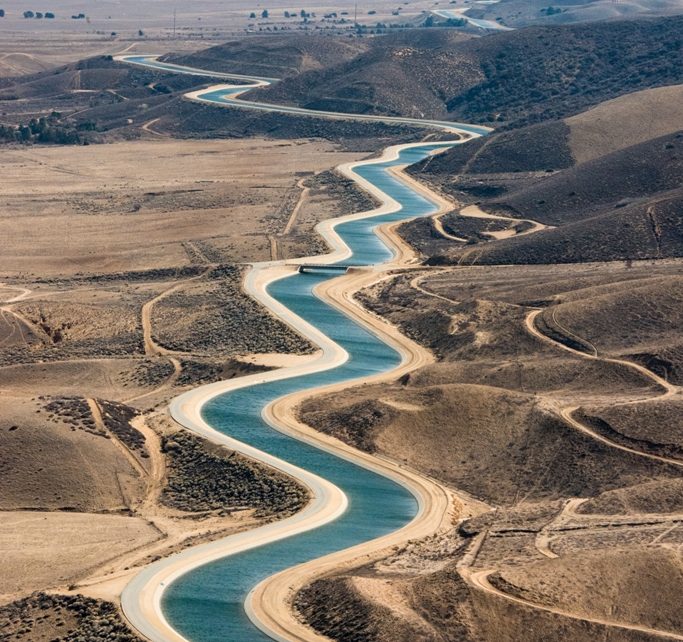
The California Aqueduct. (Photo: CA State Water Project)
Ringside: How the Federal Government Can Massively Fund Water Supply Infrastructure
Imagine if the federal government gave water supply infrastructure the amount of priority it gave to constructing intercontinental railroads or the interstate highway system
By Edward Ring, September 18, 2025 2:45 am
A few months ago I had the privilege of speaking directly with some of the top executives at one of California’s largest water agencies. Their primary question for me was explicit, and my attempts to answer were inadequate. They contend, accurately, that during the last century there were periods when massive federal funding to pay for water supply projects was sustained for multiple consecutive years, and in some cases for decades. They also explained, accurately, that nothing of the sort has happened so far in the 21st century.
So how do we restore federal funding, massive federal funding, to pay for the next generation of water supply infrastructure in California?
We are talking about a lot of money, or not, depending on your frame of reference. The cost to build new water infrastructure sufficient to add 10 million acre feet per year to California’s water supply for farms and cities would cost about $100 billion. Is that really such a big number, when the result would be abundant water even during droughts? Is it such a big number if it ensures that California not only improves its chances to restore affordability to its residents and a competitive edge to its farmers and small businesses, but also vastly improves the state’s capacity to withstand natural and civil catastrophes?
It’s certainly not a lot of money in the context of federal spending. Awarding $10 billion per year for ten years would consume about 0.14 percent of the budget. Not much, to save a state.
So how do we get that money? How do we get money that once flowed – forgive the metaphor – like water in the 20th century, but has slowed to trickle in the 21st?
The first step is to convince the federal government to recognize water infrastructure, nationwide, as a critical, cabinet level priority. We have a cabinet secretary for agriculture, energy, and transportation. Maybe it’s time to take water oriented agencies subsumed within other cabinet departments and create a U.S. Department of Water. Water should be prioritized and managed at that level. This would allow the federal government to focus on major water projects in the same manner as the federal government has focused on building interstate highways.
Next, with our state setting the precedent, we need to restore the incentive for more water supply infrastructure instead of prioritizing water conservation infrastructure. The entire concept of “decoupling” water agency revenue from water agency supply must be shattered. Water bureaucracies and water agencies, at all levels, must have an incentive to produce more water because that will produce more revenue that can be reinvested in more water supply infrastructure. California’s current policy is precisely the opposite of this, and it must change. The mentality in Washington, at least for now, is more likely to recognize decoupling as a dangerous policy because it encourages taking all resilience out of our water supply by rationing all use down to its most “efficient” level. “Decoupling” is a seductive, but ultimately destructive idea.
Another step is to streamline the laws that empower endless litigation and bureaucratic delays. It’s important for those opposed to new development and revisions to operating procedures to have a voice, but today they have become so powerful that major projects are invariably stalled for decades, if not stopped completely. To the extent federal regulations (for example, NEPA, ESA, CZMA, CWA, and the FWCA) can be streamlined, capital costs drop dramatically. To the extent capital costs drop, we reduce the amount of government investment required to preserve incentives for private partners and we avoid imposing unaffordable costs on ratepayers. Again, California needs to set an example for the federal government to follow.
In no particular order, next, restore urgency to the development of new infrastructure to deliver safe drinking water, abundant water storage, diverse sources of water, and geographically distributed reservoirs of surface water to supply water for wildfire containment. Imagine if the federal government gave water supply infrastructure the amount of priority it gave to constructing intercontinental railroads or the interstate highway system, or the burst of effort waged in the 1930s and again in the 1950s and ’60s to build water projects. Without urgency, we wallow. The process profiteers attend conferences and collect giant salaries. Nothing gets done.
Finally, recognize that water distribution infrastructure is just as important as water supply infrastructure. We consider money to be completely fungible, allowing capital to find its most efficient application anywhere in the world. Most commodities are highly fungible. The price of “West Texas Light Sweet” crude oil is affected by the price of similar grades of oil coming from the North Sea or Nigeria, because a buyer can have it delivered from any of those places. Water is not as fungible as oil because the capacity to distribute water is not sufficiently developed. Investing in pipes, aqueducts and pumping stations to augment California’s already substantial capacity to move and store water will create an incentive for investors to build water supply infrastructure because they’ll have more ability to find a remote buyer.
In an earlier analysis, I summarized an assortment of projects that altogether would add 10 million acre feet to California’s annual water supply. With reasonable regulatory relief, it could be possible to construct these projects for $100 billion (2025 dollars). If California were to demonstrate a resolve to streamline the state’s own regulatory obstacles to building water supply infrastructure, it might greatly improve the chances that the U.S. Congress would also engage in federal regulatory streamlining. And if so, they may well be inclined to award Californians a torrent of construction funding, insofar as they might at last conclude that every dollar sent to the Golden State does not end up flowing into the Pacific.


- Ringside: The Abundance Alliance - April 23, 2026
- Ringside: Why Producing More Oil In California HELPS the Environment - April 15, 2026
- Ringside: Floating Offshore Wind – A Financial and Environmental Catastrophe - April 9, 2026
RELATED ARTICLES
-
 September 4, 2024
 -

-
 July 8, 2022
Why should a federal government running high deficits give money to a kleptocracy?
In the old day’s companies like PG&E and Southern California Edison also built dams for water storage. We need to recouple water storage to the energy business again and get out Utility companies back into the energy production business. By taking this step publicly traded companies can also raise capital for big projects. Last century the stock of utility companies was desirable for retirees as they generally delivered a reasonable safe return. If American and California prosperity is what you seek, energy conservation is a component of it but in all practicality, it is expansion and growth that creates prosperity.
Anything that is done has to be done in such a manner that not one penny goes through the hands of any – statewide or local – california politicion, bureaucrat, government employee or NGO hands, the money will be diverted to pet projects, grifters or otherwise untrackably squandered. The intercontinental railways were given tracts of federal land for right of way, I don’t think taxpayer cash in any large way funded the railroads (the antics of scoundrels like Jay Gould and Jim Fisk might be relevant here as part of past railway construction and future infrastructure projects). The freeway interstate system wasn’t built for interstate trade or citizen convenience. General/President Eisenhower saw the value of a freeway system for rapid movement of the military after seeing the German autobahn during WWII.
If it were not for abundently available electricity, natural gas and fuel for cars, trucks, heavy equipment, trains and planes we would have a 19th century lifestyle with doctors accepting chickens for payment. As well with water, “conservation” as currently contributing to a future famine by denying farmers water.
Water is more abundant than you would think. It is simply government’s gross mismanagement of the states water that makes it scarce. We need to get together and talk about it because I have an idea that can provide several million acre feet to the farmers of the state and negate the need for the groundwater management act for just a couple hundred million dollars