

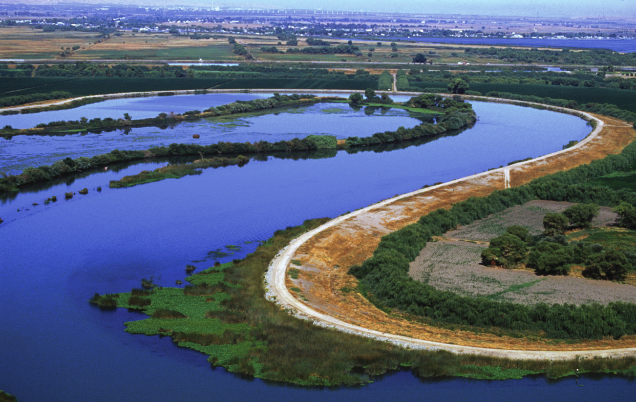
The Sacramento-San Joaquin Delta. (Photo: water.ca.gov)
Ringside: Without Sediment Removal in the Delta, Catastrophic Flooding is Coming to California
Strengthening levees without restoring channel depth is to ignore one of the biggest variables affecting how much water can safely make it downstream
By Edward Ring, August 27, 2026 8:14 am
 In the cities and farms immediately south of the Sacramento-San Joaquin Delta, the worst flooding of the 20th century happened in 1997. Several days of unrelenting rain pummeled the slopes of the Sierras, and with the snow line unusually high at 10,000 feet, nearly all of it poured into the San Joaquin River and other tributaries. Reservoirs filled to capacity, sending torrents of water into spillways at a rate far beyond the flow capacity of downstream channels. Levees were overwhelmed.
The response to this disaster has been to strengthen levees and construct bypasses. Those projects, along with habitat restoration, have been the priority for state and federal agencies. But nowhere in these project descriptions, including in the State Water Resources Control Board’s August 2026 draft of the “Water Quality Control Plan for the San Francisco Bay/Sacramento-San Joaquin Delta Watershed,” is there any mention of channel restoration through sediment removal.
It’s not enough. Strengthening levees without restoring channel depth is to ignore one of the biggest variables affecting how much water can safely make it downstream. The federal, state, and regional agencies, water districts, irrigation districts, contractors, engineering firms, environmental consultancies, NGOs, pressure groups, and countless additional “stakeholders” involved with the fate of the delta must answer just one urgent question: How much stormwater is the forecast “super El Nino” going to dump onto the Central Sierras in 2027 compared to 1997?
If the answer is “more,” consistent with the portents most of these entities have routinely served up for the last several years, why is nothing being done to address sediment?
The only group I’m aware of that is committed to sediment removal is the Great Valley Farm Water Partnership, an organization that has unified concerned farmers throughout the San Joaquin Valley, from the delta in the north to the furthest southern agricultural areas in Kern County. They have identified seven actions deemed essential to restoring the delta: enhance south of delta water storage capacity, invest in improvements in delta levees, install permanent operable gates in select delta channels, improve the capacity to safely export water from the delta, suppress non-native predators in the delta, control invasive aquatic weeds, and, listed first among their issues of focus, “silt removal in the south delta.”
The policy response to this agenda has been tepid at best, and the reasons for objections or delay are either inexplicable or just completely unfounded. One objection to silt removal, apparently, is that to advocate for this action might undermine support for the delta tunnel. There may be some political basis for such an objection, but it has no functional relevance. The channels in the delta have been neglected for over fifty years. The shallow channels heat up, favoring introduced predators and invasive vegetation. With or without the tunnel, restoring deeper channels is needed.
Another objection to silt removal centers on funding, based on a concern that the money needed to remove silt from the delta may cannibalize money that would otherwise help fund the delta tunnel, or other important projects such as aqueduct repairs. But at this point, inadequate flow capacity in the delta is a national emergency, which will unlock funds from completely unrelated sources.
The most difficult objection to sediment removal comes from environmentalists. The well-intentioned but misguided perception that sediment removal harms fish is still the conventional wisdom. So as we wait for interminable additional studies that will arrive too late, even if they finally break with conventional wisdom, there is common sense to fall back upon. For over a century, from the mid 1800s through the mid 1970s, dredging was routinely performed throughout the delta, in every channel, and up every tributary. Through it all, salmon and smelt thrived.
This fact supports a theory that ought to be convincing. When the delta was channelized, silt accumulated in the narrowed avenues to the sea, and dredging was creating habitat, by maintaining deep, cool channels that native fish were able to adapt to, preserving flow and providing refuge from introduced predatory bass that prefer warmer and shallower water. Skeptics of this theory may also answer one question: Why did salmon and smelt thrive for over a century, during an era when dredging was almost constantly performed?
If anyone remains sanguine about what’s about to happen when heavy rains come, one more fact bears emphasizing. The Sacramento-San Joaquin Delta is unique. Unlike the Nile, or the Mississippi, or the Ganges-Brahmaputra, or the Yangtze, or the Mekong, it does not fan out as it drains into the ocean. Instead, all the outgoing water encounters a choke point north of Pittsburg that is barely one mile wide. This bottleneck separates over 1,000 square miles of delta with over 1,000 linear miles of channels from the sea. Consider the implications.
The delta levees aren’t going to go away, because these engineered channels are the only reason it is possible to export around four million acre feet per year to cities and farms. That isn’t going to change. But if these levees fail because silt accumulation reduced flow capacity, the water won’t quickly escape. Instead, flooding will inundate interior farms and cities. Beyond the billions in damage and irreparable destruction to homes and businesses this will wreak, toxins from raw sewage and fuels and agricultural chemicals will be mixed into the flood water and trapped inside the unique delta geography. And when the downstream runoff abates, salt water from the ocean will flow through the broken levees at high tide and inundate the delta’s many below sea level “islands,” compounding the contamination with salinity. Water exports to the aqueducts will cease.
Opponents of sediment removal have ridiculed the entirely plausible suggestion that removing sediment would increase volume and improve flow, enabling greater water exports. Okay. Fine. But therefore, through some convolution of logic, the implication is that there is no statewide urgency for sediment removal. This is an inexplicable and destructive argument. When the super El Nino strikes, and it will, maybe this year, maybe in another few years, it will bring with it a super flood. When that happens, exports will stop, and the people who used their influence to stop silt removal when it might have made a difference will have a great deal of explaining to do.


- Ringside: Save Our Lawns, Reform AB 1572 - October 21, 2026
- Ringside: Induced Demand is a Prerequisite for Abundance - October 14, 2026
- Ringside: Observations as a New Water Year Begins - October 8, 2026
RELATED ARTICLES
-
 April 3, 2025
 -
June 13, 2025
-
 December 18, 2025
This Article makes too much sense. It’s never going to happen!
Shouldn’t the unions support dredging. Sounds like a lot of high paying union jobs would be needed to accomplish this job. Maybe they could stop working on the train and actually do something productive for the people of California.
Great comment – too funny. But seriously, there are known studies on dredging the Delta. Let’s just get it done. Hello, McFly.
Unions like *no show jobs*