
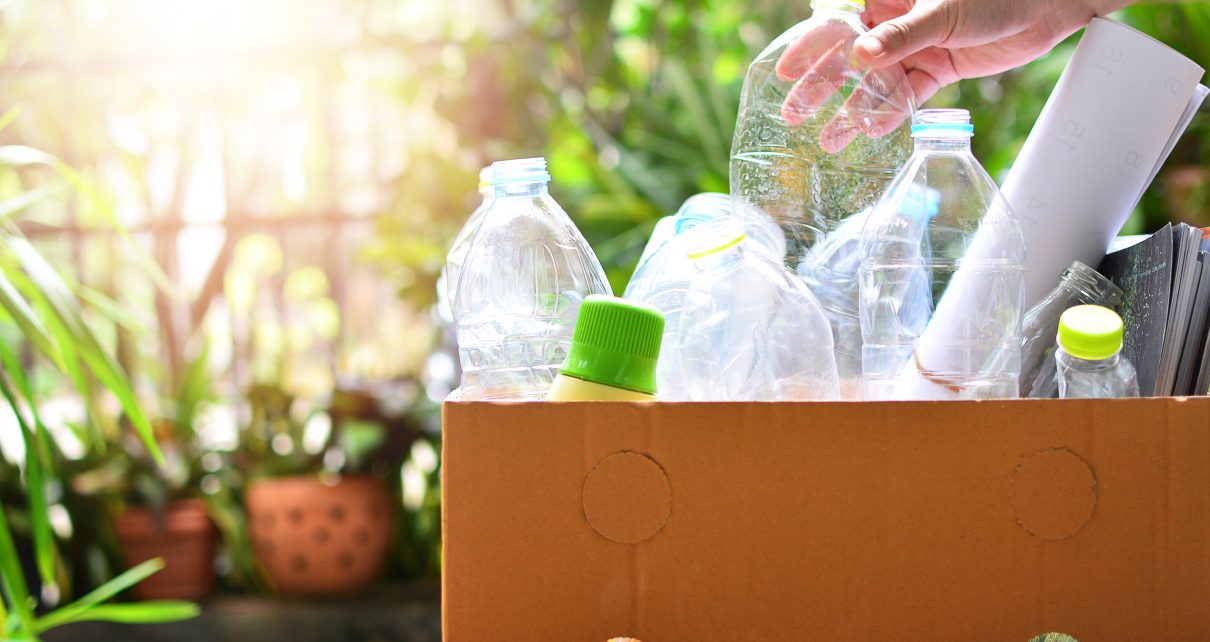
Plastic bottle garbage for recycling concept reuse. (Photo: ITTIGallery/Shutterstock)
Sacramento Bolsheviks Hire Recycling Police for ‘Curbside Trash Bin Inspections’
The real issue is submission: the government needs you to submit to their policies, legitimate or not
By Katy Grimes, July 15, 2026 12:43 pm
Sacramento is conducting curbside trash bin inspections to enforce California’s organics recycling mandate. Really. Yet, as the Globe reported in January, California’s Recycling Agency doesn’t really recycle the items we as consumers are charged extra for and required to separate out from trash into the recycle bins. According to a report from CalRecycle, only 1% of milk jugs and 2% of certain plastic material is recycled. California dumps the rest into landfills.
Many home owners report that the same waste management truck picks up their garbage and their recyclables.
But it’s the realization from the report that legislating mandatory recycling is disingenuous as there are limited options for disposing certain materials.
“CalRecycle withdrew proposed SB 54 regulations from the Office of Administrative Law’s review, noting planned revisions related to packaging for food and agricultural commodities,” WasteDive reported.
“California has not figured out how to reduce single-use plastic, the Los Angeles Times reported in January.
Senate Bill 54, by Sen. Ben Allen (D-Santa Monica) was signed into law by Gov. Gavin Newsom in 2022, and was billed by Sen. Allen as “The most comprehensive measure in the nation to address the plastic waste crisis.” His bill established the “Plastic Pollution Prevention and Packaging Producer Responsibility Act,” which placed the responsibility for costs of the new program on the packaging producers rather than the local communities who pay for waste management and recycling.
According to CalRecycle, Senate Bill 54 requires 25% reduction in single-use plastic packaging, 65% recycling rate for covered plastics, and 100% of such packaging must be recyclable or compostable, the Globe just reported in June.
Nebraska Attorney General Mike Hilgers is leading a coalition of 17 republican state attorneys general, and the National Association of Wholesaler-Distributors in suing California over Senate Bill 54, the Plastic Pollution Prevention and Packaging Producer Responsibility Act.
The law was signed by Governor Gavin Newsom in 2022. It requires plastics producers to reduce single-use plastic for packaging and food service items by 25%, and ensure that all such items are recyclable or compostable by 2032.
You can see the problem, and reason for the lawsuit, which accuses California of trying to “impose its own policy preferences on the entire nation” with the plastic packaging law.
California claims the state law addresses plastic pollution overwhelming waterways, oceans, and landfills, shifting costs from taxpayers and local governments to producers and encouraging innovation in sustainable materials.
That’s just one problem with recycling legislation.
Another is Senate Bill 1383, by then-Senator Ricardo Lara (D-Los Angeles), a California law signed in 2016 by Democrat Governor Jerry Brown aimed at “reducing short-lived climate pollutants, primarily methane emissions from organic waste in landfills.” Implementation ramped up in 2022.
According to CalRecycle, SB 1383 compliance penalties are enforced by local cities and counties, with CalRecycle overseeing. Enforcement emphasizes education first, with penalties escalating for repeat violations.
- First violation: $50–$100 per violation
- Second violation (same issue within 1 year of the first penalty): $100–$200 per violation
- Third or subsequent violations (within 1 year of the most recent penalty): $250–$500 per violation
“Sacramento residents may have their trash, mixed recycling, and organic waste bins inspected this month as part of a city effort to comply with state law and reduce methane emissions caused by organic waste in landfills,” KCRA reports.
“The city says the inspections are required under SB 1383, a state law mandating local jurisdictions to take steps to reduce methane emissions caused by short-lived climate pollutants. Crews will check containers across Sacramento to track whether residents are sorting their organic waste properly.”
Sacramento residents can expect to see the trash police inspecting trash cans.
This isn’t the first time Sacramento residents have been subjected to ridiculous mandates and secret police tactics.
In 2012 I reported that the City of Sacramento sent out a notice encouraging residents to attend a water conservation training session and “how to help your neighbor’s [sic] save water by becoming a Water Conservation Ambassador,” the notice said.
Apparently by attending a water conservation workshop, attendees could be certified “City of Sacramento Water Conservation Ambassadors.” We asked if a badge came with the title?
“Water Conservation Ambassadors will help spread the word about water conservation and protection of our water sources,” the city’s website stated. “Ambassadors will help educate neighbors, friends, family and community organizations about conservation through attending community events, conducting knock and talks, and presenting at community meetings!”
Were neighbors being encouraged to educate, or re-educate? This is a recurring theme with the City of Sacramento.
Residents who water the lawn on the wrong day, use the fireplace without approval from the county, have fat children, drive a gas guzzler, ride a bicycle without a helmet, eat shark fin soup, wear fur, or violate the Babysitter’s Bill of Rights, are all subjected to steep fines, or even arrest.
The issue isn’t water conservation or plastics recycling; the real issue is submission: the government needs you to submit to their policies, legitimate or not.
In the Soviet Union, citizens were encouraged to rat out neighbors for hiding food or other necessary goods. In Nazi Germany, people were encouraged to rat out neighbors for protecting or hiding Jews.
The issue can’t really be water conservation or proper recycling. Sacramento is located on two major rivers, so abundant water isn’t a crisis, and everyone has seen the exposés showing that California recycling is a bad joke.
SB 54 was nothing more than very expensive climate-changey woo-woo that accomplishes nothing other than to shake down business owners by lawmakers who have never signed the front of a check.
“Reports on abysmally low rates of recycling for milk cartons and polystyrene have been widely shared and known,” the LA Times reported. “But the newest numbers were still a grim confirmation that there are few options for dealing with these materials.”
It wasn’t that long ago the California Globe reported CalRecycle Loses $200 Million a Year Due to Bottle Deposit Fraud.
And, CalRecycle Management Paid Bloated Salaries Even as CalRecycle is Dying. “More than 50 percent of the recycling centers around the state are closed while taxpayers are paying $1.1 billion in annual beverage container recycling taxes,” we reported.

Most of the “recycling” in California goes to the landfills. One can only conclude that these bills were a financial shakedown, and the blame will go to CalRecycle – and consumers.



A California native and Navy mom, Katy lives in Sacramento, CA.
- California Voters: Howard Jarvis Taxpayers Association’s 2026 Voting Guide - October 23, 2026
- Newsom Gaslights Over California’s Bad Student Test Scores - October 22, 2026
- How the DMV Enabled Voter Fraud in California - October 21, 2026
RELATED ARTICLES
-
 August 8, 2022
 -
 January 31, 2020
 -
 November 25, 2019
I can see a lot of restaurants going out of business due to the organic waste requirement. As for the citizenry, they could do like the mexicans and put their “poo paper” in the trash instead of flushing it – it’s a cultural thing, and who is the city to resist culture : “take that!” Maybe a liberal spraying of “liquid ass” might be in order. In the meantime, will these trash digging, hairless, two legged racoon squad members be any more productive than the average government employee? Only if the ideology and tolerance for filth and stench are strong. I’m betting lazyness will prevail and the only ones ticketed will be targeted because of political or personal disfavor.
We live in southeast area of Sacramento and the same Waste Management truck picks up our garbage, yard waste and recyclables (every other week). We see the trucks take all the waste to the Sacramento Recycling & Transfer Station operated by Waste Management which is off of Fruitridge Road.
The city will probably only inspect the trash, mixed recycling, and organic waste bins in the wealthier areas of Sacramento like Land Park, Sierra Oaks and the Fab 40’s? Where we live in the southeast area of Sacramento where there are lot of lower income residents, some of whom are renters, and many of whom are originally from different countries. They generally do whatever they please and they tend to ignore government laws and regulations. Good luck in getting the city to try and enforce California’s organics recycling mandate with them.
“ Plastic pollution overwhelming waterways, oceans and landfills.” Anybody with a brain should see that for what it is -utter BS!
Another move to create another ‘ revenue stream’ for the city and eventually the State.
This is just a test ballon for the always – money and power hungry State Government. And municipalities. When is the last time Sacramento fixed anything?
The worst part of all? Most of these mandatory recycling bills have special exemptions for homeless people. CA to taxpayers: litter on side of road = $1000 fine. stick a paper plate in trash instead of recycle = $500 fine. CA to homeless: steal shopping cart and litter an ENTIRE campsite on side of road = no fine. leave drug paraphernalia outside school = no fine. def@cate in city’s water supply = no fine.
talk about a two tiered system!
If the city or state wants to know what’s in our garbage, then they should ask some of the “un housed” citizens of this fine state. They would know more than anyone about what is in our trash cans. I believe this may be an opportunity to put some of the “un housed” citizens of the city to work. They would probably work for minimum wage. Wait, they would be making minimum wage which is what now? $20 dollars an hour? I lost track. Anyway, sounds like a problem solved to me. I just might need a job in the not too distant future too.
I quit taking aluminum cans to the recycler when I found out that many recylers will give you the lower scrap aluminum value while collecting for themselves the higher redemption value. I further tried to get recyclers in three cities to zero out the scale with the recepticle on it before putting the cans in it so as to get an accurate weight of the cans – they all refused to do so. So, if the recyclers are going to steal from me I’ll just discard the cans in the trash so they don’t get any of it.
@Don’t Rip Me Off, not doubting you but common sense says if they don’t zero the scale before putting the receptacle on it, it would show any even heavier weight than if they zeroed it first – so you’d get more money, not less. Unless I’m misunderstanding how you’re describing it, anyway. Maybe you just phrased it wrong?
I do agree it’s a ripoff how CRV works, you pay by the container, but they pay you back by weight. Anyone that buys bottled water is getting REALLY ripped off, because the empty water bottles are light as air!
The issue about not zeroing out the recepticle on the scale is you are dependent on the recycler subtracting the recepticle weight from the gross. So, what weight are they subtracting? They aren’t going to tell you. Zeroing out the scale would make it easier by not having to subtract anything and would be a transparent transaction. And no recycler is going to give you a half penney more than they have to, so they aren’t going to add any weight to the net for them to lose money. So, how much does the recepticle, often a plastic trash can, actually weigh vs what they subtract? The fact that they won’t zero out the trash can in front of you loudly says they are ripping you off. Years ago I gave a elderly neighbor, who was living on $500.00 a month, all sorts of recycleables. The first time out he counted the aluminum cans and calculated the redemption value, the recycler tried to pay far less after weighing. I asked him about the end result and he said “do you think he’s going to hit an old man? He gave me the money.” Knowing that cranky old geezer, I could well imagine the wild scene that undoubtably developed around the recycler trying to rip him off. I found out about scrap value vs redemption value when I took a large load of scrap aluminum to a recycler in the san joawuin valley for my then employer and told the recycle employee that story.
One last thing: there is an average weight for aluminum cans that matches the redemption value, depending on the size of the cans. 12 oz cans have a different redemption value than 16 or 24 oz cans because of different mass/weight. You can look up redemption values by size/weight with an internet search.
@ Don’t Rip Me Off: Absolutely agree they should place the trash can (or whatever they use) on the scale and zero it out. One recycler here used to do it this way, you’d put all your cans into a standard plastic trash can, they would put an empty one of the exact same can on the scale, zero it out, then dump your cans from the one you’re using into the one they just zeroed out. This is the only totally honest way of doing it I think (or you use an RVM – Reverse Vending Machine, but they’ve all disappeared when RePlanet went bankrupt). I go to a local recycler that uses home made carts instead of trash cans, they’re plastic irrigation pipes glued together for a frame with plastic netting that holds the recyclables, and they have written on the plastic pipe the exact weight (each one being hand-made have a slightly different weight). I pretty much trust them to have the correct weight on them – but I can’t be 100% certain of course. I’ve been going there for years now, they even give seniors an extra amount on aluminum cans on Wednesdays. I hope you can find an honest recycler in your area. It sucks, I know, to feel like you’re getting ripped off.