

AZ Senator Ruben Gallego and Alex Soros (Photo: @RubenGallego)
Senator Ruben Gallego Introduces Bill to Hike Federal Minimum Wage to $20 by 2029
The proposal comes as Democrats seek to regain footing on affordability issues, after ignoring record inflation and affordability issues under the Biden administration
By Megan Barth, February 5, 2026 1:13 pm
Arizona Democratic Sen. Ruben Gallego announced Thursday that he has introduced legislation to raise the federal minimum wage to $20 per hour by 2029, framing it as a necessary step to ensure “no one who works full time in this country should live in poverty.” The bill, dubbed the Raise the Wage Act of 2025, proposes a phased increase over the timeline, positioning it as a bold Democratic push amid ongoing economic debates. Gallego, in a post on X, emphasized building “an economy that works for working people” through a “living wage,” while suggesting that President Trump’s populist policies could open doors for bipartisan negotiations, yet dismisses California’s job-killing lessons from a similar mandate.
🚨I just introduced a bill to raise the minimum wage to $20/hour.
Because no one who works full time in this country should live in poverty. Building an economy that works for working people starts with ensuring not just a minimum wage but a living wage. https://t.co/See061Ycm1
— Ruben Gallego (@RubenGallego) February 5, 2026
The proposal comes as Democrats seek to regain footing on affordability issues, after ignoring record inflation and affordability issues under the Biden administration. The federal minimum wage has remained at $7.25 since 2007, which equates to a full time salary of $15,000 per year.
Gallego notes that a previous bill by Sen. Bernie Sanders (I-VT) aimed for $17 per hour, making his $20 target more ambitious. However, cosponsors for Gallego’s bill were not immediately detailed in announcements. For context, a similar Raise the Wage Act (S.1332) introduced earlier in the 119th Congress by Sanders in April 2025—which phased increases to $17 before indexing—garnered support from over 30 Democratic senators, including Gallego himself and his Arizona colleague Senator Mark Kelly, along with California Sens. Adam Schiff and Alex Padilla.
Conservative critics quickly condemned the measure as economically destructive, pointing to evidence from high-wage states and historical data showing job losses, reduced hours, and higher prices that disproportionately harm low-skilled workers. Heritage Foundation analysts have long warned that mandated wage hikes “cut off the bottom rung of the career ladder, effectively pricing the least-advantaged workers out of employment.” In a recent commentary on state-level increases, Heritage noted a “clear preponderance” of employment losses from minimum wage rises, particularly affecting teens, young adults, and less-educated workers—groups the policy claims to help.
Heritage has repeatedly highlighted that such policies lead to disemployment effects: “High minimum-wage laws cut off the bottom rung of the career ladder, effectively pricing the least-advantaged workers out of employment.” They cite meta-analyses showing consistent job reductions, with businesses responding through automation, reduced hiring, or closures. On broader impacts, Heritage research has shown that minimum wage increases “substantially raise prices,” with consumers—especially lower-income households—bearing the burden through higher costs in restaurants and retail.
“The minimum wage law very cleverly is misnamed,” Economist Thomas Sowell said. “The real minimum wage is zero. That is what many inexperienced and low skilled people receive as a result of legislation that makes it illegal to pay them what they are currently worth to an employer.”
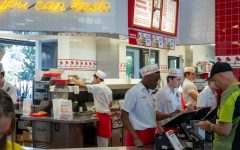
Gallego’s plan ignores these harsh realities seen in states like California, where a $20 minimum wage for fast-food workers has led to widespread job losses, skyrocketing prices, and accelerated automation. The California Globe has extensively documented these fallout effects, providing a cautionary tale for national policy.
In April 2025, the Globe reported that over 22,000 fast-food jobs were lost in the year following the law’s implementation, with prices surging 14.5 percent—double the national average—and 89 percent of restaurants slashing employee hours. Similarly, “California Minimum Wage Madness” highlighted how such hikes destroy on-the-job training opportunities and disproportionately harm low-skilled workers, reducing their take-home pay to zero as employers cut back.
Since the passage of AB 1228 in September 2023 that increased the minimum wage for fast food workers to $20 per hour, California’s privately-owned fast food restaurants have lost -6,166 jobs. Over the same period the previous year, prior to passage of AB 1228 (September 2022 through June 2023), California gained 17,528 private sector fast food jobs, according to the Bureau of Labor Statistics and the Employment Policies Institute, the Globe reported in December 2024.
Even supporters like California’s Service Employees International Union have admitted job losses tied to the policy, yet Gallego’s bill presses forward without addressing these pitfalls. With California’s unemployment at 5.4 percent—1.2 percent above the national average—opponents argue that a federal $20 wage could exacerbate inflation and stifle small businesses nationwide.
As the 119th Congress debates economic priorities, Gallego’s legislation sets the stage for a partisan clash, with Republicans likely to highlight California’s experience as evidence of government overreach harming the very workers it claims to help.


- Rep Dina Titus’s Radical Rhetoric and Voting Record Under Fire After Calling ICE Agents ‘Terrorists’ - February 5, 2026
- Senator Ruben Gallego Introduces Bill to Hike Federal Minimum Wage to $20 by 2029 - February 5, 2026
- UNR Women’s Volleyball Team Alleges ‘Emotional Blackmail’ and Intimidation Over Match Against Trans Athlete - February 4, 2026
RELATED ARTICLES
-
-
-

-

-
 February 20, 2024
 -
California wannabe – guess this dipsh!t Democrat hasn’t been reading the newspapers about the massive LAYOFFS that followed California taking the “lead” on this economic suicide pact….
AZ is lost….as is California….
This is what will happen. If the price of energy is low, everything is cheaper and no one needs a raise. If energy is sky high, no one can afford anything, which means no business and no employees having jobs much less an income. Now contemplate what the morons in sacramento have done with their insane war on oil and by extension refineries. Buckle up for some hard times. As one old timer once said, “I knew the depression was over when I saw a rabbit running across the road and no one was chasing it.”