
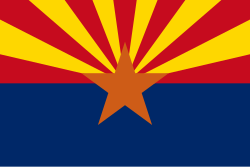
Arizona Flag. (Photo: public domain)
Supreme Court Ruling Could Trigger Challenge to Arizona’s Congressional District Maps
Arizona currently has multiple majority-Latino legislative and congressional districts, as well as a majority-Native American legislative district
By Matthew Holloway, May 1, 2026 4:10 pm
The U.S. Supreme Court ruling in Louisiana v. Callais on congressional redistricting could prompt a legal challenge to Arizona’s current district maps, including those covering Congressional Districts 3 and 7, according to reporting from Votebeat.
The ruling, which addressed a congressional map in Louisiana, found the map to be an unconstitutional racial gerrymander, a decision that legal observers say may influence how courts evaluate similar claims in other states.
Arizona Senate President Warren Petersen (R-LD14) said Republican lawmakers are preparing to file a lawsuit challenging Arizona’s congressional districts, a step required to trigger any mid-decade redraw by the state’s redistricting body.
Petersen wrote, “Great decision this morning from the U.S. Supreme Court on redistricting. Very likely we bring a claim to eliminate our unconstitutionally gerrymandered districts here in AZ.”
Great decision this morning from the U.S. Supreme Court on redistricting. Very likely we bring a claim to eliminate our unconstitutionally gerrymandered districts here in AZ. https://t.co/B8dAlTnhum
— Warren Petersen (@votewarren) April 29, 2026
In a statement to The Arizona Republic, Petersen, a candidate for Arizona Attorney General, said, “Our maps are racist. The redistricting commission should meet and they should fix the maps. And if they don’t do it, then we’ll litigate.” He told the outlet, “We’re setting it up,” adding that Arizona House Speaker Steve Montenegro would likely join the lawsuit.
Arizona’s current maps were drawn by the Arizona Independent Redistricting Commission, a voter-created panel established by Proposition 106 in 2000 to remove map-drawing authority from the state legislature. The U.S. Supreme Court upheld the constitutionality of the commission in a 2015 decision, affirming that states may assign redistricting authority through voter initiatives.
Under Arizona law, the commission cannot unilaterally redraw district boundaries outside the normal redistricting cycle and would require a court order to make changes.
The potential legal challenge is expected to focus in part on Arizona’s majority-Latino districts, including Congressional Districts 3 and 7, which were drawn to comply with the federal Voting Rights Act and have historically elected Democratic candidates. Arizona’s 3rd District, represented by Rep. Yassamin Ansari, is currently a D+22 district according to the Cook Political Report, and the 7th District, represented by Rep. Adelita Grijalva, is assessed as a D+13 district by Cook.
Arizona currently has multiple majority-Latino legislative and congressional districts, as well as a majority-Native American legislative district, reflecting efforts during the last redistricting cycle to ensure minority representation.
Critics of potential litigation have warned that weakening or eliminating such districts could reduce minority representation, while supporters argue the maps may rely too heavily on race in drawing district boundaries.
Any lawsuit would likely initiate a legal process that could ultimately determine whether Arizona’s current congressional and legislative maps remain in place through the 2030 redistricting cycle or are modified earlier by court order.


- Hobbs Audio Recordings, Released After Reported Yearlong Records Wait, Renew Sunshine Questions - October 7, 2026
- TPUSA Frontlines Reporter Says Activists Assaulted Him, Slashed Tires At Arizona Border Protest - October 6, 2026
- Fontes Rejects ‘Cartel Lawyer’ Label in AZ SOS Debate Clash With Kolodin - October 2, 2026
RELATED ARTICLES
-
-

-

-
 January 6, 2026