
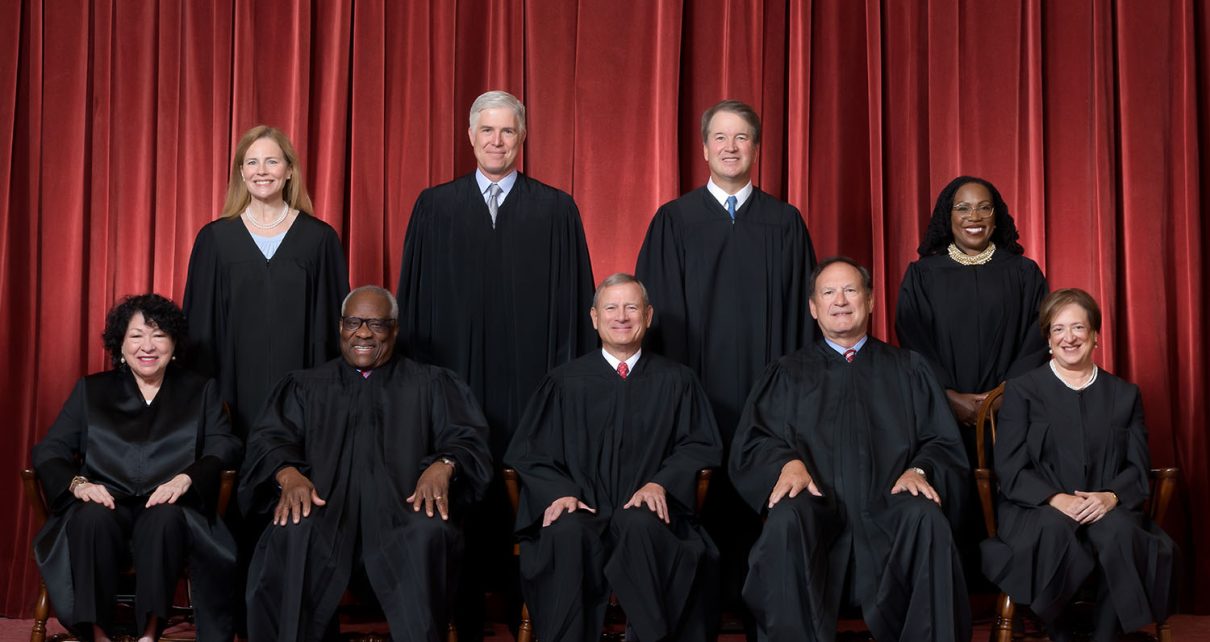
he Supreme Court as composed June 30, 2022. (Photo: https://www.supremecourt.gov/about/justices)
Supreme Court Strikes Down Colorado Conversion Therapy Ban, Implicates California’s Ban
This ruling directly implicates California’s SB 1172 from 2012
By Katy Grimes, March 31, 2026 12:02 pm
The U.S. Supreme Court just issued a ruling this morning on Colorado’s ban on “conversion therapy” for minors, stating that it violates the First Amendment rights of licensed counselors, sending the case back to lower courts for further review.
In a landmark 8-1 decision in Chiles v. Salazar, “the justices agreed with Kaley Chiles, the licensed counselor challenging the law, saying that the ban discriminates against her based on the views that she expresses in her talk therapy.”
Justice Neil Gorsuch writing for the majority, said a federal Appeals Court should have applied a more stringent standard of review, known as strict scrutiny, to determine whether the law violates the First Amendment as applied to Chiles,” SCOTUS blog reported.
“Colorado’s law regulates the “verbal language” she may use,” Gorsuch wrote.
The Court held that Colorado’s law “regulates speech based on viewpoint,” impermissibly allowing certain perspectives while censoring others.
In his 23-page opinion, Gorsuch stressed that in cases like Chiles’, Colorado’s ban “censors speech based on viewpoint,” and “the First Amendment stands as a bulwark against any effort to prescribe an orthodoxy of views.”
Gorsuch continued:
“Consistent with the First Amendment’s jealous protec-
tions for the individual’s right to think and speak freely,
this Court has long held that laws regulating speech based
on its subject matter or ‘communicative content’ are ‘presumptively unconstitutional.’”
“When the government seeks not just to restrict speech based on its subject matter, but also seeks to dictate what particular ‘opinion or perspective’ individuals may express on that subject, ‘the violation of the
First Amendment is all the more blatant.’”
“While the First Amendment protects many and varied forms of expression, the spoken word is perhaps the quintessential form of protected speech. And that is exactly the kind of expression in which Ms. Chiles seeks to engage. As a talk therapist, all Ms. Chiles does is speak with clients; she does not prescribe medication, use medical devices, or employ any physical methods.”
And he noted, “Colorado’s law does not just regulate the content of Ms. Chiles’s speech. It goes a step further, prescribing what views she may and may not express.”
California’s conversion therapy restriction law was one of the earliest and strictest restrictions in the U.S. California passed the first-in-the-nation ban on “conversion therapy” law in 2012.
SB 1172, authored by then-Sen. Ted Lieu (D) was signed into law by Gov. Jerry Brown in 2012, and was the nation’s first statewide ban. It prohibits licensed mental health providers from performing “sexual orientation change efforts” on patients under 18. Violations lead to professional discipline. The law frames such efforts as unproven and potentially harmful. Courts largely upheld it against free speech and parental rights challenges.
Today’s ruling directly implicates California’s SB 1172.
Another bill in 2018, AB 2943, sought to expand restrictions by treating certain “sexual orientation change efforts” as unlawful business practices under consumer protection laws (applying when money changes hands, such as paid counseling or programs). It passed the Assembly but faced significant criticism for potentially chilling religious speech, pastoral counseling, or sales of materials (e.g., books or Bibles discussing traditional views on sexuality). Opponents argued it could broadly impact free exercise of religion and free speech. The author ultimately dropped the bill before final passage.
Critics have viewed these measures as government intrusion into therapy, parental rights, religious freedom, and voluntary counseling, especially for those seeking help with unwanted same-sex attraction or gender dysphoria.
Some therapists, religious groups, and detransitioners have argued that California’s laws sweep too broadly, which banned talk therapy, exploratory counseling, or religious guidance even when clients voluntarily seek it.
The left prioritized affirmation-only approaches, especially for gender identity issues, while restricting alternatives, despite growing evidence of desistance in youth with gender dysphoria and concerns over rushed medical interventions, including permanent chemical castration sold as “puberty blockers” and hormones.
Justice Ketanji Brown Jackson was the sole dissenting opinion. Her opening is telling:
“[T]here is no right to practice medicine which is not sub-
ordinate to the police power of the States.” Lambert v. Yel-
lowley, 272 U. S. 581, 596 (1926).
This was true 100 years ago, and it should be true today.”
Gorsuch concluded:
“We do not doubt that the question ‘how best to help minors’ struggling with issues of gender identity or sexual orientation is presently a subject of ‘fierce public debate.’ But Colorado’s law addressing conversion therapy does not just ban physical interventions. In cases like this, it censors speech based on viewpoint.
Colorado may regard its policy as essential to public health and safety. Certainly, censorious governments throughout history have believed the same. But the First Amendment stands as a shield against any effort to enforce orthodoxy in thought or speech in this country. It reflects instead a judgment that every American possesses an inalienable right to think and speak freely, and a faith in the free marketplace of ideas as the best means for discovering truth. However well-intentioned, any law that
suppresses speech based on viewpoint represents an ‘egregious’ assault on both of those commitments.”

A California native and Navy mom, Katy lives in Sacramento, CA.
- Newsom Gaslights Over California’s Bad Student Test Scores - October 22, 2026
- How the DMV Enabled Voter Fraud in California - October 21, 2026
- Newsom Doth Protest Over DOJ Voter Fraud Allegations and 20,000 Noncitizens Receiving Ballots - October 20, 2026
RELATED ARTICLES
-
 February 27, 2023
 -
December 13, 2022
GOOD. What a relief this decision is.
Authored in the first place by Ted Lieu and signed by Jerry Brown.
Who’s surprised? No one