
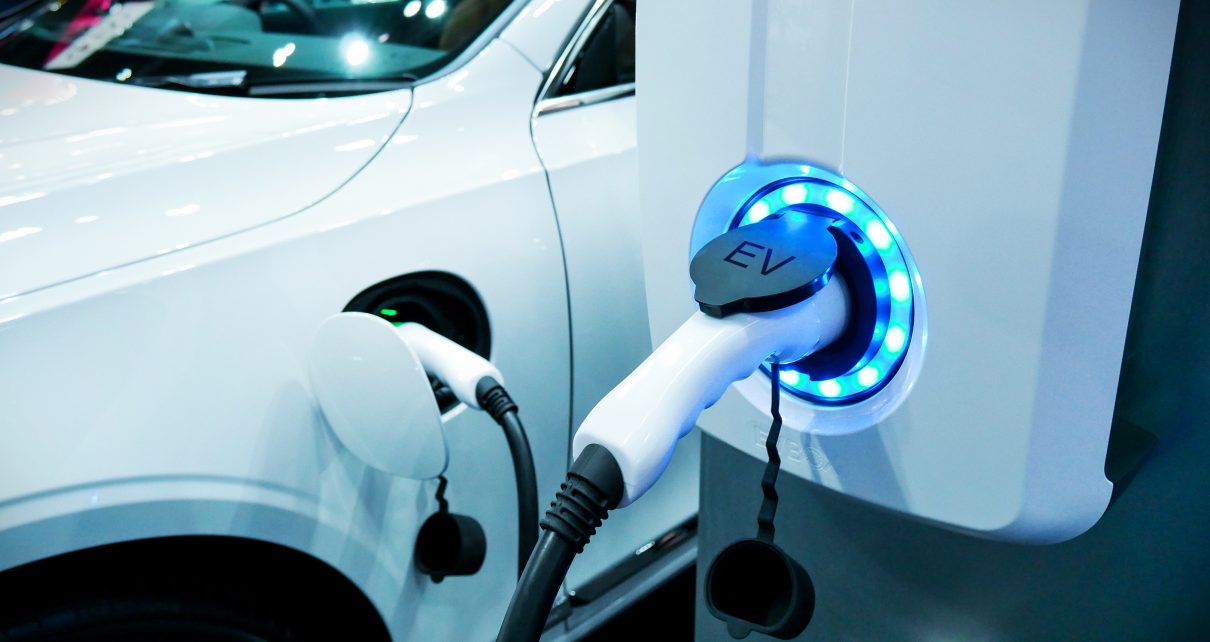
A power supply charging the battery of an electric vehicle. (Photo: Shutterstock/buffaloboy)
Trump DOJ Sues to Kill California’s ‘Backdoor’ EV Mandate
The suit targets California’s Advanced Clean Cars II regulations, adopted by the California Air Resources Board (CARB) in 2022 under Governor Gavin Newsom
By Megan Barth, March 12, 2026 3:30 pm
President Trump’s Department of Justice (DOJ) filed a lawsuit against California on Thursday, accusing the state of imposing an unlawful “backdoor” electric vehicle (EV) mandate through stringent mileage and emissions rules that burden automakers and inflate costs for consumers.
Attorney General Pamela Bondi lambasted the policies as holdovers from the Biden era, stating, “California is using unlawful policies from the last administration to create exorbitant costs for their citizens. This Department of Justice is proud to stand with President Trump and Secretary Duffy to bring litigation that will make life more affordable for American consumers.”
The suit targets California’s Advanced Clean Cars II regulations, adopted by the California Air Resources Board (CARB) in 2022 under Governor Gavin Newsom, which mandate escalating zero-emission vehicle sales culminating in a full ban on new gas-powered passenger cars by 2035.
These rules, which received a Biden-era EPA waiver in December 2024, are alleged to circumvent federal preemption under the Clean Air Act by forcing automakers to comply or face penalties, effectively dictating national standards from Sacramento.
The DOJ argues this violates federal law, echoing earlier Trump administration actions that revoked similar waivers and ended California’s diesel engine mandates.
As detailed in previous California Globe reporting, such mandates have already faced federal scrutiny, with the EPA under Trump appointee Lee Zeldin moving to terminate California’s regulation waivers .
This latest legal battle intensifies the ongoing feud between the Trump administration and Newsom’s California, a state long criticized for its aggressive green cap-and-trade agenda that critics say prioritizes ideology over affordability and threatens energy independence.

As detailed in recent reporting by our own Editor Katy Grimes, CARB operates in opacity, with their own Delaware LLC, while their environmental regulations utilize studies that are not only decades old, but used Chinese research to ban diesel trucks.
CARB is using flawed PM2.5 deaths research, much of which has been conducted by Chinese investigators, to ban diesel trucks in the state. California has record-low pollution levels and CARB admits that trucks represent only 6% of the vehicles on California’s roads.
Grimes cites:
The science behind these regulations is not only dubious, it is from China, which has a strong motive to see that the United States succumbs to the climate change movement–much of which is funded by China, as Real Clear Energy reported: “For China, climate change offers a strategic opportunity. Decarbonizing the rest of the world makes China’s economy stronger – it weakens its rivals’ economies, reduces the cost of energy for its hydrocarbon-hungry economy, and sinks energy-poor India as a potential Indo-Pacific rival.”
Critics, including retired military officials, have long warned that such mandates benefit foreign adversaries like China while hiking utility and car costs for Americans.
The federal suit comes amid slumping EV sales nationwide—down to a mere trickle despite subsidies—and growing backlash from automakers like General Motors, which recently lobbied against the 2035 ban. Trump, who vowed during his campaign to end federal EV mandates, signed executive orders on day one to unleash American energy and terminate state emissions waivers limiting gasoline-powered vehicles .
Updated developments show the suit aligns with broader Trump efforts to level the regulatory playing field, including settlements forcing California to repeal its “Advanced Clean Fleet” electric truck mandate by 2045 .
As we reported, multiple states and auto dealers have joined the pushback against California’s EV dictates which initiated with Newsom’s executive order in 2020 and once influenced a dozen other states. Those states are rapidly defecting from Democrat’s green dreams to economic realities. The House’s recent vote to repeal the EPA waiver for the 2035 mandate further paves the way for a full federal repeal .
Newsom’s administration fired back as expected, with the governor slamming the lawsuit as “doubling down on stupid” and an “all-out assault on California,” vowing to sue Trump “the subsidiary of big polluters” in response to protect the state’s clean air authority.
“We are suing to stop this latest illegal action by a President who is a wholly-owned subsidiary of big polluters,” Newsom stated, echoing his responses to prior Trump rollbacks, such as the June 2025 resolutions ending California’s restrictive diesel rules.
Attorney General Rob Bonta added that the move ignores “life or death consequences for California communities breathing dirty, toxic air,” pledging fierce defense against federal overreach.
Speaking of overreach, California has filed over 37 suits against Trump policies since 2025, including challenges to birthright citizenship orders and National Guard federalizations to ICE agents wearing masks.
As Trump escalates his battle with Newsom—spanning sanctuary cities, wildfires, and now EVs—the Golden State’s green dreams appear increasingly vulnerable. With EV sales slipping and CARB mandates under fire, California’s progressive (and failed) policies may finally meet their match in federal courts.


- Former Biden Official and Reno Mayoral Candidate Kate Marshall Hit with Dual Complaints Over Campaign Finance and Hatch Act Violations - May 6, 2026
- Department of Education Launches Title IX Investigation Into LAUSD for Union Deal That Shields Alleged Sexual Predators From Termination - May 6, 2026
- DCCC Drops Thumb on Scale in Heavily Latino CA-22 Primary, Sparking Open War Among Democrats - May 5, 2026

Let’s amplify this GREAT NEWS by doing a little research into ‘BYD” the CCP-aligned Chinese manufacturing conglomerate that buillds electric cars AND BUSES (the Buses are built in Lancaster, CA – which partially explains the CARB board and Newsom’s fixation on making gasoline so expensive that one would be encouraged to either purchase a BYD electric car or ride an electric BYD bus :
“RIDE is the US spinoff of BYD, focusing on transit solutions in the US and Canada. Headquartered in Pasadena, California, US, the company was announced in 2023 and during a transition period, in which it won awards for innovative school bus designs, was known publicly as BYD | RIDE. RIDE operates the former BYD Coach & Bus facility in Lancaster, California. Type A, C, and D school buses, transit buses and trucks are manufactured and assembled at the facility, which employs about 500 American union workers who are affiliated with the SMART union. RIDE battery electric school buses have been deployed in Oakland, California in concert with Zum.
Zooming OUT, let’s take a look at BYD (“Build Your Dreams”, although the CNN overview article from 2014 obfuscates that)
“Based in the Chinese megacity of Shenzhen, BYD was founded in 1995 by Wang Chuanfu, a low-key former academic who still runs the company. Wang says the letters BYD don’t stand for anything in particular. {BS}
He said he chose a “rather strange” name to set it apart from other startups.
It is China’s top EV producer and exports electric taxis, buses and other vehicles to the rest of the world, including Europe, South America, Southeast Asia and the Middle East. Unlike Tesla (TSLA), it also makes plug-in hybrids.
Israel and Thailand currently count as BYD’s major overseas markets, where the Chinese company ranks number one in EV sales.
Its best-selling passenger cars are the Qin and Song models. The Qin is a compact sedan available as a plug-in hybrid or an all-electric car. The BYD Song is a series of compact crossover SUVs.
Compared to Tesla, BYD is known for offering more affordable cars, which helped it attract a wider group of consumers. Its entry-level model sells in China for just over $10,000; the cheapest Tesla Model 3 costs more than $32,000.
BYD’s passenger cars are not yet available in the United States. But its electric buses — made in Lancaster, California — are sold in the country.
Made in China
Wang, an engineer, first moved to Shenzhen in the early 1990s to run a battery making business for a Beijing-based government research institute, according to his official resume in the company’s filings.
Government posts in China at that time were considered “iron rice bowls,” a popular term for a job for life. But Wang soon quit and founded BYD.
The start of his entrepreneurial journey coincided with the opening of the Chinese economy to the world. China’s former leader Deng Xiaoping had set up the country’s first special economic zone in Shenzhen, which encouraged hundreds of manufacturing businesses to flock to the city, lured by its liberal economic policies and cheaper labor and land costs.
By 1997, Wang had grown his small workshop to a medium-sized cellphone battery maker with more than 100 million yuan ($14 million) in annual sales.
That year, the Asian financial crisis provided a growth opportunity as plunging battery prices pushed many competitors out of business. Wang’s company was able to survive due to its cost advantage, according to the Southern Weekly newspaper.
By 2003, BYD had become the world’s largest producer of nickel-cadmium batteries, which were widely used in mobile phones.
Backed by Buffett
But Wang wanted more. Eyeing the future growth of EVs, Wang ventured into the car industry in 2003, acquiring a state-owned automaker in the city of Xi’an for 269 million yuan ($38 million).
While that surprise decision angered the company’s strategic investors and triggered a 21% plunge in the company’s Hong Kong-listed shares, as Wang later described, he remained steadfast.
“I build cars because I am optimistic about the future development of electric vehicles,” he said defiantly after the share price plunge, according to state-owned Beijing Business Today.
Just five years later, in 2008, Wang was vindicated when he received a $230 million investment from his most famous backer, Warren Buffett, who paid about $1 per share for a stake of around 10%. That vote of confidence helped boost the company’s stock by as much as 1,370% over the next year.
BYD launched its first plug-in hybrid model at the end of 2008. Since then, BYD has taken off as an EV manufacturer, partly thanks to the Chinese government’s support for the industry.
Buffett has been gradually trimming his stake in BYD since 2022, taking some of the enormous profits he has made. According to the most recent filing by Buffett’s Berkshire Hathaway, the firm held nearly 8% of BYD as of late October. Those shares are now worth 18.28 billion Hong Kong dollars ($2.3 billion).
Competing with Tesla
BYD has dominated the Chinese EV industry since 2015, when it surpassed its domestic and overseas rivals in the world’s biggest car market. One of its key advantages against Tesla, the number two player in China, is price.
Tesla’s four models — the Model 3, Model Y, Model S and Model X — have price tags ranging from $40,000 to $120,000 in the United States. In China, the cheapest Tesla model, the base Model 3, has a starting price of 229,900 yuan ($32,375). It has a range of 272 miles on a full charge and a top speed of 140 miles per hour.
By contrast, the BYD Seagull has a starting price of 73,800 yuan ($10,392) in China. It has a top speed of 81 miles per hour. The Seagull is available with two battery packs. The smaller battery has a range of 190 miles, while the larger battery has a range of 251 miles.
Both Tesla and BYD vehicles have received safety ratings from international organizations. In 2022, Tesla’s Model Y and BYD’s Atto 3 received a five-star Australasian New Car Assessment Program (ANCAP) rating respectively.
Making its own batteries
Since 2020, BYD has been making its lithium iron phosphate battery (LFP) “Blade Batteries” for use in its own cars and for sale to other auto makers, such as Toyota.
The company says the blade-shaped battery is thinner and longer than conventional lithium iron cells, and thus can maximize the use of available space within the battery pack. It’s also less likely to catch fire even when it’s severely damaged, according to BYD.
Tesla also reportedly uses BYD Blade Batteries for its Y cars produced in the Berlin Gigafactory, according to German media.
In March 2023, Elon Musk denied a media report saying Tesla was ending cooperation with BYD on battery supply.”
Let’s let CNN continue to share China’s long-game and how Newsom is facilitating its entry and success in California AT YOUR EXPENSE :
“China doesn’t want to catch up with the US in tech. It aims to lead”
“In an era marked by US overseas military actions and trade turbulence, Chinese leader Xi Jinping is counting on a plan to shield his country from the storm: driving innovation to transform China into the world’s leading tech superpower.
Over the next five years, China seeks to upgrade its already powerful industrial sector, strengthen tech “self-sufficiency” and incubate sectors that will help accelerate the country’s tech supremacy, from artificial intelligence and robotics to aerospace and quantum computing.
“For the first time, China wants to lead in a number of technologies. Previously, the focus was always catching up with the West,” said Dan Wang, China director at political risk consultancy Eurasia Group.
Details of Xi’s gambit for the future were approved on Thursday by China’s rubber-stamp legislature in Beijing as the week-long annual assembly drew to a close. The policy document, known as the Five-Year Plan, has been hashed out behind closed doors by Xi’s inner circle for months and serves as a North Star for the country’s development into the next half-decade.
“Strive to achieve new breakthroughs in advancing original innovation, tackling key core technologies, and seizing the strategic high ground in science and technology,” Xi told local officials in a meeting discussing the new plan last week.
As China’s economy contends with deep-rooted structural challenges, including a persistent real estate crisis and low consumer confidence, Xi is zeroing in on bolstering its tech sector, betting proactively on emerging technologies to power the country’s growth in the decades ahead. Last week, China set its lowest-ever economic growth target since it began adopting such figures.
“In the face of tumultuous international dynamics and a range of risks and challenges,” the policy document reads, “we must concentrate on doing our own work well… consolidate and expand our strengths, remove bottlenecks and constraints, and shore up weaknesses.”
Although Xi is expected to host US President Donald Trump in Beijing later this month to discuss extending a trade truce and narrowing their differences, experts said relations between the world’s two biggest economies will continue to center on competition in the next five years.
“Collaboration will drop in every aspect from academia to industries. Both sides want to reduce reliance on the other side and thus decoupling is mutual,” Wang of Eurasia Group said, warning that bilateral tensions could flare up again after a period of calm brought by the trade truce.
In an uncertain world, China is positioning itself as a “stabilizing anchor for the global economy,” said Henry Huiyao Wang, president of the Beijing-based research group Center for China and Globalization.
“The China the US is dealing with today is a highly organized country, one that is still driven by strong vitality and growth momentum, and moving forward with clear strategic resolve through successive five-year plans,” said the analyst, who previously served as an adviser to China’s cabinet, the State Council.
The long game
China’s state-led model is helping the country rapidly narrow the gap in research and development spending with the US.
Beijing has committed to a 10% increase in annual budget for science and technology – in line with the pace of growth over the past two years. The plan also set a goal of expanding annual research and development investment by at least 7%.
“China now leads the world in research and development and application in fields such as artificial intelligence, biomedicine, robotics, and quantum technology, and new breakthroughs were made in the independent research and development of chips,” a separate government report released last week read.
The term “artificial intelligence” was mentioned in the plan more than 50 times – and it’s a field where China has already proven itself a top player, dominating open-source large language models and raising huge sums in market debuts.”
NOTHING in this article dissuaded me from believing that Gavin Newsom is on the CCP payroll, and using his CARB minions to “open the market” to BYD and is being paid for his efforts, while we SUFFER from the CARB policies and fuel refiners EXIT the state…
Gavin Newsom’s support of BYD Motors is economic treason.
Good good good news. You know, because, uh, the Newsom mandate was impossible to fulfill anyway? Made even more impossible because Newsom himself has devastated California’s electrical grid and sensible energy capabilities with his phony green crap? That he doesn’t even believe in, guaranteed? And everyone who had a brain in their head was screaming at the time at Newsom & his Minions that it cannot be done? OMG, these people. Sigh. Grateful to the Trump Administration and DOJ Pam Bondi for taking this on. Really grateful. Little by little, we are getting relief by killing what needs to be killed. With those things dead and no longer sucking all the money and energy out of the state let’s hope we will stop the endless suffocation and begin to breathe again. We’ll see, knock wood.
“Attorney General Rob Bonta added that the move ignores “life or death consequences for California communities breathing dirty, toxic air,” pledging fierce defense against federal overreach. ”
The air is not dirty or toxic from gasoline powered cars. It is dirty and toxic because of marijuana smoke.
Secondhand marijuana smoke exposure in multi-unit housing is a growing public health concern, with significant health impacts reported among nonsmokers.
A 2024 study of 162 nonsmoking residents in 104 apartments across 19 U.S. states and two Canadian provinces found that exposure to secondhand marijuana smoke caused serious health effects, including eye, nose, throat, and lung irritation, headaches, dizziness, nausea, difficulty breathing, tachycardia, and asthma attacks.
About 12% of affected residents resorted to litigation, and some reported their apartments were uninhabitable due to persistent smoke and odors.
PM2.5 levels in units with marijuana smoking were estimated to reach “Very Unhealthy” to “Hazardous” levels on the U.S. Air Quality Index, comparable to wildfire smoke or heavy traffic pollution.
THC was detected on surfaces in five units, ranging from 1.25 µg/m² to 6.92 µg/m², indicating significant residue and exposure risk.
Children and vulnerable populations (e.g., those with asthma, COPD, heart disease, or pregnant individuals) are especially at risk, with studies showing detectable THC in children’s urine and potential for long-term developmental harm.
While exact nationwide numbers are not available, approximately 46% of U.S. multi-unit housing residents with smoke-free rules still experience secondhand smoke infiltration—highlighting the widespread and serious nature of the issue.
The Democrats are so big on banning things, but they don’t ban smokeable marijuana and THC vaping products.
Thanks for writing about this, Protect Freedom, and you are right to make the case and do what you can to alert the public. Would only like to add that vaping “juice,” even WITHOUT added THC, once ignited, heated, and turned into aerosol, is also extremely toxic and causes myriad problems for many who get it “second-hand”: Difficulty breathing, lung inflammation (searing pain), headache, vertigo, limb and body weakness, sapping of energy, confusion. Heated and aerosol-ized vape “juice” is not merely “water vapor” as propagandized by the addicts and sellers, but is a sticky substance that comes into your home through venting systems and into your lungs, affecting your entire body. And yes, it is playing a significant role in the general filthy air quality. When it comes into your home, its stink blots out every other home-like or even alarming aroma. You can’t tell if you have a gas leak, if your furnace or electrical system is on the fritz, or smell dinner cooking. Reactions are varied. Some are merely annoyed by the stink, but others cannot tolerate vape’s other effects at all. I contend it’s because of the documented poisons (duh), the exact opposite of how vape is touted as “benign,” and “a good alternative to smoking tobacco,” but I’ve also heard it called an “allergic reaction.” Interesting because some of us who are not allergic to anything at all have — in addition to an effect that is like the beginnings of the worst case of flu you’ve ever had — a panicky desperate reaction of suddenly not being able to catch one’s breath and having to run outside in search of “fresh air.” And this is happening in suburban neighborhoods as well as multi-unit housing, because the stuff is so strong, pervasive, and constant it appears to reach a critical mass and enter homes in a concentrated form, especially if nearby. These addicts — at least the ones near us — never stop once they start. If nothing else “the poison is in the dose,” for certain, especially as the dose is so high. Attempts at civil discussions are met with “it’s legal,” “you’re harassing us, and we’re the victims here,” etc. The pot smokers say this too, I’ve learned from a neighbor. Not at all surprising that the rate of litigation is so high.
Here are just some of the ingredients of flavored and unflavored vape:
Lead, zinc, nickel, benzene, diacetyl, nicotine “salts,” acetone (nail polish remover), diethylene glycol (anti-freeze).
Showandtell, thank you for pointing this out. Vaping poses serious health risks, particularly to the lungs, heart, and brain, despite being marketed as a safer alternative to smoking. While e-cigarettes generally contain fewer harmful chemicals than traditional cigarettes, they are not safe. The aerosol from vaping can include nicotine, cancer-causing chemicals (like formaldehyde and acetaldehyde), heavy metals (such as lead and nickel), ultrafine particles, and flavorings like diacetyl linked to “popcorn lung”—a serious lung disease.
You can’t have a civil or intellectual discussion with an addict. Their drug is more important than people.
If you think California is bad, you should smell COLORADO…
WEED GEADS EVERYWHERE and the skunk weed smell….
Awful…
Beautiful state, again ruined by Democrats and Jared Polis’ “Blueprint”
The link to the CARB’s Delaware LLC appears to be broken.
Everything associated with CARB appears to br broken…
CARB ITSELF should be broken up….
It is a Board pursuing environmental goals that have already been handled via automotive technologies and now serves as yet another Democrat money laundering front….