
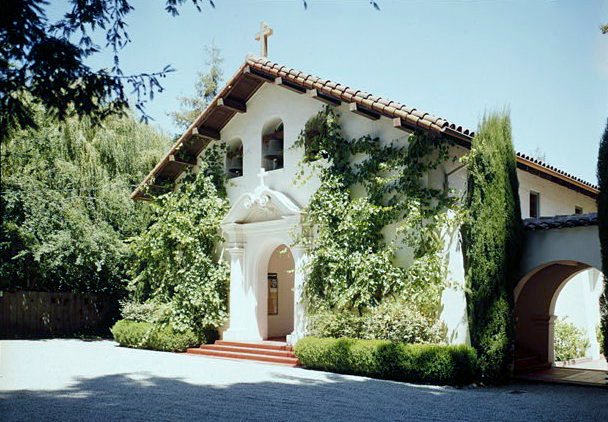
Our Lady of the Wayside Church, Portolla Valley, CA. (Photo: Public Domain)
Beyond the Polls: Arizona’s Churches Signal a National Faith Revival
This revival, particularly among younger generations, is not confined to the Southwest; it’s a national undercurrent seen by many as a rising tide
By Matthew Holloway, October 8, 2025 3:03 pm
A recent Pew Research study reported that 58 percent of Arizonans identified as Christian in 2023-24, a decline from 71 percent in 2007, alongside a rise in Republican-leaning respondents to 52 percent from 38 percent, according to AZ Central. These figures, drawn from self-reported affiliations in a survey concluded in early 2024, indicate a steady decline in religious identification, a trend that several outlets reported on. Yet, such metrics, while valuable for tracking broad trends, offer only a partial view—one that may be contradicted by “ground truth” in Arizona, and beyond.
Pew’s methodology relies on telephone and online responses in English and Spanish, sampling responsive adults without probing deeper into active practice, doctrinal adherence, or recent cultural shifts. It overlooks the distinction between nominal labels and lived faith, much like measuring a river’s depth from a single, outdated gauge.
In Arizona, where the spiritual landscape is as dynamic and unpredictable as the monsoon weather, this snapshot misses the gathering storm: a profound resurgence in church attendance, biblical engagement, and personal commitments to Christ. This revival, particularly among younger generations, is not confined to the Southwest; it’s a national undercurrent seen by many as a rising tide, with echoes reverberating through Arizona’s megachurches and tech hubs, signaling hope for a broader cultural shift.
The Barna Group’s Take
The Barna Group’s State of the Church 2025 initiative offers a more nuanced portrait, revealing a “groundswell of commitment to Jesus” that has accelerated on a national level over the past four years. Contrary to earlier narratives of unrelenting decline, belief in Jesus as Savior has risen nationally, with younger adults driving the momentum. Barna’s September 2025 release on church attendance underscores this reversal: Barna reports that Gen Z and Millennials are now the most frequent churchgoers, with a typical Gen Z churchgoer attending about two weekends per month, reversing previous patterns—a trend some interpret as an emerging resurgence. Specifically, Gen Z men, who have long been stereotyped as the vanguard of secularism, are reportedly bucking trends, with 46 percent attending weekly, outpacing women in a historic shift.
A September 2025 report from Barna and Arizona Christian University’s Cultural Research Center highlighted several emerging trends, including upticks in commitment, baptisms, and small-group indicators in several samples. These weren’t abstract projections; they’re rooted in surveys of thousands, showing baptisms and small-group participation climbing steadily since 2020.

Arizona’s ‘Ground-Truth’
In Arizona, this national trend appeared to begin manifesting with unmistakable force as early as 2024. The Arizona Ministry Network (AZMN) reported a significant increase in 2024: worship attendance rose from 28,237 to 31,542 weekly, while baptisms and Bible study engagement also increased by 12 and 13 percent, respectively. Christ’s Church of the Valley (CCV), a prominent Arizona church, marked the surge with an 18 percent growth in average weekend attendance, reaching 48,796 worshippers per service by year’s end on its website.
The reporting is seemingly supported by a corresponding jump in Bible sales by 22 percent in 2024, according to Circana BookScan, as cited by Fox, with over 20 percent of Gen Z respondents to State of the Bible USA 2024 stating they increased bible-reading last year, presaging the 2025 rise we’re seeing.
This Arizona momentum extended westward as well, resonating deeply in California, where similar patterns are igniting transformation. The 2025 Harvest Crusade at Angel Stadium reportedly drew nearly 50,000 attendees over a weekend in July, with Pastor Greg Laurie proclaiming a “spiritual revival spreading like wildfire.”
The “California Will Be Saved” tour, announced in May, will include seven revival gatherings from Riverside to Temecula, anticipating full-blown awakenings in a state long viewed as spiritually parched. In Silicon Valley, Christianity Today’s July profile detailed a budding “revival with momentum,” describing “a unique and contradictory combination of post-Christian disillusionment and pre-Christian openness, hostility toward religion and curiosity about Christ, and fascination with the new alongside a longing for something lasting.”
Reporting from ABC15 highlighted Barna’s data in a September 30th feature, noting Gen Z’s role: “The typical Gen Z churchgoer attends 1.9 weekends per month—edging out Millennials at 1.8,” as young adults seek solace in structured faith amid economic and social pressures.
Dr. Owen Anderson, pastor of Christ The King Reformed Church and a professor of philosophy and religious studies at ASU, told the outlet, “As a philosophy professor, what I see is students wanting some connection with the transcendent.” He added, “Gen Z right now is.. they find meaning in TikTok, YouTube, social media, money, etc. Those things don’t last, while Christianity does.”
In a post to Substack, he said much more, applauding Barna, calling their latest report “surprising, since Barna has previously reported that church attendance overall is declining. The fact that Barna has published both findings should silence the claim that they’re just a Christian organization trying to spin numbers. Barna is an empirically grounded research group, and their methods can be examined by anyone.”
At the same time, while Pew Research released its findings in February noting “After many years of steady decline, the share of Americans who identify as Christians shows signs of leveling off,” outlets like AZCentral and others who picked up the story recently, pulled from the massive survey that “The share of Arizonans who identify as Christian has dropped by double digits since the mid-2000s, even as Republican Party affiliation increased.”

The “Charlie Kirk Effect”
What the survey from over a year ago didn’t capture, is the poignant catalyst that arrived in on September 10th with the horrific assassination of Turning Point USA co-founder Charlie Kirk, sparking what faith leaders have reported as the “Charlie Kirk Effect,” a resurgence of faith fueled in part by shock, grief, outrage, and a resolve from many to find, or return to, the faith he died championing, in a simultaneously visceral and spiritual reaction.
Fox News reported faith leaders describing roughly 15 percent increases in attendance at some churches in the weeks after Kirk’s death, based on on-the-ground church reports rather than statewide polling. Glendale’s Dream City Church became a focal point, with overflow crowds and viral testimonies of conversions.
“People are coming to us, and they are saying, ‘I want to know the meaning of life, the purpose. Why am I here?’”, Calvary Chapel Chino Hills Pastor Jack Hibbs of California told Fox and Friends.
Matt Zerrusen, co-founder of Newman Ministry, a Catholic nonprofit on 200 campuses nationwide, told the Catholic News Agency, “I have not talked to anyone who has not seen an increase in Mass attendance. Some schools are reporting increases of 15 percent.”
“Museum of the Bible CEO, Dr. Carlos Campo, recently wrote in an op-ed for FOX News saying, “Gen Z is embracing the Bible in an unexpected global spiritual awakening,” with U.S. youth leading surges in attendance across multiple countries.
Vice President of Research for the Barna Group, Daniel Copeland, told Fox that a majority of adults attend church around two out of every five weekends, but Gen Z is reversing this trend.
“This data represents good news for church leaders and adds to the picture that spiritual renewal is shaping Gen Z and Millennials today,” Copeland said.
Fox’s coverage frames the phenomenon as a “modern-day spiritual revival,” with young men defying decline while women depart at higher rates, suggesting the need for tailored outreach opportunities. “Gen Z males are becoming fed up with a virtual world run by algorithms and dating apps… and are seeking something real,” Dr. Cory Marsh, professor of New Testament at Southern California Seminary, told the outlet. “Churches should respond to the current trend by modeling grace and truth, without elevating one above the other.”
In Arizona, as in the rest of the nation, Gen Z appears to drive this: Fox reports young adults boosting attendance from San Diego to Sacramento, mirroring the Southwest’s youth-led charge. These developments reveal the limitations of affiliation-focused polls like Pew’s, which undervalue the vitality of practiced faith and stands in contrast to on-the-ground reporting. The parallel rise in Republican identification in Arizona may also reflect this spiritual deepening with Christian values of community, morality, and purpose aligning with conservative principles.
Yet, revival transcends politics; it’s a human story of redemption, one soul at a time. And as Vice President JD Vance told hundreds of thousands of mourners in Glendale, Arizona: “The evil murderer who took Charlie from us expected us to have a funeral today, and instead, my friends, we have had a revival in celebration of Charlie Kirk.” President Donald Trump agreed, comparing the memorial service to “an old-time revival,” and Secretary of War Pete Hegseth concurred, saying “Charlie started a political movement but unleashed a spiritual revival.”
Author’s Note: For Arizona’s pastors, TPUSA chapters, and California’s congregants: The hour calls for documentation and declaration. Conduct quick surveys of your pews—tally attendance gains, baptism surges, and transformation stories since 2024—and partner with Barna or local networks like AZMN for aggregated reports. Amplify on platforms: Share videos of packed services, threads of Gen Z testimonies, and op-eds challenging outdated narratives—rally interdenominational events, from Valley vigils to Golden State marches, to unite the body. The revival need not be a fleeting spark; it could be a gathering storm, fueled by the faithful. We should rise to meet it not with whispers, but with the bold proclamation of a desert blooming anew.


- ‘No Kings’ Organizers Turn To Early Voting In Latest Bid For Arizona Mobilization - October 15, 2026
- Hobbs Campaign Attack On Biggs’ Sex-Offender Vote Omits His Objection To Licensing Exceptions - October 13, 2026
- Sober Living Plaintiffs’ Attorneys Allege Bribery Inside Arizona Agencies, Challenge Mayes’ Response - October 13, 2026
RELATED ARTICLES
-
 October 7, 2025
 -
 January 18, 2021
 -
 August 28, 2023