
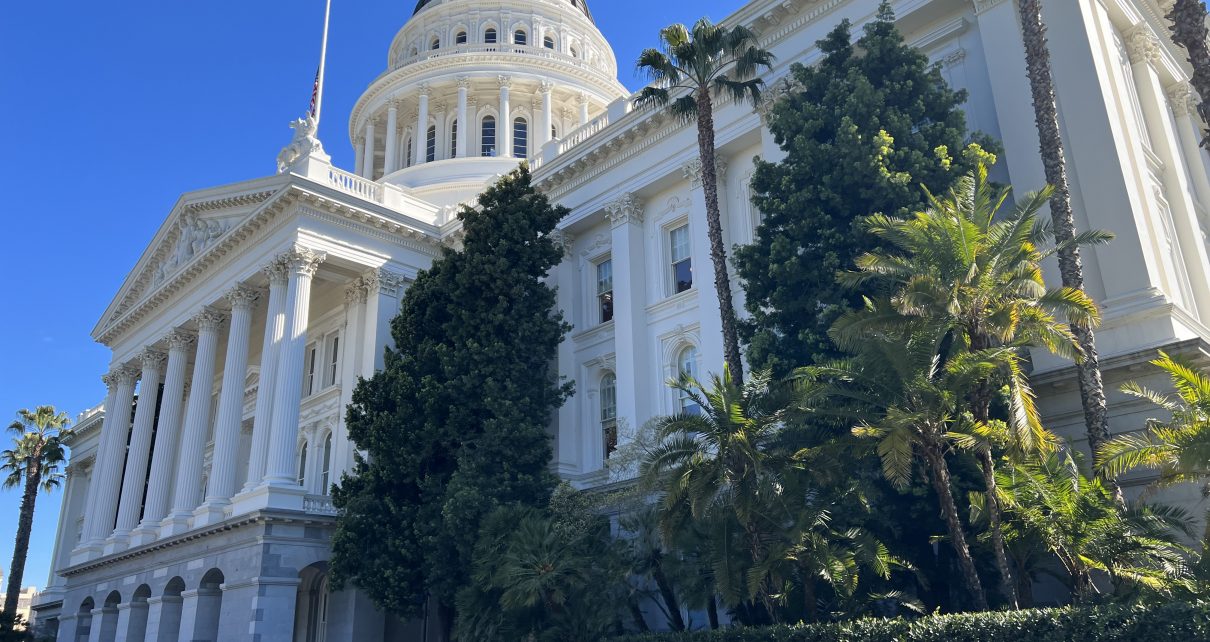
California State Capitol. (Photo: Kevin Sanders for California Globe).
A Better Approach to Contingent Enactment Language
There are several reasons for contingent enactment language, such as upon a budget appropriation, a federal law being repealed, or, another bill being enacted
By Chris Micheli, October 8, 2025 2:42 pm
“Contingent enactment” amendments in the California Legislature are used to connect a bill to another action in order for that bill to become operative. There are several reasons for contingent enactment language, such as upon a budget appropriation, a federal law being repealed, or, most commonly, another bill being enacted during the same Legislative Session.
Generally, contingent enactment language is used for policy reasons rather than to resolve technical issues. Contingent enactment language makes the policy goals contained in one bill dependent upon the policy goals contained in another bill, for example.
The following is an example of contingent enactment language from a 2023 Session bill (my highlight of unnecessary language):
This act shall become operative only if Assembly Bill 39 of the 2023–24 Regular Session is enacted and takes effect on or before January 1, 2024.
The following is the standard language that we see in California bills now for a contingent enactment provision, which is taken from a 2025 Session bill (my highlight of unnecessary language):
This act shall become operative only if Assembly Bill 715 of the 2025–26 Regular Session is enacted and becomes effective on or before January 1, 2026.
In addition, we find the same form language in double-jointing amendments that are used to address a chaptering-out issue (again, my highlight of unnecessary language):
Section 1.5 of this bill incorporates amendments to Section 45500 of the Education Code proposed by this bill, Assembly Bill 147, and Senate Bill 147. That section of this bill shall only become operative if (1) this bill and either Assembly Bill 147 or Senate Bill 147 is enacted and becomes effective on or before January 1, 2026, (2) this bill and either Assembly Bill 147 or Senate Bill 147, as enacted, amends Section 45500 of the Education Code, and (3) this bill is enacted last of these bills amending Section 45500 of the Education Code, in which case Section 45500 of the Education Code, as amended by either Assembly Bill 147 or Senate Bill 147, whichever is operative, shall remain operative only until the operative date of this bill, at which time Section 1.5 of this bill shall become operative, and Section 1 of this bill shall not become operative.
Why is the second clause of the language highlighted above needed in either section? I do not believe it is needed because enacting a bill makes it “effective” or “in effect,” and so the remaining question is simply when is that bill effective or what is its effective date?
There are two possible effective dates in California: A statute enacted in the 2025 Legislative Session becomes effective either immediately (because it is one of the four types of statutes that take immediate effect) or on January 1 of the following year (pursuant to Article IV of the state Constitution). As a result, from my perspective, this second phrase in the standard or form contingent enactment language is unnecessary and so it should no longer be used in bills.
Instead, similar to another bill passed in the 2025 Legislative Session, the following is the better approach to contingent enactment language that should be used going forward:
This act shall become operative only if Assembly Bill 1098 of the 2025–26 Regular Session is enacted.
As the reader can see in the final language example, the unnecessary “and becomes effective on or before January 1, 2026” language is not present in this bill example. I think this final example is the better approach and should be adopted as the standard or form language in the future.


- Physically Disabled Persons - October 20, 2026
- What are Some Unique Aspects of California’s Judicial Branch? - October 20, 2026
- Employer Subrogation - October 20, 2026
RELATED ARTICLES
-
 October 15, 2022
 -
 September 10, 2023
 -
 October 12, 2020