
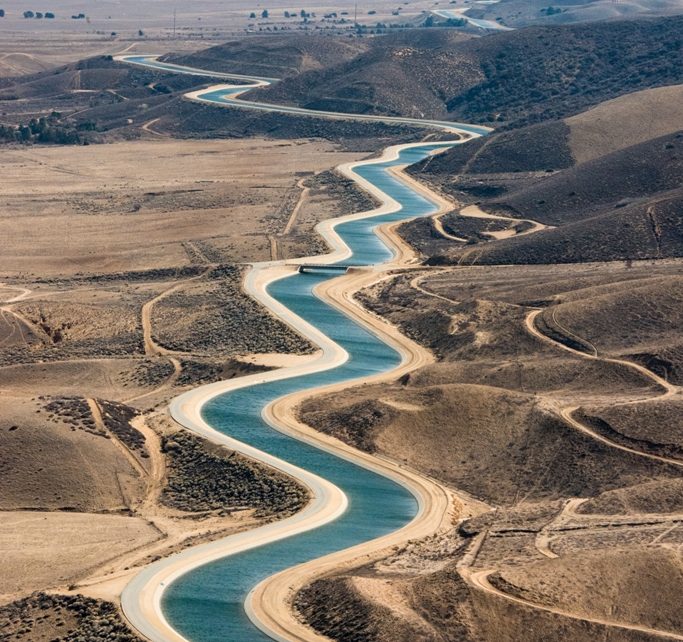
The California Aqueduct. (Photo: CA State Water Project)
Ringside: California’s Plans for Energy and Water Can be Misleading
When the California Energy Commission announces plans to float twenty gigawatts of wind capacity in waters off the coast, that does not equate to twenty gigawatts of reliable electricity
By Edward Ring, May 20, 2026 4:53 pm
 When Governor Gavin Newsom’s water plan calls for nine million acre feet of new water supply, it turns out part of that total is increased storage capacity in reservoirs, which will not result in an equivalent amount of available water. When the California Energy Commission announces plans to float twenty gigawatts of wind capacity in waters off the coast, that does not equate to twenty gigawatts of reliable electricity.
Whether it’s an energy project or a water project, it’s important to avoid conflating capacity with actual production, or yield. With energy projects, that difference is much more certain than with water projects.
For example, in 2024, California’s lone remaining nuclear power plant at Diablo Canyon, with an output capacity of 2.4 gigawatts, would have produced 20.9 terawatt-hours (TWh) if it had ran 100 percent of the time. In reality, its uptime was 88 percent, and it generated 18.4 TWh.
Natural gas power plants in California, if they operated as baseload power plants with 90 percent uptime, could have generated over 300 TWh of electricity in 2024, but because most of them now only operate when wind and solar electricity is not available, they only produced 86.5 TWh, 26 percent of their capacity. The state’s wind turbines had a yield of 28 percent (15.7 TWh), and solar photovoltaics had a yield of 25 percent (48.6 TWh).
The other big source of electricity generation in California is hydroelectric, but the annual yield is not nearly as certain. With nuclear, natural gas, wind, and solar, the reported differences in yield from year to year are insignificant, because the input is relatively predictable. But while California’s big hydroelectric generators yielded 23 percent of hydroelectric capacity in 2024 (25.2 TWh) and 25 percent of capacity in 2023 (27.1 TWh), their output in 2022 was only 14 percent (14.6 TWh), and was only 11 percent in 2021 (12.0 TWh).
Obviously, the uncertainty with hydroelectric power is the result of uncertain weather, and that carries over to most water projects. Desalination and wastewater recycling are immune from the vagaries of weather, but that’s about it.
The ratio of capacity to yield with water projects is also subject to the related uncertainty of what environmental policies may apply and how they may evolve over time. Even in a very wet year, there may be regulations that limit the utilization of a water project’s capacity. The proposed Sites Reservoir offers a dramatic example of just how wide the range of yield scenarios can get.
Last year, in response to an inquiry regarding its projected yield, here is what representatives of the powerful organization Friends of the River wrote in reply:
“The Sites Reservoir is estimated to divert on average approximately 255,000 acre-feet per year. This does not account for conveyance losses, evaporation, etc. Project yield would be less than this value. When asked by the Water Board to use the Water Board’s own tool to determine water availability, the output estimated annual diversions to only be 22k-59k acre-feet.”
The document where this claim is made was submitted before the State Water Resources Control Board in August 2024 and can be viewed here. On page 17, Table 1, “Summary of Estimated Volume and Frequency of Water Available for Appropriation and Potential Diversions Using Division’s WAA Tool,” the low scenario estimate of “Annual average potential diversion” is 22,000 acre feet.
These contrary estimates of acre-foot yield per year compared to the estimated storage capacity of 1.5 million acre-feet for the Sites Reservoir range from 17 percent based on 255,000 acre-feet per year to 1.5 percent based on 22,000 acre-feet per year.
The financing implications of this disparity are decisive. Imagine extremely favorable borrowing terms of 2 percent over 40 years, which equals an annual payment of $249 million. This ultra-low rate assumes a significant portion of the $6.8 billion estimated construction cost is covered with grants and does not translate into a charge levied on the contractors who will purchase whatever the project yields.
Put another way, assume the contractors have to cover a 4 percent, 20 year bond for half the amount, only $3.4 billion, because the other 50 percent of the cost is covered by grants. That financing charge, on less favorable terms but for half as much, is $250 million per year, virtually the same amount. If you spread a $249 million annual payment over 22,000 acre-feet of yield, then just to cover the construction costs – you pay $11,299 per acre-foot. At 255,000 acre-feet of yield, the payment drops to $975 per acre-foot.
Which brings us to the Delta Conveyance. I was recently cautioned, from an official source, to avoid reporting the maximum capacity of the Delta Conveyance unless taking care to simultaneously recognize that it would never be utilized to its full capacity. I was provided with a publicly available fact sheet that provides what must be a credible estimate as to how much additional water could have been sent down the California Aqueduct over the four water seasons through September 2025, if the Delta Conveyance had been in operation.
This “missed opportunity” tallied up as follows: 110,000 acre-feet for water year 2022, 186,000 acre-feet for 2023, 815,000 acre-feet for 2024, and 956,000 acre-feet for the water year ended September 2025. That is a total of 2.1 million acre feet of additional water over a four year period.
The total amount of water that was pumped into the California Aqueduct over four years through September 2025 was 8.1 million acre-feet. Having the tunnel would have increased that to 10.2 million acre-feet. If you spread the additional four year yield of 2.1 million acre-feet over the projected $20 billion cost at a rate of 2 percent over 40 years, you get a financing cost per acre foot of $2,848. If you make hypothetical best case financing assumptions – either 2 percent and 40 years for the full cost, or 4 percent and 20 years for half the cost – you get a financing charge of $1,415 per acre-foot.
Of course for the Delta Conveyance, as for the Sites Reservoir, or any other major project, the possibility of final costs exceeding any given estimated cost is ever present. And while the varying economics of energy and water project proposals may have a decisive impact on the final decision to move forward with one or not, it’s important to acknowledge that other considerations – the impact on local communities, the environment, and on resilience to potential disasters – can carry equal weight.


- Ringside: El Nino Emergency Planning Must Include Dredging the Delta - September 24, 2026
- Ringside: The Energy and Water Footprint of AI - September 17, 2026
- Ringside: Comments on the ‘Water Quality Control Plan’ for the Delta - September 9, 2026
RELATED ARTICLES
-
 April 4, 2024
 -
-
The richest State in the richest country in the history of the world….. stuck.
Because the “community organizers” that run this state don’t understand the financial discussion and calculations discussed here…