
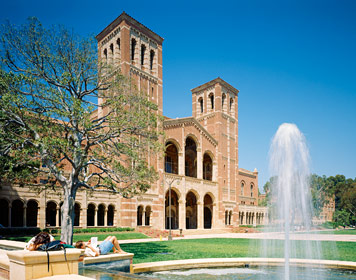
UCLA. (Photo: alumni.ucla.edu)
UCLA Law Is Producing Partisans, Not Lawyers
Are state funds generating legal service providers, or empowering privileged ideologues?
By Seth Oranburg, May 22, 2026 7:49 am
Today, UCLA must answer Sen. Eric Schmitt, chair of the U.S. Senate Judiciary Subcommittee on the Constitution. He wants to know why, after UCLA Law students disrupted a Federalist Society event, the school’s assistant dean for student affairs warned the Federalist Society not to identify the disrupters.
Senator Schmitt is right to treat this as a free-speech issue. Public schools cannot permit hecklers to disrupt some events and not others. Under settled First Amendment doctrine, that is viewpoint discrimination, and the heckler’s veto is precisely what the rule against it forbids.
But viewpoint discrimination is not the only constitutional concern. Schools like UCLA Law are gatekeepers. If the dean does not certify your character and fitness to the state bar, your law career is, as the kids say, “cooked.”
Threatening conservative law students with “processes” is a barely concealed threat to block bar admission based on viewpoint. That kind of discrimination is unconstitutional and undermines the rule of law.
Our rule of law depends on adversaries who are willing and able to argue both sides of tough cases. It depends on judges willing to hear both sides before deciding who wins. Law schools form both. They are obligated to teach students how to disagree without being disagreeable.
UCLA taught the opposite lesson. Students who shouted down a senior federal lawyer got protected. Students who hosted an academic debate got threatened with “campus processes” for identifying the disrupters. The dean’s office wrapped the threat in a foreseeable-consequences theory: if the chapter identified the disrupters and they were later harassed, the chapter would bear the consequences. That is a thinly veiled prior restraint.
This isn’t the first time UCLA revealed its secret syllabus. Soon after Hamas kidnapped Israeli civilians on October 7, 2023, law students tore down hostage posters. Assistant Dean Bayrex Martí, the same dean who would later threaten the Federalist Society, devoted a single sentence to the poster-tearing. He used the rest of his statement to warn the students who filmed the desecrators that disciplinary findings are “reportable to state bar authorities as part of the Moral Character process to gain a license to practice law.”
See something? Say nothing.
This inversion isn’t an accident. UCLA has merged two things that should stay separate. Aristotle knew the difference: law is forensic, looking backward at facts; politics is deliberative, looking forward at what should be. The first forbids prejudgment. The second requires it. A law school’s job is to train the first. UCLA has built infrastructure for the second. It admits students through essays that ask candidates to demonstrate their commitments. It reinforces those commitments through three years of law school. And it threatens them with character-and-fitness review if they step out of line.
A school that protects one side and threatens the other trains the protected side to fight harder for the win, and the threatened side to read the room before they speak. Both products are partisans. Neither is a lawyer.
California depends on such lawyers. A deputy district attorney decides whom to charge and whom not to charge. A public defender decides which arguments to make. A judge decides which arguments to credit. Each of those jobs requires the discipline of taking the other side seriously.
A lawyer who wants to drown out opposing views is just a partisan with a bar card. A judge who prejudges a case based on ideology is just a hack masquerading in black robes. Neither supports the rule of law. Both support the rule of whoever staffed the school that trained them.
UCLA Law is a public school and one of the largest sources of California lawyers. The students in that room in April are who California is hiring twenty years from now. If they were trained to figure out which side wins before they read the brief, California’s courts will follow.
Sen. Schmitt asked UCLA to explain its free speech violation. Californians should also be asking, what are public law schools producing? Are state funds generating legal service providers, or empowering privileged ideologues?
Seth C. Oranburg is a law professor and a member of the California Bar. He had no role in the UCLA event.


- UCLA Law Is Producing Partisans, Not Lawyers - May 22, 2026
RELATED ARTICLES
-
 February 26, 2026
 -
February 13, 2026
-
March 16, 2026
UCLA has always been UC Berkeley South… it was like that 40 years ago, much to my horror….and it can only have gotten worse, and this article supports that hypothesis…